Join EDF’s Economics team and leading economists at our virtual Economic Seminar series to explore the economics research and insights significant to U.S. domestic and global climate policy! Sign up to receive invites to our upcoming seminars: https://t.co/TQKRdGAkBc
You can read the full paper https://t.co/Ktx2Oh25ex.
Includes more details on dispersion modeling, pollution-migration response, migration elasticities, pollution -->productivity elasticity, and more!
Thank you for reading!
10/
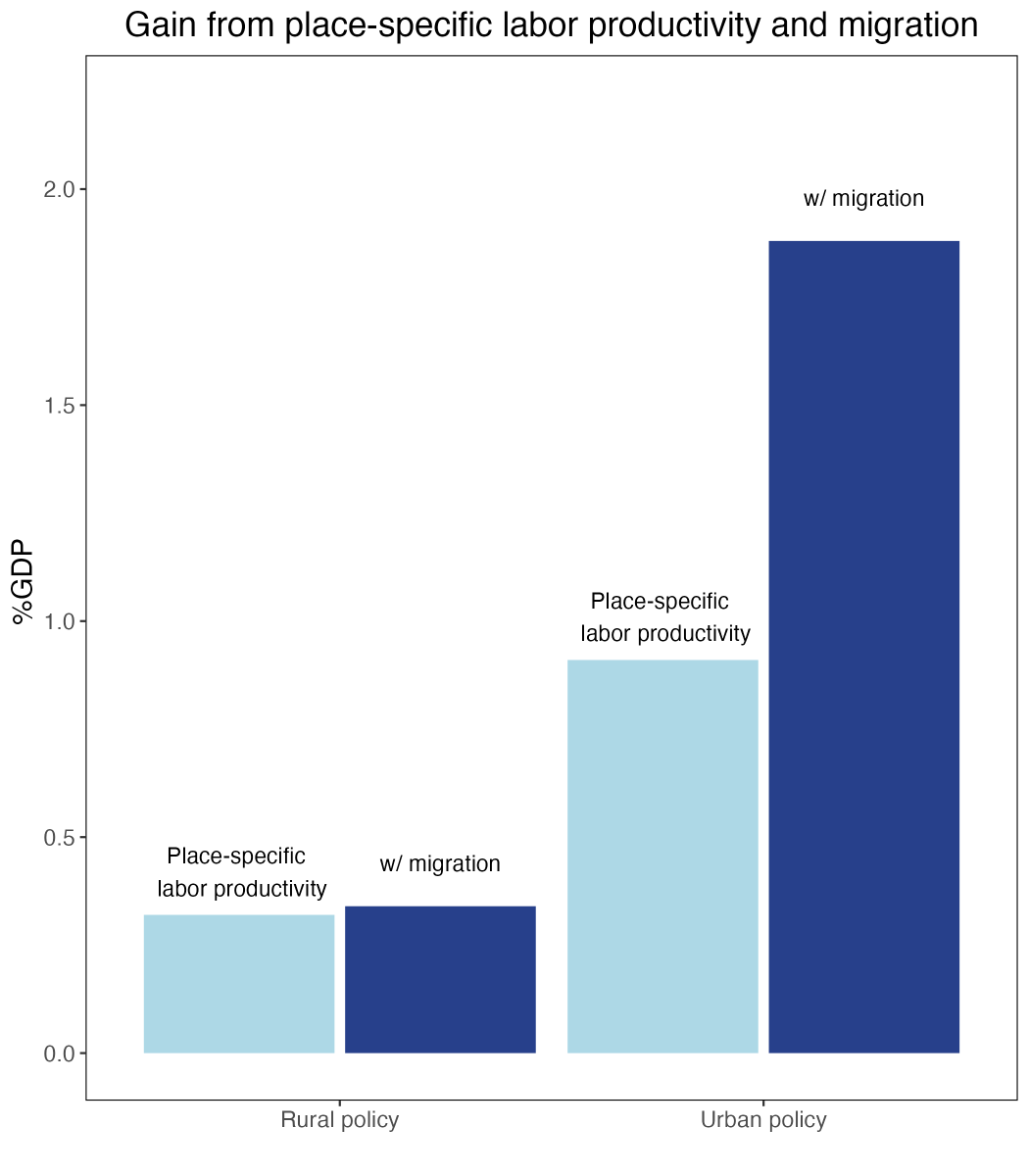
2: With migration
Sorting toward largest cities doubles income gains but adds <1% for rural policy.
Why?
When marginal workers move to cities, it increases their productivity a lot more than moving to rural areas!
Migration to cities also amplifies agglomeration economies! 9/
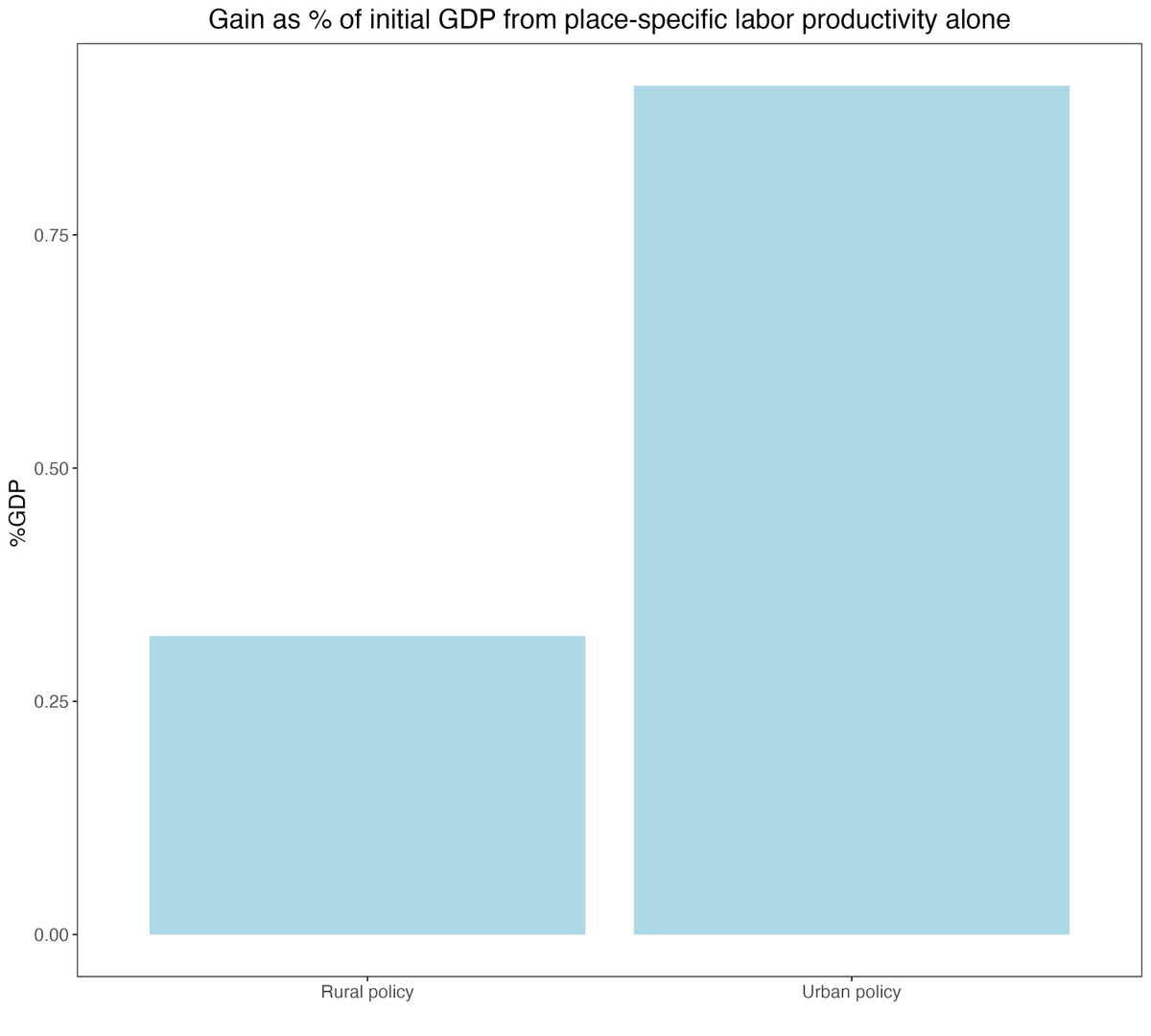
1. Without migration
Urban policy leads to 3x larger income gains than rural policy!
Why?
Rural policy reduces mostly rural pollution, while urban policy benefits cities only.
Urban health improvements are more valuable because those people live in more productive cities.
8/
Next, I develop a spatial equilibrium model to understand how aggregate income gains differ between these interventions due to following:
1. Location of people benefitting from lower pollution (without migration)
2. Worker migration in response
So, here are the results!
7/
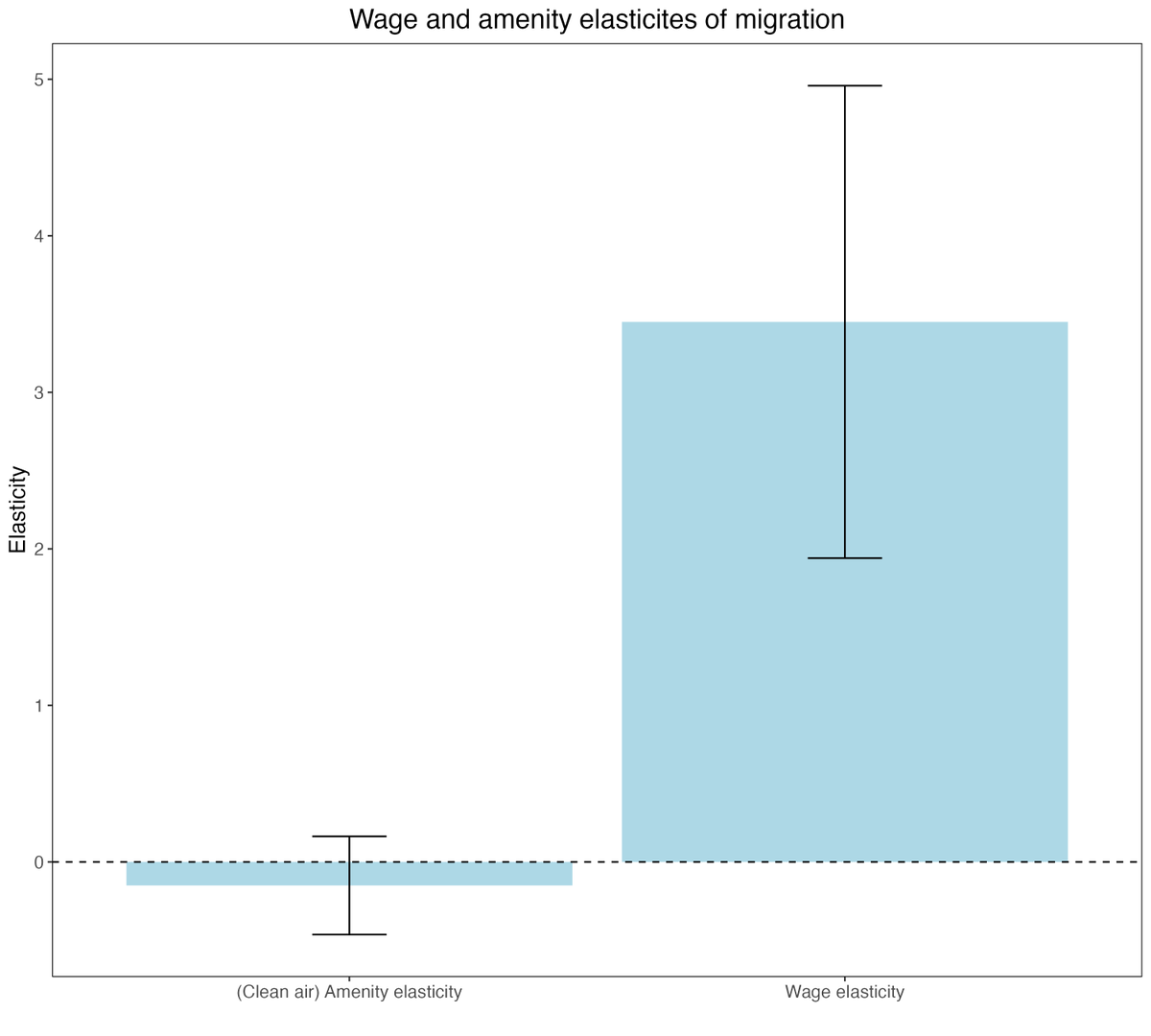
Lower pollution can pull in more workers because of higher wages, or due to more liveable conditions.
I find that only the wage effect matters in India, not the amenity effect!
Consistent with wages driving migration of poor while rich demand clean air – India is poor!
6/
Could this lead to very different income gains? We will come back to this soon.
But this is not all! Place-based pollution policies may cause migration!
I show that a 1% increase in pollution reduces in-migration by 2% to Indian districts.
5/
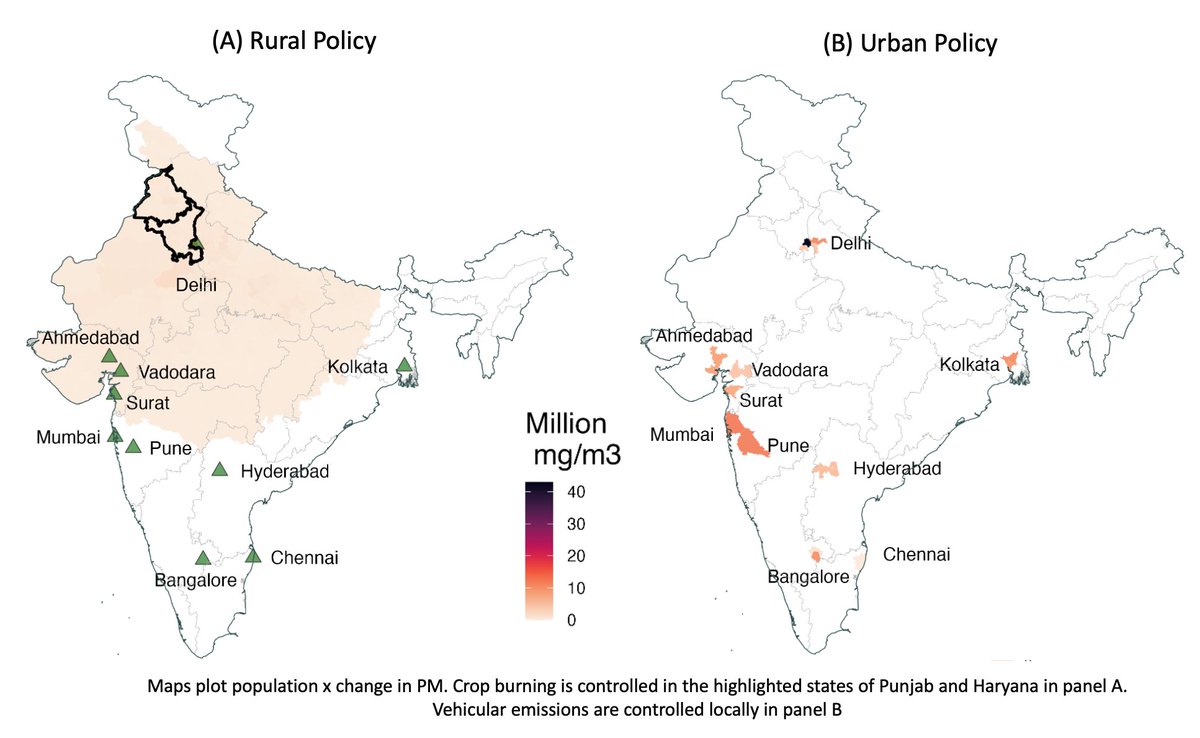
To compare income gains, I hold reduction in total population exposure between these measures fixed.
=> Leads to similar health benefit calculations per standard guidelines from US EPA.
But the locations where pollution goes down are very different!
4/
1. Rural crop burning that also affects downwind cities in north India (“Rural”).
2. Vehicular emissions in 10 largest cities that predominantly affect local pollution (“Urban”).
I build a pollution dispersion model to estimate avoided downwind pollution from rural policy.
3/
India is an important context to study these issues: home to 65 of the 100 most polluted cities.
Pollution sources can be within cities such as vehicles, or upwind of cities such as crop burning.
My JMP compares income benefits from two potential control measures:
2/
Thrilled to share my JMP #EconTwitter!
Cities in poor LMICs often make news for toxic air, but limited budgets constrain action.
Can reducing pollution increase aggregate incomes and help ease budget constraints? Can targeting specific sources produce larger income gains?
👇1/
Can debt distress be a useful lever for developing countries to offer accelerated energy transition in exchange for investment support and debt relief?
FEATURE: Macro pressures threaten climate investment as finance debate hots up ahead of COP28 https://t.co/HWZwq2O5Bj
Here's one of those science issues I always struggle with. We need to explore all options for climate action - but with great care.
Why using ammonia in power generation is risky for the climate https://t.co/kliI1SiRKe via @EDFEnergyEx
How can the insurance industry adapt to climate change? Our Dr. Carolyn Kousky shares her thoughts with @usaadapts, discussing the role of insurance in building equity, reducing losses, expanding coverage and managing climate disasters. https://t.co/OFQNThbHJv
Interesting finding: When it comes to carbon credits low prices *are not* always a primary purchase motivator. Buyers’ willingness to pay should boost the overall integrity and impact of the voluntary carbon market (report via @BCG@EnvDefenseFund) https://t.co/a4v7DAt1XO
A new satellite will help tackle methane leaks, a major driver of global warming. New Zealand has been supporting this valuable @EnvDefenseFund effort. https://t.co/5PVyuRxqX0 via @nprone