@Trujillo_Group @LatinXChem@sollebac@amclabs However, the relationship between the stability parameters, such as odd–even oscillations, is not very clear. Interestingly, for n = 12, we found a special case with a high IP, low EA, and high stability according to Δ2E, suggesting that NiB12 is a typical magic cluster.
@Trujillo_Group @LatinXChem@sollebac@amclabs In this work, the structures and stabilities of Ni-doped Bn clusters were determined. The relative stability of the clusters was rationalized using energetic parameters such as ionization potential, electron affinity, second-order energy difference, and the HOMO–LUMO gap.
@joaquinbarroso@LatinXChem@sollebac@amclabs In these clusters, we found typical bonding characteristics of such species, and the results indicated that the clusters are rigid without any fluxional behavior.
@Rosymguevara@LatinXChem Nice work. Which information can be obtained by the frontier molecular orbital and spin density distributions? Which computational approach has been used? @amclabs
@Juanpi_reagent @LatinXChem Interesante trabajo. Como funciona la búsqueda conformacional PM3? Se refinaron los resultados a nivel DFT? Como se podrían validar los resultados? @amclabs
@Anthoni_AT@LatinXChem@openmm_toolkit@CIQUAEM Interesante trabajo. El código openmx es una aproximación periodica o molecular? como validaron los cálculos? se consideraron configuraciones aleatorias? como se define el FDR? saludos cordiales! @amclabs
@kamerlinlab@LatinXChem@amclabs@autonomadechile We have used both the gaussian g09 and ADF codes. We have compared some parameters for the clusters with other papers, for example doi: 10.1007/s00214-012-1241-8. By using standard functionals both codes showed reasonable results, for example at the PBE0/Def2TZVP level. Regards
@Rojas_Chavez_@LatinXChem@amclabs@autonomadechile Gracias, claro que si, hasta el momento nos hemos enfocado en sistemas finitos, pero queremos desarrollar proyectos en superficies, por ejemplo, los cúmulos se podrían soportar en graphene. Saludos cordiales y estamos muy a sus órdenes.
P.L.R.-K. y @amclabs
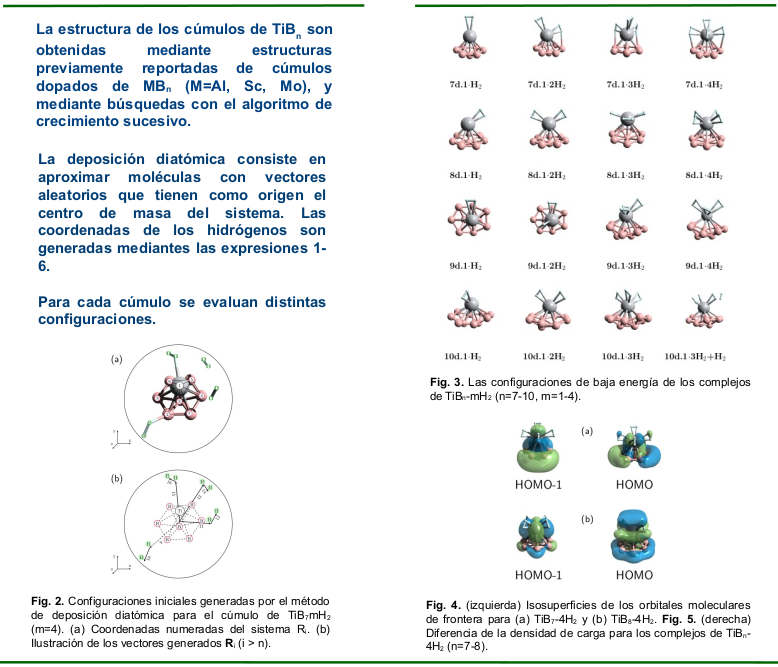
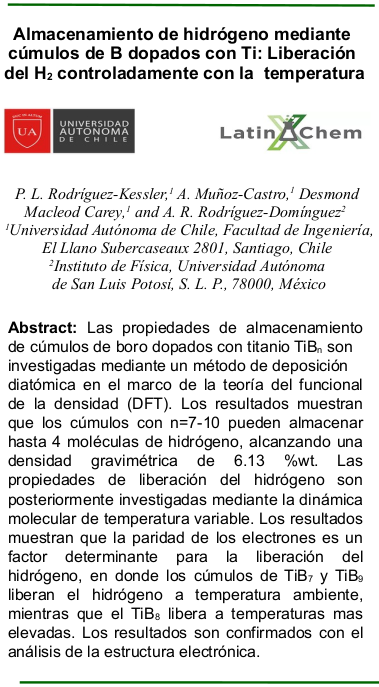
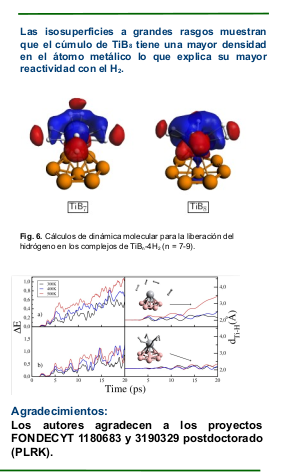
Almacenamiento de hidrógeno mediante cúmulos de B dopados con Ti: Liberación de H2 controladamente con la temperatura. Mural LXIII-2173 Nanociencias y Nanotecnología. SMF: LXIII Congreso Nacional de Física
https://t.co/bg6T0aBl00
#chemtwitter#LatinXChem@CienciasChile@amclabs
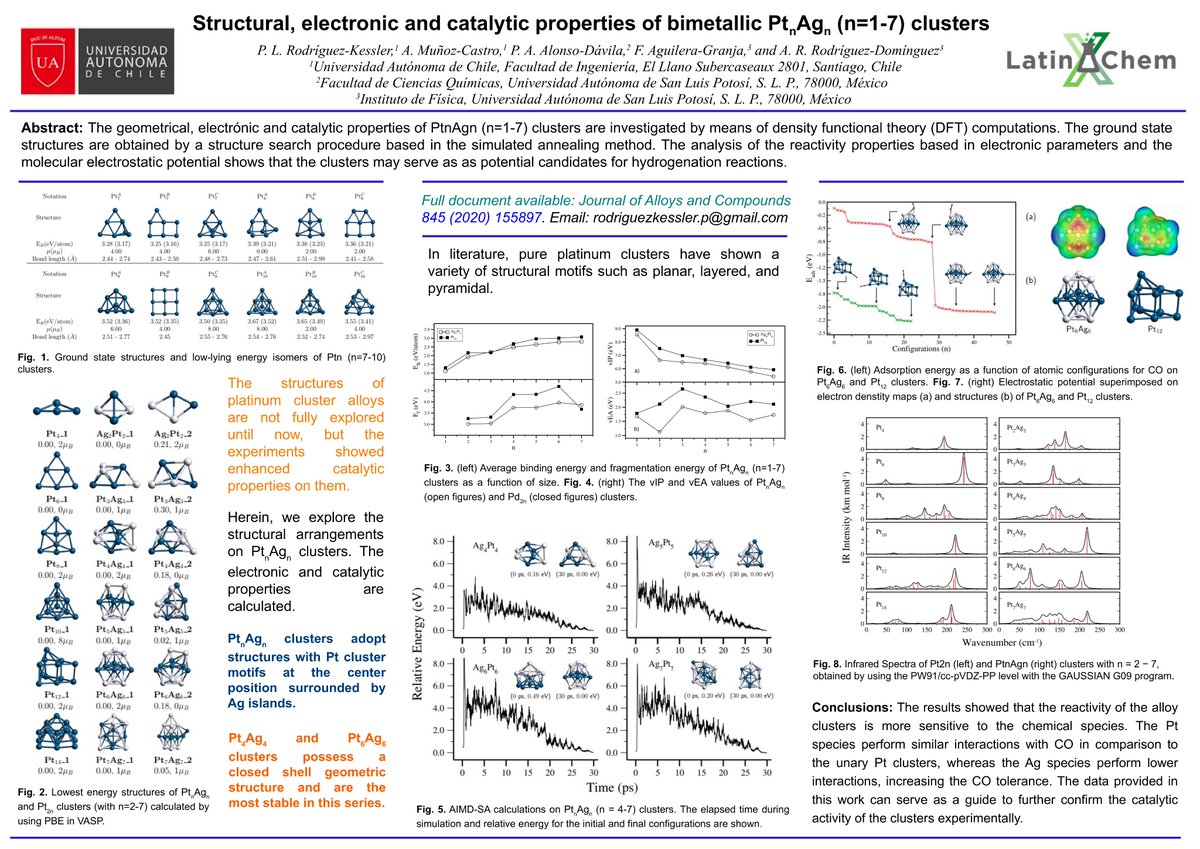
@a_koverga@LatinXChem@amclabs The high cost of bulk materials is a bottleneck for catalysts commercialization. The cluster approach offers more opportunities for tuning the catalytic properties as a function of the size. Recent advances are available in literature: [Chem. Rev. 2020, 120, 2, 1397-1437].
@BoadoCercis@LatinXChem@amclabs thanks, yes, the d-band center parameter (obtained from DOS) shows more negative values for the bimetallic alloys compared to platinum. Thus, the Ag content reduces the reactivity of the clusters, as expected.
@VictorB59730354@LatinXChem@amclabs Thanks for your comments. The IR data for pure platinum clusters is compared with previous theoretical studies. The catal. prop. are analyzed by using the adsorption energy descriptor and the MEP map. Yes, in fact, the Pt border sites are more reactive, and the Ag sites are less.
@EveryWhereChem@LatinXChem@amclabs Thanks, Pt4Ag4 and Pt6Ag6 are the most stable clusters in this series. Pt6Ag6 apparently has a D3h point group. In practice, small clusters tend to polymerize and fuse, by this, further studies for Pt alloys are still needed to explore their stability for practical realizations.
@jezalberto@LatinXChem@amclabs Gracias, si, resulta que los cúmulos puros son mejores reductores, según las propiedades electrónicas... Pero al parecer la reactividad tiene un caracter local en la superficie de las aleaciones... la plata ayuda a disminuir el costo del catalizador y el envenenamiento con el CO.