Called a tree service guy to cut down two dead oaks near my driveway.
Quote: $2,400 for four hours of work.
Before I could even raise an eyebrow, he goes:
“I know it sounds like robbery. But my woodchipper cost $65,000, insurance for my crew is $1,800 a month, diesel is $4.50 a gallon, and if a branch touches your roof, my liability policy handles it.”
He wasn’t wrong.
You’re not paying for four hours of labor. You’re subsidizing the massive wall of equipment, liability, and fuel required to operate a physical business in 2026.
umbrella liability insurance is pound-for-pound some of the best, most cost effective insurance you can buy
I routinely see people with $5M - 10M+ net worth carrying very basic liability coverage within their home & auto and no umbrella policy to sit on top
>car accident with a serious injury
>someone gets hurt on your property
>your teenager causes an accident
>lawsuit exceeds your underlying policy limits
you can get millions of dollars of coverage for a few hundred or a few thousand dollars per year
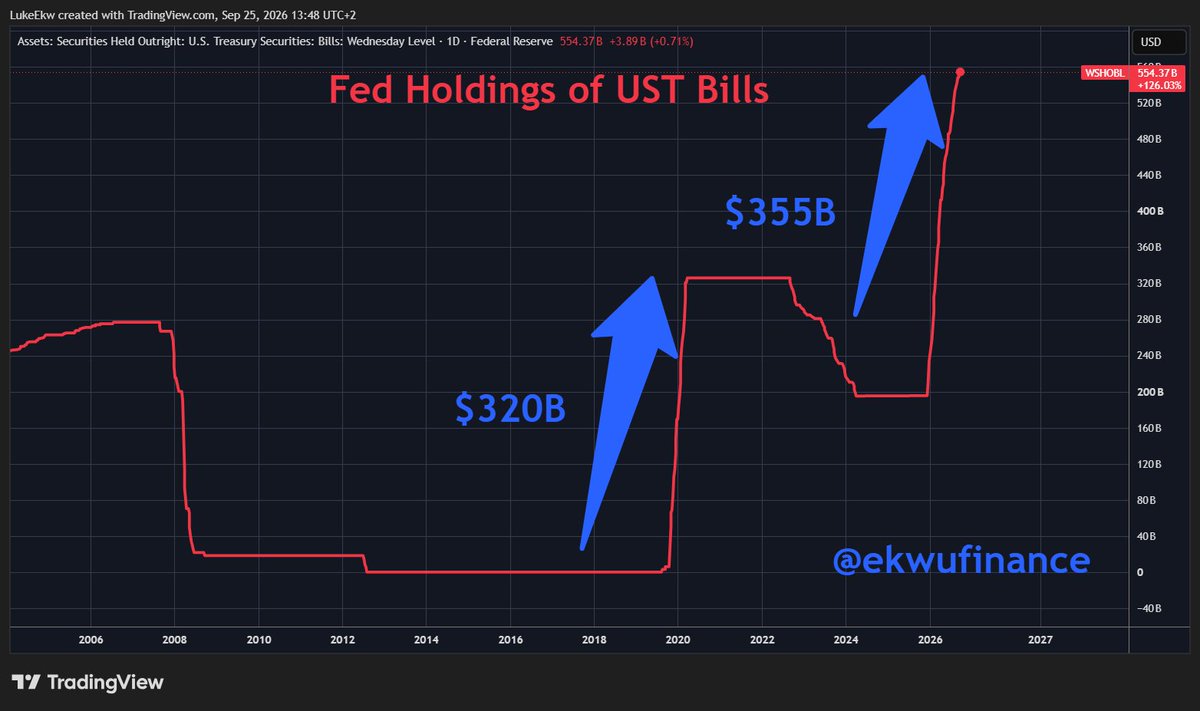
The Fed is printing money to buy US Treasury bills... more than during Covid.
- Covid: ~$320B
- Last 9 months: ~$355B
Everyone is talking about the Fed hike... no one is talking about Warsh printing money Covid-style to buy UST bills.
At the same time, Bessent is issuing more UST bills to buy back US long-term debt.
In other words, the Treasury buyback is nothing else than QE in disguise.
We don't own enough hard assets for what's coming.
For my insurance friends, asked Grok why the carriers might deny the claim.
Found the response interesting, though I think Duty to Defend is mostly the nature of the suit by Kraft.
A standard CGL policy does cover most product-related bodily-injury claims. The products-completed operations part of Coverage A is written for exactly that: injury caused by a product after it leaves the manufacturer. That is why Kraft Heinz is suing—the denial is not the usual outcome. https://t.co/4WZZbak0Tq
Insurers still deny in cases like these for a handful of policy-language and timing arguments:
• No “occurrence.”: Coverage applies only to bodily injury caused by an “occurrence” (an accident, including continuous or repeated exposure). Insurers can argue that selling a legal, widely consumed food product over many years is not an accident.
• Expected or intended injury exclusion: The exclusion bars coverage for injury the insured expected or intended. The underlying UPF complaints allege that manufacturers designed products to be hyper-palatable, knew the health risks, and sold them anyway. Insurers treat that as expected harm from the insured’s standpoint. https://t.co/kRFrCL7k2d
• Known-loss / fortuity problems: If the company already knew of the alleged risks (the lawsuits cite internal discussions going back decades), later policy years can be denied under the “known loss” or “loss in progress” doctrines.
• Trigger and allocation: These are long-tail claims. Disease develops over years of consumption. An insurer can say the injury did not “occur” during its particular policy period, or that defense and indemnity must be spread across many years and many carriers.
• The government case may not be a bodily-injury claim at all: The San Francisco action is framed as unfair competition and public nuisance seeking recovery of public medical costs, not damages “because of bodily injury” to a specific person. That can fall outside Coverage A.
The duty to defend is broader than the duty to indemnify. If any allegation in the complaint could potentially be covered, the insurer normally must defend even a weak or groundless suit. An outright denial of defense, as Chubb and Liberty Mutual issued here, is therefore the issue now being tested in court.
Breaking CNBC:
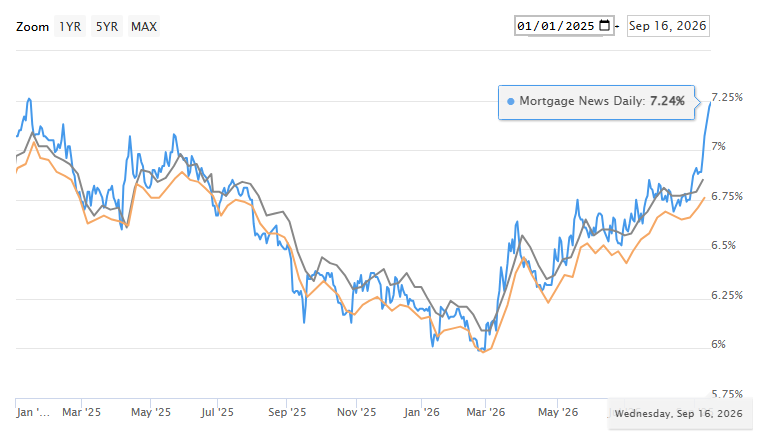
Mortgage rates soar to 7.45% tonight following the huge surge in yields.
This is up from 7.24% just yesterday.
.19bps in one day. Huge move.
8% coming soon.
RIP Housing 🪦
Unbelievable.
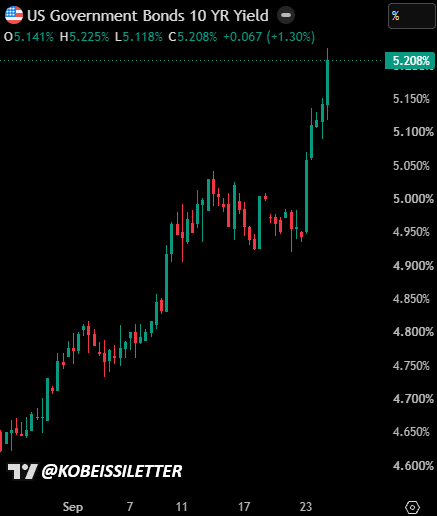
3 hours later and the 10Y Note Yield is now above 5.20% for the first time in 19 years.
The 10Y Note Yield is now up +50 basis points in 30 days and +30 basis points in 2 days.
Even more remarkable is that the average American has no idea this is happening. Yet.
The bond market is imploding in front of our eyes.
Net worth past $500,000 and no umbrella policy?
$300 a year is all that stands between you and paying a lawsuit yourself
Here's how umbrella insurance works: 🧵
Guy I know owns a strip mall.
One of his tenants brings a dog into the store. A customer walks in and the dog bites the customer.
He’s sues the landlord. No problem, he has insurance.
He checks the policy closely.
Dog attacks are covered, but only if it’s a customer’s dog!
A tenant’s dog? Not covered.
So the landlord is on his own!
Read your insurance policies.
Mortgage demand is now WORSE than the Great Financial Crisis.
Read that again.
Worse than 2008.
Yet sellers are still pricing homes like it’s 2021 with 3% rates.
The math stopped mathing
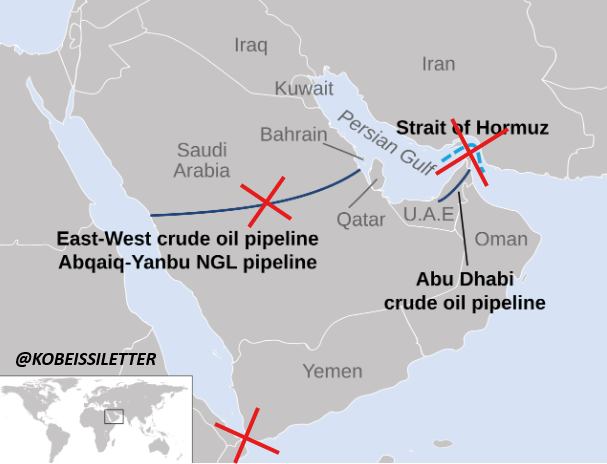
It seems most people don't understand how severe the energy situation is right now in the Middle East.
As of Friday, Saudi Arabia's East-West pipeline has officially been shut down after recent attacks, putting -4 million barrels of daily oil exports at risk.
Meanwhile, the Bab el-Mandeb Strait is now at risk of being shut down, threatening up to -9 million barrels of daily oil supply.
All while the Strait of Hormuz is operating at ~20% of its pre-Iran War capacity, removing -15 million barrels of daily oil flows.
Combined, this represents nearly ~30 MILLION barrels per day of oil flows that are either offline or at risk.
Even after accounting for some overlap between these routes, the scale of the potential disruption is enormous relative to the ~100 million barrel per day global oil market.
This is one of the most severe energy supply situations in modern history.
Your home insurance quietly turns off if nobody sleeps there for 60 days
It's in the policy. Almost nobody reads that page. It's called a vacancy clause, and it's how a family inherits their mother's house, leaves it empty for a summer, and finds out after the pipe bursts that they own a house with no coverage:
How it works:
A standard homeowner's policy is written for a house someone lives in. Most of them say that once the house is vacant for 30 or 60 straight days, depending on the company, coverage for the things that happen to empty houses stops. Vandalism. Broken windows. Frozen pipes. Some companies go further and cancel the whole policy once they find out
And they find out. The adjuster's first question after a claim is "who was living there?"
Who this hits, in the order I see it:
The family with a dead parent's house sitting empty while the siblings argue
The couple who moved into the new house before the old one sold
The landlord with 3 months between tenants
The person who took a job in another state and left the house "for now"
And every flipper, every house, which is why we buy a different policy on day one
What "vacant" means to an insurance company: nobody living there AND the furniture gone. A furnished house you're away from is "unoccupied," which most policies treat more kindly. The moment the moving truck leaves, the clock starts
What to do the day a house goes empty:
1. Call the insurance company and say the word "vacant." Ask for a vacancy endorsement or a vacant dwelling policy. It costs more. It's a policy that exists instead of one that doesn't
2. Keep the heat on and shut the water off at the main. Frozen pipes are the claim that gets denied most
3. Have someone walk through weekly and take dated photos. Proof the house was checked is proof the loss wasn't neglect
4. Tell the mail carrier and the neighbor. An empty house with a full mailbox is a billboard
5. If it's going to sit more than 60 days, price the vacancy policy into what the house is costing you. That number is usually the argument that gets the siblings to sell
Flippers carry a builder's risk or vacant policy from the day of closing to the day of sale, because we know the house is uninsured under the normal one
The family that inherited the house down the street doesn't know that
They find out from an adjuster
They are never going to give you $9,000 to stay home with your kids. Just like you never got your DOGE check, tariff refund, cheaper groceries, $2 gas, a healthcare plan, or 600% off prescriptions.
At some point, being this gullible becomes a fucking choice.
Social Security is approaching the crisis point for whoever is the next President of the USA.
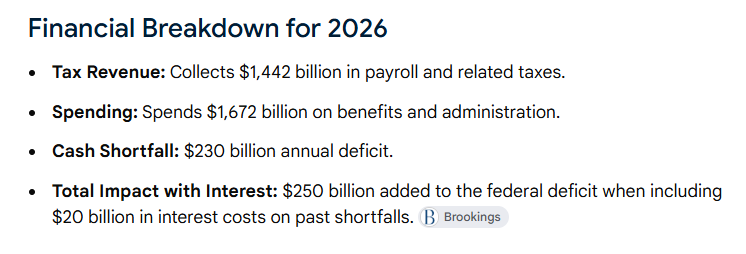
The program collects $1.44 trillion.
Social Security spends $1.67 trillion.
The deficits are covered by selling treasury bonds that social security built up over decades.
In 2032 that fund of treasury bonds will be empty. Then Congress and the President have to make a decision. Current law automatically will cut benefits by 22%. So Congress has to decide whether:
1) let the cuts happen
2) raise taxes to cover the cuts in benefits
3) just use the general revenue funds and let the overall budget deficit increase by about $600 billion per year in 2033.
During the 1995-2000 dot-com melt-up…the highest returning, most compressed bull market in US history…the average on the 10 yr was 6.1%, with multiple spikes over 7%.
Today’s 10 yr: 4.65%
Perspective helps.