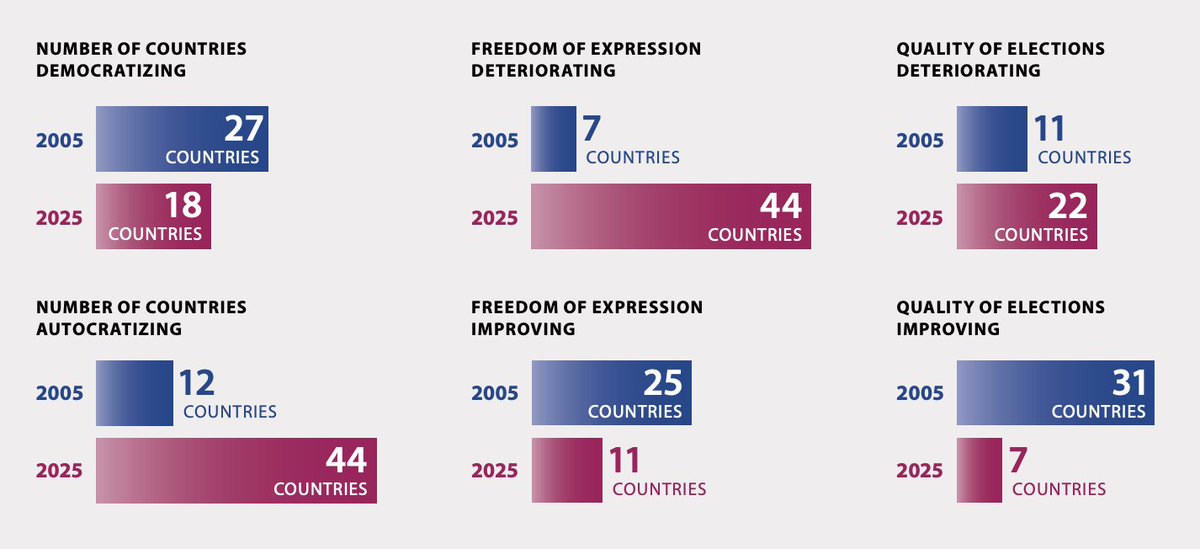
One crazy important yet understudied issue:
how internet shutdowns may now foreclose access to the greatest tool for democratizing access to information, expertise, and democratic organizing (AI).
#ICYMI if you're a believer in democracy, we have a lot of work to do.
"74% of the world population (6 billion) now live in autocracies" - V-Dem Institute.
And, even within democratic nations, there's a heck of a lot of room for improvement.
It's time to develop a posture that treats AI labs and other private actors as the first movers in discovering policy interventions that Congress can then scale, with a particular eye toward younger Americans.
New from senior fellow @KevinTFrazier on Civitas Outlook: https://t.co/2k7i8TigT9
"Labs that have argued, persuasively, that their tools will reshape the labor market cannot then treat the workforce response as somebody else’s problem."
My latest via @CivitasOutlook
Closing lines: "Congress will eventually act on AI and labor. The question is whether it acts on a policy foundation the labs helped build or on one assembled in their absence. The former is almost certainly better policy. For the labs, it is almost certainly better politics."
One due process issue that may emerge sooner than many expect: inadequate access to AI assistance.
As AI becomes more capable, access to legal assistance may increasingly depend on access to compute.
A litigant with frontier models, large token budgets, and agentic workflows can effectively deploy thousands of hours of research, drafting, document review, and case preparation.
Another litigant may have access only to a free chatbot or no AI at all.
The concern around disparate AI resources also manifests as a capability gap—where one party has significantly more powerful models—and a token gap—where both parties have the same model but one can afford vastly more inference and iteration.
Courts have long tolerated differences in legal resources. But if AI becomes a prerequisite for meaningfully participating in complex proceedings, due process questions become harder to avoid. At what point does access to baseline AI assistance resemble access to an interpreter, legal materials, or other tools necessary to be heard?
The answer is likely not that everyone gets unlimited AI on demand. But I suspect courts, legislatures, and legal aid organizations will eventually need to confront a basic question: what level of computational assistance is necessary for a meaningful opportunity to be heard?
As concerns over AI-related cyber risks rise, @KevinTFrazier explores whether the Office of the National Cyber Director, created to coordinate national cyber policy, can handle the cross-cutting risks that AI now presents and how the ONCD could be reformed.
We're expanding Glasswing today. To solve such a big/complex/urgent problem, we need Mythos-level capabilities in as many defenders' hands as possible. That's why we're working on safeguards to scale that safely ASAP.
11 of my reflections from the past 2 months of Glasswing 🧵:
How do you create that really high throughput flywheel from safety research into standards best practice?
Big question posed by an important voice in AI governance.
Huge thanks to @OCLarter (@GoogleDeepMind) for joining @scaling_laws
We. Need. More. Nehemiahs.
#ICYMI he dedicated himself to building for others, traveled >1500 miles to Jerusalem, and inspired a diverse set of stakeholders to join the cause.
Pope Leo was right to lift him up as an example for others in an age that requires creativity, dedication, and vision.
Hint: it’s optimism.
You can only build a better future if you’re willing to take smart risks and imagine new institutions.
Kudos to @GovCox for setting forth an ambitious vision and daring others to follow.