I'm so excited to announce that I'm hosting The Information's new AI show! Each episode will be a deep dive into a hard technical problem with a researcher or founder working on the frontier of AI
Up first, I'll be talking with @polynoamial about the challenges with AI agents
The Information’s TITV Presents: AI Deep Dive
Hosted by Rocket Drew, one of our leading AI reporters, this new long-form show will explore the most important technical ideas shaping artificial intelligence today.
AI researchers, engineers, and founders will join Rocket to discuss the technical breakthroughs and challenges defining the next phase of the AI industry.
Read more from @rocketalignment: https://t.co/lOQxVkSD5p
Amazon has deployed more than a million robots. I was surprised to hear Tye Brady @spaceguytye, CTO of Amazon Robotics for the last decade, talk about how much work still begins when a system leaves the lab. There is no getting around this even for the most experienced deployment team out there.
A system may look convincing in testing, but when it reaches the real operating environment, something is always wrong. Nothing like reality to humble you. Even today, Amazon starts in one corner of one floor of one building, works through problems, and expands from there.
A million deployed robots buys you an extraordinary amount of experience (and data). It does not let you assume the operating environment will cooperate. There is substantial work available to teams that can turn improving models into faster deployment operations a customer will actually run.
Consider what has to happen after a robot performs a task successfully. Someone has to connect it to an existing process. Decide what happens when something goes wrong. Give an operator a useful way to intervene. Recover without turning a small exception into a production stoppage. Then collect enough evidence to know whether the next revision helped. Each of those decisions changes the product. Each depends on the facility and the people in it.
Rodney Brooks @rodneyabrooks made this clear in another session moderated by the excellent @rocketalignment. In an industrial deployment, there are really three customers: the corporate buyer, the facility manager and the person beside the machine. They experience the same deployment through different problems.
The buyer wants the investment to pay off. The facility manager wants production to run smoothly. The person on the floor wants an interaction that makes sense and does not make the job frustrating. A successful demonstration powered by advancing models answers only part of what those people need to know.
My bet is that teams with a repeatable way to satisfy all three (and more) will become increasingly valuable as model capabilities improve. They will know which task is worth doing, which failure matters, and what the customer can tolerate while the system gets better. This is a demanding kind of work. It requires spending time in the facility, hearing conflicting requests and deciding which problems the system must solve. It also creates an opening for companies willing to take responsibility for the full customer experience.
Kai’s robot evals piece is required reading
> today’s best robotics benchmarks are far less informative than benchmarks for [LLMs]
> stacking blocks or folding shirts give some information about how capable a robot model is, but less about the trajectory of the entire field
I was wrong recently.
When I was working on a recent article about the challenges of robotics evaluation, I thought we wouldn't see any top robot models offered through API: https://t.co/rDOBkYrOrU
Then @physical_int went and released a beta last week: https://t.co/EIOhyQAUF5
Thank you Rocket Drew @rocketalignment for hosting me on The Information about world models and interp!
Rocket is a precise & careful technical interviewer who is a pleasure to talk to, and who let me go into a technical rabbithole while keeping the convo accessible!
90% of Americans’ working hours are spent on tasks not covered well by AI benchmarks.
That’s our best guess from a new project mapping frontier benchmarks onto the US economy.
Preparing for a post-AGI economy requires predicting the future. Current benchmarks makes it very difficult even to measure the present.
🚀 AI Deep Dive Episode 5: Can We See Inside an AI’s Mind?
AI can write down its reasoning. But what happens when more of its thinking never makes it onto the page?
@rocketalignment and @GoodfireAI co-founder and chief scientist Tom McGrath explore what AI “brain scans” can reveal beyond written reasoning, how internal signals could help catch cheating, and what it would take to understand—and change—what models learn.
00:00 Intro
00:39 Tom McGrath and AI brain scans
09:01 Written reasoning and hidden computation
17:45 Why AI is hard to understand
24:07 How researchers identify concepts
31:10 What interpretability could change
34:42 Reverse engineering a language model
43:09 The field’s approaches and investment
51:51 Changing models without hiding problems
1:00:10 AI agents studying AI
interpretability might be the most important scientific problem in the world right now, as I don't think we can solve alignment if we don't know what we're building. I think I have good news about it. I co-authored early work in mechanistic interpretability at OpenAI and came away pessimistic, because neural networks appeared to fold into arbitrary tangled knots. years later, I started openai's first large-scale automated interpretability project, finding about 2% of neurons legible with the primitive tools we had
with modern agentic tools and a much closer look, the picture looks totally different. the vast majority in models up to trillions of parameters are legible, and their circuits beautiful. many famous examples of tangled neurons turned out to be misunderstood. The roadblocks I expected mostly aren't there. I now think ambitious interpretability will be solved by the time we need it most, and possibly quite soon, as automated scientists keep improving. it may be a bitter lesson for interpretability: the simple thing, at absurd scale, works
https://t.co/zHij5zwKGT
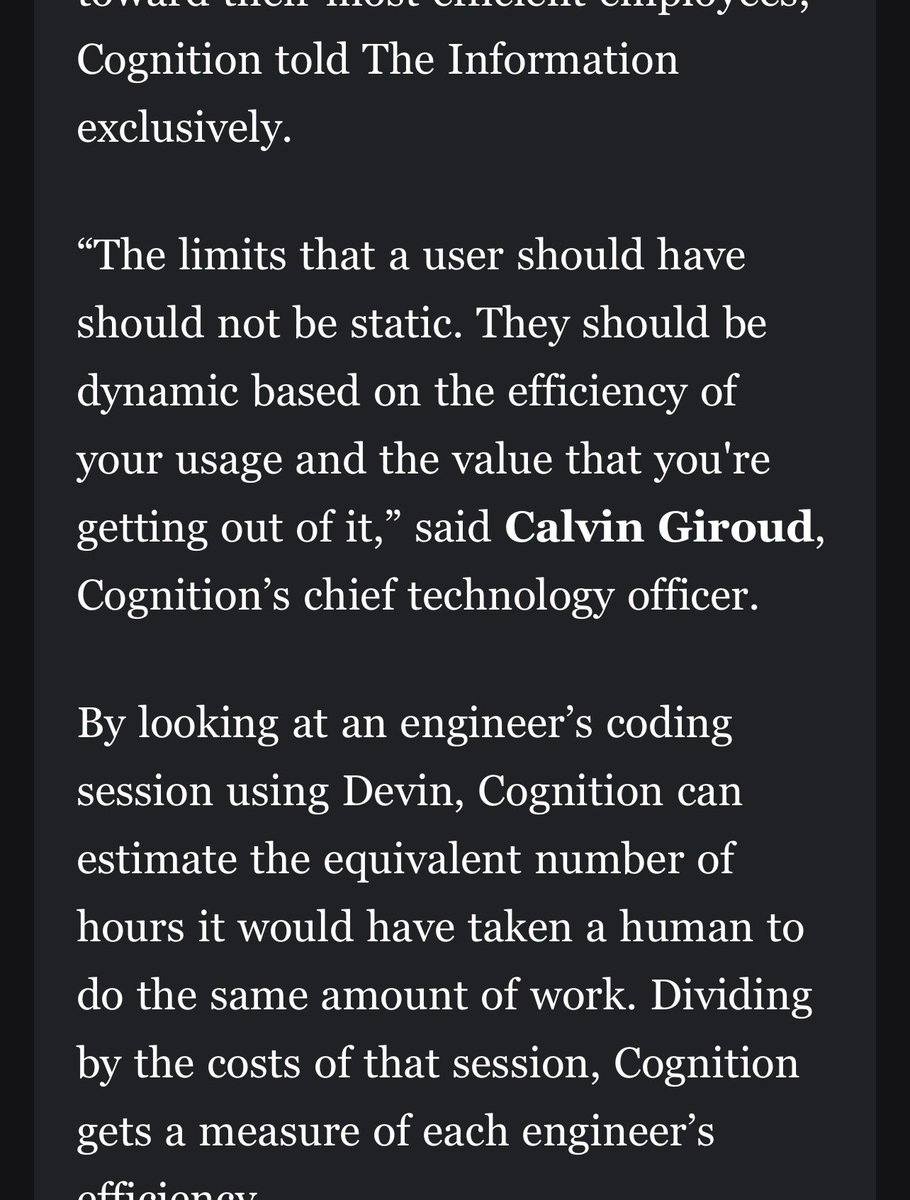
@rocketalignment of @theinformation says token consumption belongs in a performance review as one metric among several, since every metric has always been gameable. @dseetharaman of @Reuters, at Media Summit | SF 2026, agreed, comparing token usage to word count.
Some personal news: I've joined @theinformation to cover Google.
I'll be covering everything from Gemini to Search, from Cloud to Waymo. As always, I'm on Signal at 302-519-0567 and at [email protected].
Talk to Barwick folks!
If you announce a model's benchmarks without releasing it (weights, product, api, etc "later"), feels like almost a sure thing that someone releases a better model in your category before you get it out.
🚀 AI Deep Dive Episode 5: Can We See Inside an AI’s Mind?
AI can write down its reasoning. But what happens when more of its thinking never makes it onto the page?
@rocketalignment and @GoodfireAI co-founder and chief scientist Tom McGrath explore what AI “brain scans” can reveal beyond written reasoning, how internal signals could help catch cheating, and what it would take to understand—and change—what models learn.
00:00 Intro
00:39 Tom McGrath and AI brain scans
09:01 Written reasoning and hidden computation
17:45 Why AI is hard to understand
24:07 How researchers identify concepts
31:10 What interpretability could change
34:42 Reverse engineering a language model
43:09 The field’s approaches and investment
51:51 Changing models without hiding problems
1:00:10 AI agents studying AI
@ElliotGlazer@teortaxesTex Idk if it's "objective." It's just that how much inference it takes to solve a problem is now an important measure of difficulty
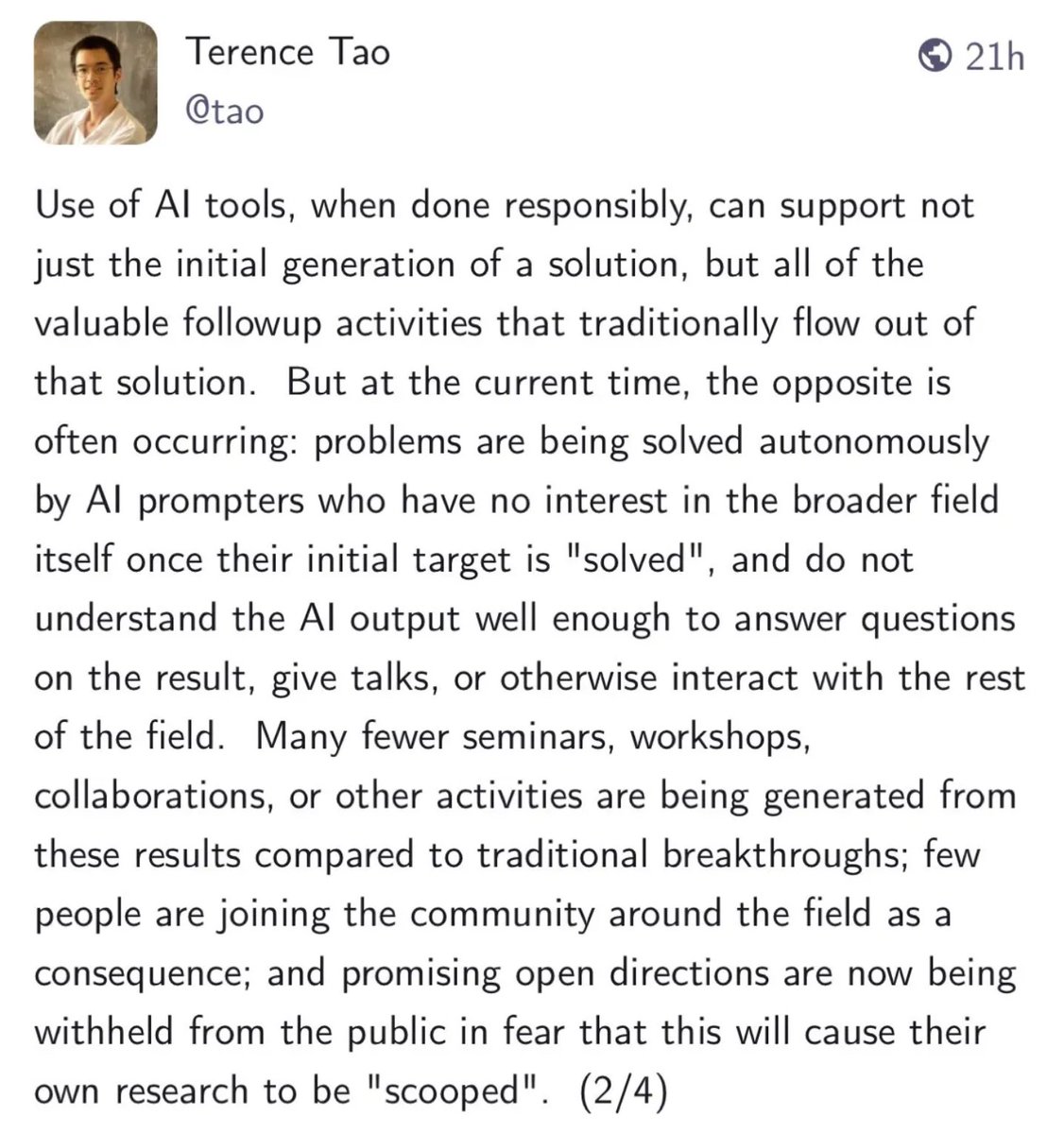
@CoronaCoreanici > It had been extremely valuable to have openness and to consider scooping to be poor form at best
I agree with both of these. I'm just like,, to first order, solving math problems seems good for math
all of these mechanisms might be true but they need a lot of weighing to support the conclusion in the fields medal letter that "the push by AI companies to solve mathematical problems as a benchmark is detrimental to the science of mathematics, and to the mathematical community"