90% of Americans’ working hours are spent on tasks not covered well by AI benchmarks.
That’s our best guess from a new project mapping frontier benchmarks onto the US economy.
Preparing for a post-AGI economy requires predicting the future. Current benchmarks makes it very difficult even to measure the present.
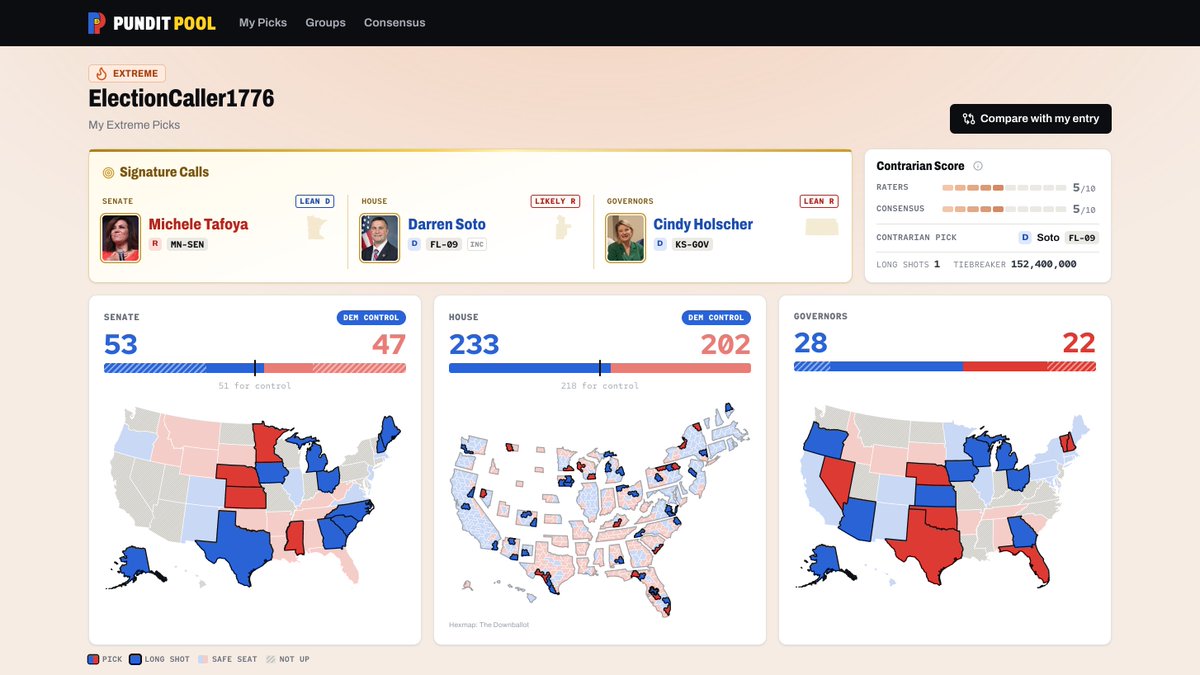
Do you think you can call the elections?
Prove it 👀
Pundit Pool is a 2026 prediction game:
🦅 Basic: 5 calls per chamber
🔥 Extreme: all 77 battlegrounds
📈 Forecast: every race + margins
Make a group with your friends!
https://t.co/IHzSdaBvTt
If you've noticed a distinct dialect emerging in frontier AI models and struggled to understand what they're talking about, you're not crazy!
We turned to psycholinguistics to investigate what makes the writing style so weird, and why this might be happening
🚨New preprint! 🧵
@SamiBelhareth We actually quantify (b)! Would be very interesting to look at regulatory exposure in the next iteration of this index. https://t.co/rnMBLQA6Bl
Benchmarks prioritize high wage-bill, AI-exposed jobs & tasks. This makes sense.
But the rest of the economy becomes more relevant as models diffuse. We want to know what AI means for paralegals and medical assistants too, not just doctors and lawyers.
@JasminLovesAI It’s a good q. If we really think these benchmarks are public goods, that suggests optimal coverage requires funding from gov’ts or non-profits — I think this solution is underdiscussed.
90% of Americans’ working hours are spent on tasks not covered well by AI benchmarks.
That’s our best guess from a new project mapping frontier benchmarks onto the US economy.
Preparing for a post-AGI economy requires predicting the future. Current benchmarks makes it very difficult even to measure the present.
Nordic data would be better for measuring IQ, but presumably wage effects would be slower there, and AI adoption is decently lower there too per @AnthropicAI Economic Index
@OppInsights should check if the IQ wage premium has changed post-ChatGPT using their linked SAT/IRS data. @LichtingerGuy & @SeyedMH98 suggests impact should be U-shaped, but admin data would be so good here.
Full blog here, plus an interactive Benchmark Map you can click through. This is joint work with Isaac Robinson and @aden_barton , with invaluable support from the rest of the Mercor research team. https://t.co/MPKYDEvjmF
Of course, there are limitations to this work. We base our analysis on an initial set of 29 economically relevant benchmarks. We sought out a broad sample of high-quality, unsaturated benchmarks, but selection might still skew our results in various ways, and any incomplete sample necessarily biases down coverage estimates. We will continue to expand our benchmark list over time, updating these results as we do so.