Even if we have ways to break up neural networks into interpretable parts, the largest weights between those parts can be confusing. Why is that?
In our new research note, we study the *weight* superposition that causes interference weights.
This is Roland.
He is one of our performance engineers.
And a passionate pizza maker.
One Tuesday, he just set up shop in the @cerebras lunchroom.
Brought in a hand truck filled with dough and sauce.
Set up his pizza oven in the patio.
Now it’s a thing.
Great pizzas on Tuesday evenings.
Everyone stops by and grabs a slice.
For 4 months, he paid for the ingredients out of pocket.
He didn't even think to ask for it to be subsidized.
He just wanted to practice his pizza making.
Now we buy the ingredients.
He did what he loved and shared it.
And by doing that, he brought the team together.
That is the culture we want at Cerebras.
Where people get to be their whole selves.
We want the office to be more than a place to show up to work.
If you're passionate about something, share it with your colleagues.
Everyone benefits, everyone learns.
That’s the environment we want at @cerebras.
Introducing Stagehand v4: the SDK for browser agents.
Playwright was built for testing, we built Stagehand for your agent: with improved context management, self-healing actions, and iframe support.
@MilksandMatcha the first time I used /goal I came back after a day and i caught it aggressively trying to spin up massive, expensive compute instances
"In the future, there's going to be no market for slow inference."
We asked Cerebras DevOps head @MilksandMatcha why Cerebras pivoted to inference:
"The amount of inference that developers need is just scaling so remarkably."
"Switching in the direction of inference was a very good decision by Cerebras, we are constantly having to scale up production. We do a lot of it in-house."
"As our models get bigger, people are using bigger context windows. Even for one prompt, you're gonna have this many more, like, input, output tokens. When speed is faster and you can do more in a minute, you're gonna have more inference."
"When you have fast inference, you know, you can do reasoning models, and you can have, like, five different reasoning steps and all condensed within a few seconds, whereas usually it would take minutes."
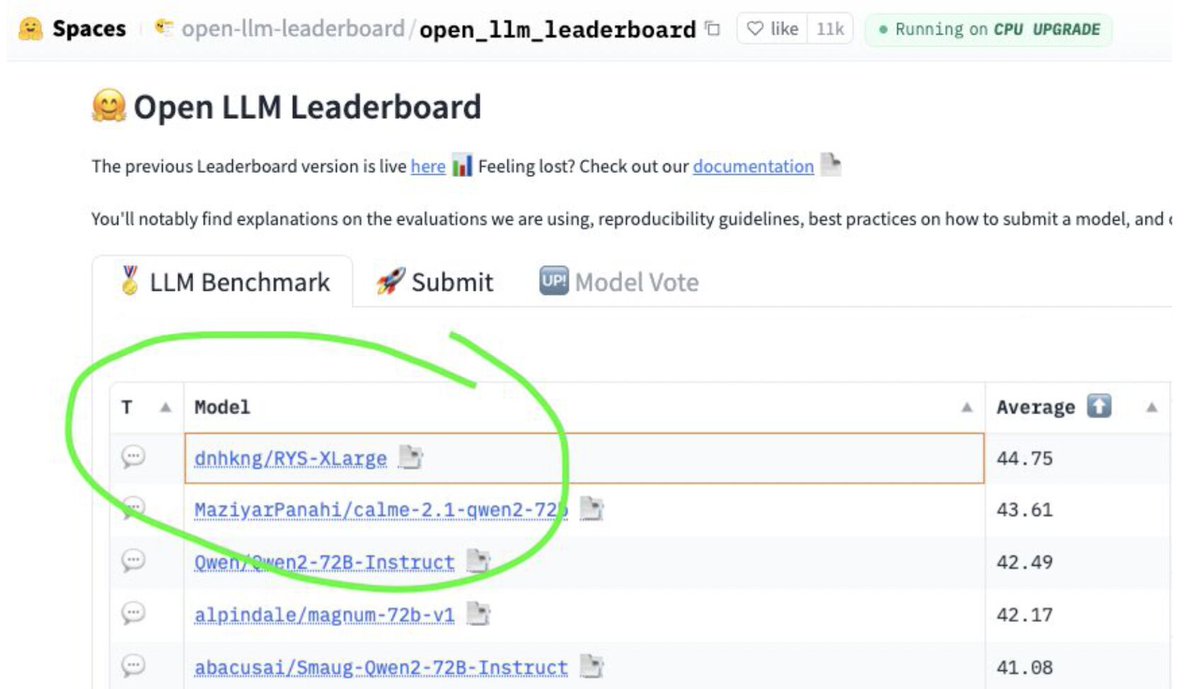
1/n I topped the HuggingFace Open LLM Leaderboard without changing a single weight.
No training. No merging. No gradient descent.
I duplicated 7 middle layers of Qwen2-72B and stitched it back together.
This is the story of LLM Neuroanatomy 🧵
Good question - I don’t have any proof for how well K scales, but I bet it won’t really need to scale much.
giving the model more heads means more directions are suppressed anyways, so it’s probably not necessary to scale k unless higher dimensions per head introduces significantly more noise. Still definitely worth experimenting with though