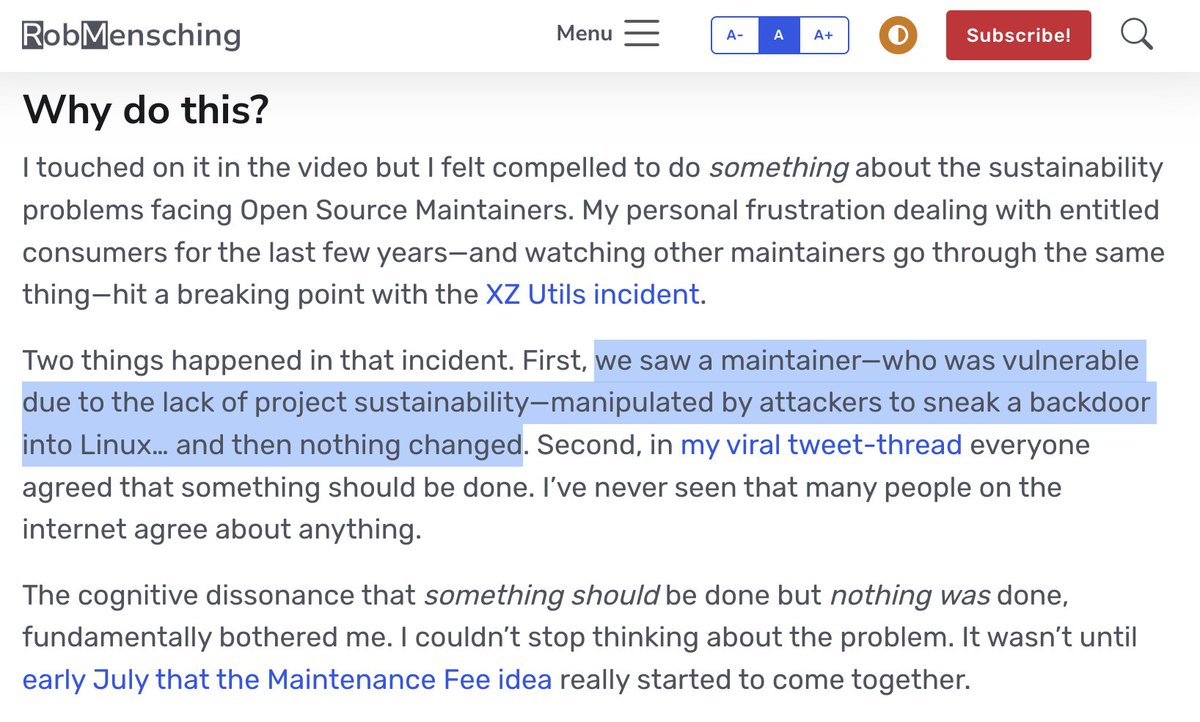
Honestly, we should celebrate an OSS maintainer putting their foot down, saying "you know what, I'd like to make my OSS project that is heavily used commercially to be sustainable the long-term, and not burn out."
This is what @robmen is attempting to do, and it's great.
There are only three "planning poker" values that are useful: 1, Too F'ing big, and No F'ing clue. You can even get a card deck for that: https://t.co/V0vDOdhicx
Microsoft has long downplayed its role in the 2020 "SolarWinds" attack -- one of the largest cyberattacks in US history -- but a new ProPublica investigation reveals that the tech giant ignored warnings that could have stemmed the damage... 🧵
Given the cost of blocking, asynchronous code reviews, I'm surprised more teams haven't experimented with eliminating them.
What bad things would happen if you just integrated changes? Are those bad things happening already? What else could you do to avoid those problems?
I just got back from @fintechdevcon in Austin. It was a super fun trip (notwithstanding the 105 degree air 🥵).
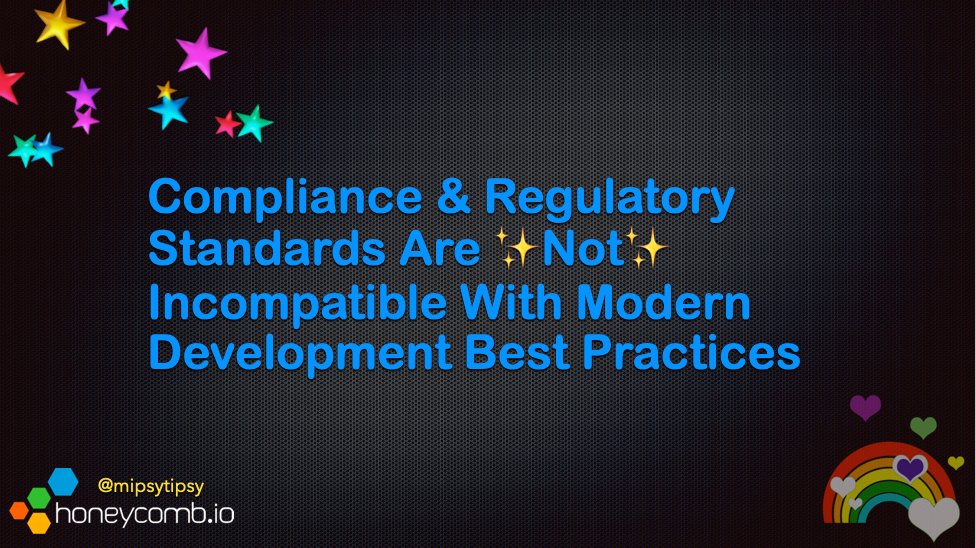
I gave a new talk while I was there, on why compliance and regulatory standards are ✨not✨ incompatible with modern development best practices.
Scrum is a cancer.
I've been writing software for 25 years, and nothing renders a software team useless like Scrum does.
Some anecdotes:
1. They tried to convince me that Poker is a planning tool, not a game.
2. If you want to be more efficient, you must add process, not remove it. They had us attending the "ceremonies," a fancy name for a buttload of meetings: stand-ups, groomings, planning, retrospectives, and Scrum of Scrums. We spent more time talking than doing.
3. We prohibited laptops in meetings. We had to stand. We passed a ball around to keep everyone paying attention.
4. We spent more time estimating story points than writing software. Story points measure complexity, not time, but we had to decide how many story points fit in a sprint.
5. I had to use t-shirt sizes to estimate software.
6. We measured how much it cost to deliver one story point and then wrote contracts where clients paid for a package of "500 story points."
7. Management lost it when they found that 500 story points in one project weren't the same as 500 story points on another project. We had many meetings to fix this.
8. Imagine having a manager, a scrum master, a product owner, and a tech lead. You had to answer to all of them and none simultaneously.
9. We paid people who told us whether we were "burning down points" fast enough. Weren't story points about complexity instead of time? Never mind.
I believe in Agile, but this ain't agile.
We brought professional Scrum trainers. We paid people from our team to get certified. We tried Scrum this way and that other way. We spent years doing it.
The result was always the same: It didn't work.
Scrum is a cancer that will eat your development team. Scrum is not for developers; it's another tool for managers to feel they are in control.
But the best about Scrum are those who look you in the eye and tell you: "If it doesn't work for you, you are doing it wrong. Scrum is anything that works for your team."
Sure it is.
@ben11kehoe In a meeting, someone once asked me "but what if all AWS goes down?" and I replied "The fulfillment of customer orders will the least of my worries. I'll be getting home as fast as possible, grabbing my camping gear, and heading north until it all blows over."
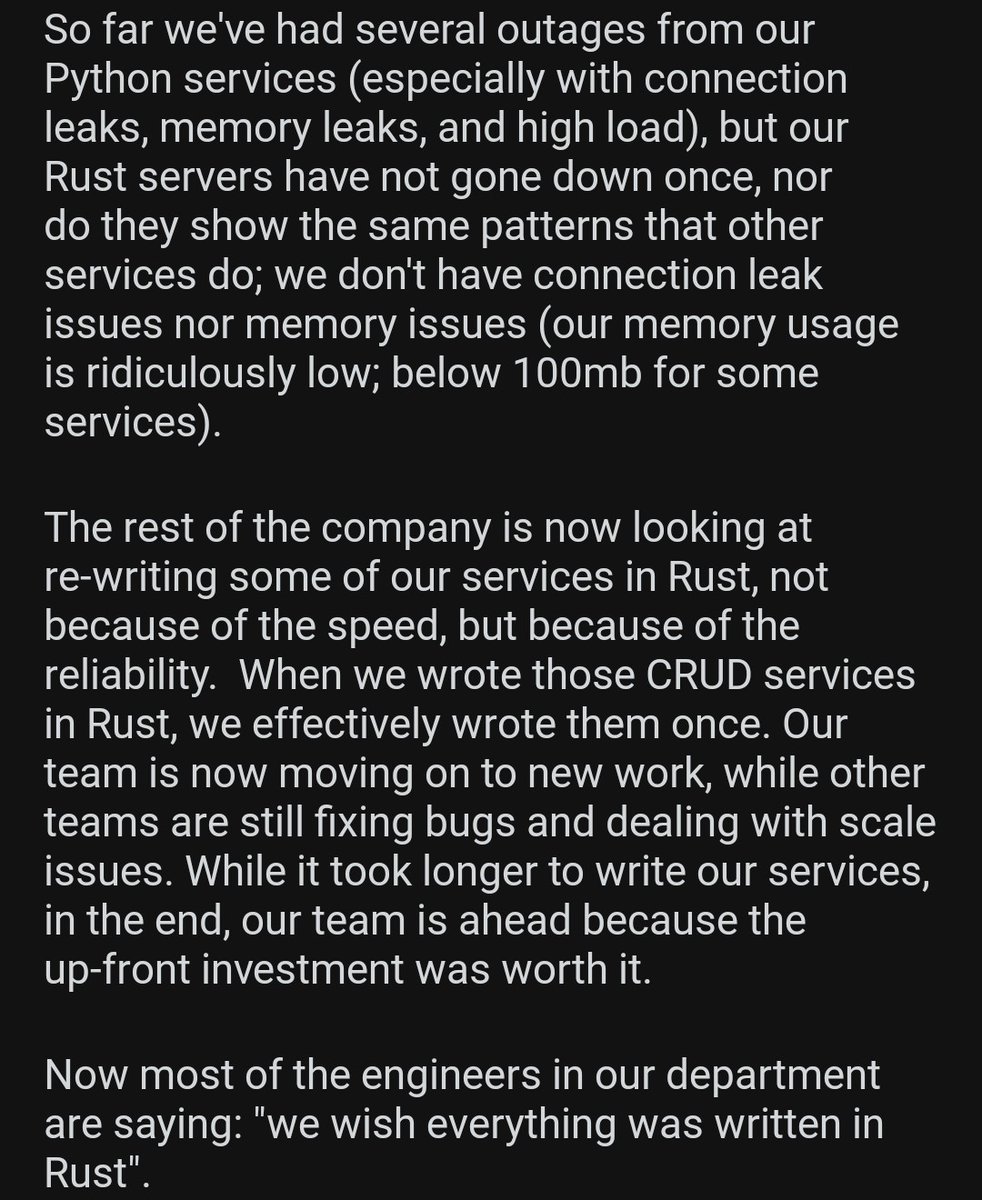
✨ Why use Rust on the backend? -nice article by @adam_chal
💯 "Turns out Rust is a pretty good high-level programming language"
"@ThePrimeagen works at Netflix and had an interesting twitter thread about using Rust for a "high level" service"
https://t.co/oQLECQVl65
#rustlang
🦀 Is rust overkill for apps that could be done quickly by NodeJS and PHP?
"not because of speed,but because of reliability.When we wrote those services in Rust,we effectively wrote them once.Our team is now moving on to new work,while other teams are still fixing...
#rustlang
Google's Service Weaver claims that it can hide the difference between RPC and local method calls. Just like CORBA claimed in 1991. Is it different this time? The docs say barely a word about handing failures, such as RPCs timing out https://t.co/NQjT9IxgZy