Going to take a break from here. Given the algorithm, I expect no one will really notice. :)
Building a lot this summer. Be back when I have something to show for it.
Given the algorithm, I expect no one will really notice. :)
You can find me at https://t.co/Rw2GhWlMZN
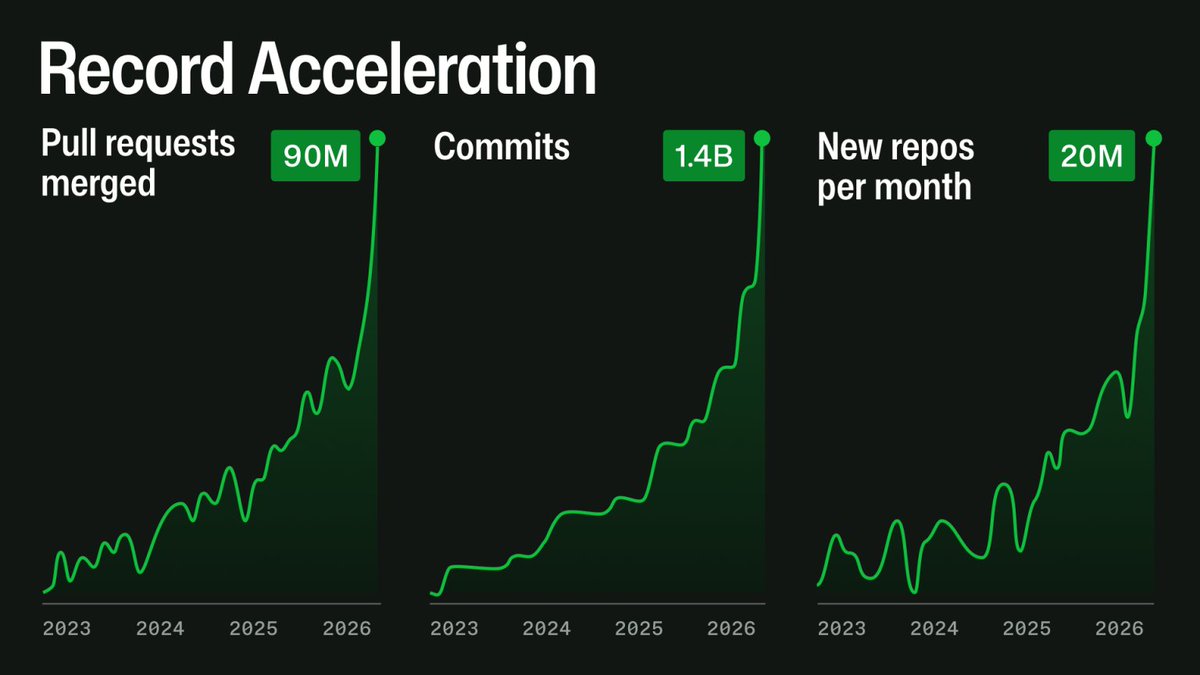
I don't work on reliability & scaling at GitHub, but the people who do aren't bad at their jobs. They're dealing with unprecedented scale from agents.
It's easy to shit on GitHub from the outside if you're not in charge of 30X-ing capacity within a few months. Have some grace.
I find much of the discourse around GitHub discouraging. The world changed on them faster than most. They need to improve to handle it. They know they need to improve. Everything suggests they are working on it.
Punching them while they do so is not productive, IMHO.
Being the foundation for millions of developers means our bar must be higher for availability, reliability, and security. I’m sorry it’s been a rocky stretch at GitHub. We know we need to do better.
Today we published an update on two recent incidents: one on April 23 involving merge queue behavior, and one on April 27 affecting pull requests, issues, projects, and search-backed experiences.
We’re taking this seriously. We’re listening, and you have my commitment that we’ll communicate more frequently about the work underway to improve reliability and scale GitHub for what comes next.
https://t.co/lJNGGISyVw
How does one post with such conviction and a completely flawed understanding about the fundamentals about which they are talking?
I think I need to leave for a while. The state of things here makes me sad.
This is such a complete misunderstanding of how complicated it was to do this within Microsoft when he did it. Plotting telemetery is one thing. Getting the largest software vendor, at the time, to coordinate that all software within needs to play nice with this one tool is not.
@triathenum@kellabyte I'd argue ADO is designed for a scale few need and that gets exposed as complexity. GitHub has also come a long way since ADO was created so I expect intertia is the key reason ADO remains.
@vlad_mihalcea@YuriKushch I believe that Opus is not made available on free plans because it is 3x-7x more expensive than other models. Codex is very good for free.
When I introduced the OSMF, people told me that enforcement would be my biggest problem. It wasn't and isn't.
Procurement remains the biggest pain point.
The challenge is that there is little I can do to fix the root issue. Instead, the OSMF serves as a simple forcing function.
@ClintRutkas Not a need, but it definitely reduced eye strain when I got one. I can't explain why except that it lights up the correct part of the room for staring at a monitor.
I'm not big on DDD but defining the Ubiquitous Language and mapping Bounded Contexts is a hugely valuable process to go through when designing a large system with LLMs.
It helps organize your thinking and improves the chances you and your Agents start on the same page.
I'm starting to think that DDD might be the answer to all of my problems
- Model not doing what you want? Shared language
- Can't navigate a massive codebase? Bounded contexts with global mapping
- Don't know why a decision was made? ADR's
It's just so freaking elegant
I'm "stuck" testing codex at FireGiant. I asked Claude to double-check some code and test coverage. It first said the code was designed and implemented well (thank you very much), and Claude found 4 cases where test coverage was missing and offered to fix them.
Cool. Make it so:
> Do these tests pass, or is there a specific variation you'd still like added?
Uhh, thanks, Claude. Yeah, they pass. That's why I asked you to review the code, not implement it.
codex has never done that... but I do prefer the way Claude communicates. Subtly better, IMO.
@Aaronontheweb@indy_singh_uk@AkkaDotNET I'd guess this (plus the privacy) is the real answer.
We see similar behavior from our customers (totally expected/encouraged), but our OSS project gets way more bugs reported directly. There are a gazillion squared edge cases.
The world is not kind to installation technology.
@wesbos@syntaxfm My project was called an "insignificant geekware tool" back in 2004, which is probably fair. :)
But what may be interesting to you today is the OSS sustainability model that we're trying.
https://t.co/ixLsvRtNl5