Leveraging rRNA's 100,000-fold higher abundance over rDNA, we developed a one-pot method for RNA isolation, enrichment, and assembly of RNA identifiers, enabling detection of pathogenic bacteria and AMR variants without the need for amplification! 🧬🥼
@sarahesandler@KeyserLab
pre-print alert!🚨 @FilipBoskovic12 and I’s collaboration from our time in the @KeyserLab using #nanopores for serovar discrimination with single base pair specificity of rRNA is now on biorxiv! 🦠 https://t.co/ko2odcgf0F
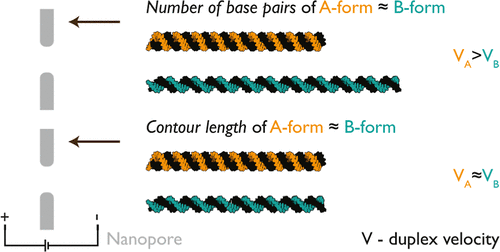
In a study led by @FilipBoskovic12 we examined how the electrophoretic transport of RNA:DNA and DNA through nanopores depends on the contour length rather than the number of base pairs. Nice blend of experiments and simulations! @aksimentievLab@acsnano 🧬🕳️⚛️ @Cambridge_Uni
_1/n Honestly, it has been an incredible experience to scratch the surface of the physics behind our applied work! Building on the work of nanopore crew, we've uncovered some unexpected clues about the electrophoretic translocation of duplexes and how their form affects velocity!
🥳 New paper from the group! @casey_platnich has shown with nanopore sensing that the denaturing properties of urea can be used to break up RNA secondary structure and allow DNA staples to bind without heating! 🧬 Check out the paper in @J_A_C_S here:https://t.co/2ik35D4yES
Check out our new article in @NatureComms ! We use RNA nanotechnology and nanopore sensing to assess transcript size and heterogeneity. We identify premature transcription termination, study rolling circle transcription and describe enzymatic processivity. Special thanks to everyone at @KeyserLab, @FilipBoskovic12 and our great collaborators @fondzanauku_rs. 🧬
https://t.co/cWC1ajIezV
Our latest paper collab with lots of great colleagues is now available in @an_chem, extending our solid-state #nanopore approach to analyzing the size distribution of heavy-chain modified #hyaluronan from physiological biofluids. https://t.co/JI2y4pO1D6
While characterising harmful oligomers is crucial to developing accurate diagnoses and treatments for diseases involving misfolded proteins, like Alzheimer's, identifying them in complex mixtures has remained challenging. This new test may change that.
https://t.co/MhoatMMPFE
Four of our physicists have been recognised in the
@IOP
Awards 2023 for their outstanding contribution to experimental physics, public engagement, soft matter physics, and atomic physics. Congratulations to them!🏅
Follow the thread to learn about the winners and their awards 🧵
Finally we are happy to announce that in the last week of September we spent an amazing time with the members of the DYNAMO consortium. Students under the guidance of professionals in the field of #nano presented their projects and defined goals for the future
#DYNAMO#nanopores
In a paper in @NatureNano, researchers @Cambridge_Uni went fishing for viruses using programmable DNA nanobait technology. @KeyserLab
https://t.co/ZoZIOtB0d9
Check out my first first author paper of my PhD out now in @natBME ! We utilize solid state #nanopore sensing and #dna#nanotech as a way to assay #CRISPR#Cas9 binding efficiency!
Check out our new paper in Nanoletters led by the talented Yunxuan Li, where we use DNA nanostructures and nanopore signals to characterize the physical properties of DNA! @NanoLetters@KeyserLab#dna#nanotech#nanopores
https://t.co/ebMcNGHcr1