@GarridoQuintin Fantástico
Conozco este sitio desde hace muchos años y me ha sido una interesante y generosa fuente de información para la redacción de mis libros de texto, desde aportar ideas hasta confirmar pensamientos
Mi más sncera enhorabuena. Estos lugares son los grandes faros de la red
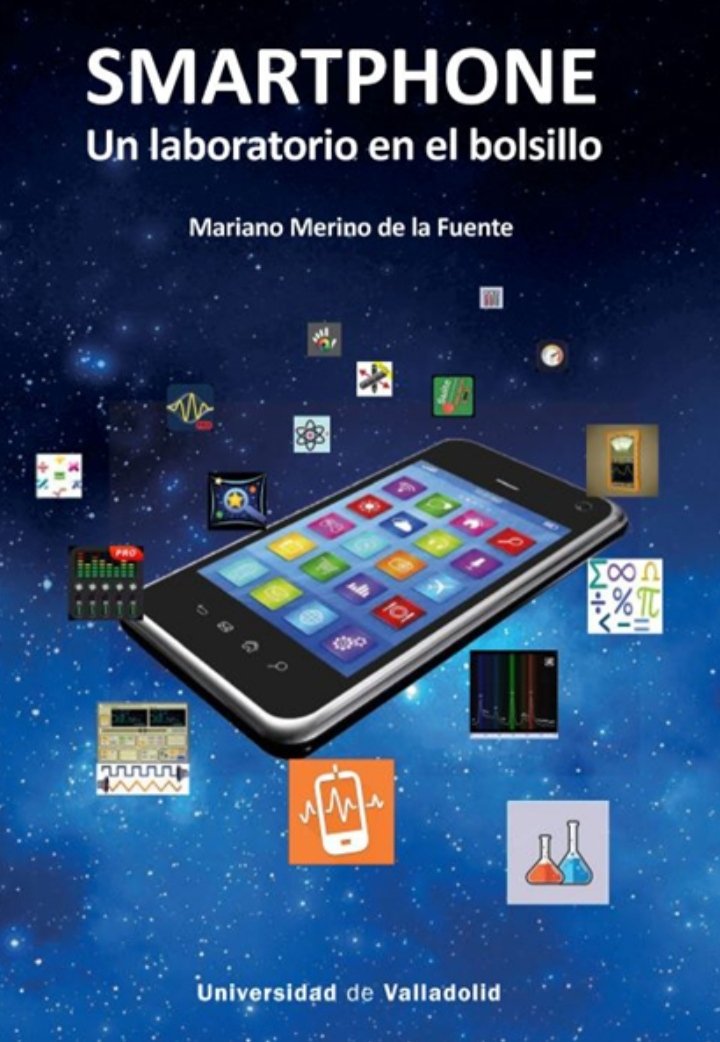
Cuando el clickbait convierte un artículo periodístico en una falsedad científica.
De forma premeditada o por desconocimiento, se nos vende nuevamente un móvil perfecto de primera especie. Bastaba con cursar 4ESO.
Ah! Que es optativa
#CienciaEsCultura
https://t.co/GxUSmCWAGd
Triste que mi primera entrada en BlueSky sea precisamente para denunciar una aberración, un retroceso, un maltrato reconocido por la comunidad internacional
https://t.co/E6sGwcoR97
https://t.co/0xW8O9mOqb
🧵¿Cómo se hace una predicción meteorológica? ¿Cómo funciona un modelo meteorológico? En este hilo hablaremos del complejo proceso científico y técnico en que se basa el método de elaboración de la predicción moderna del tiempo y que se usa para la predicción de una dana.
Re: "1935: Einstein, Podolsky, and Rosen publish the EPR paradox"
Clarification: EPR shows a direct SELF-CONTRADICTION in Quantum Mechanics between the Heisenberg Uncertainty Principle and the Max Born Rule "wavefunction collapse."
Explained:
The history of Quantum Physics in one tweet ✍️
1900: Max Planck introduces the quantum hypothesis to explain black body radiation.
1905: Albert Einstein proposes the light quantum hypothesis to explain the photoelectric effect.
1924: Louis de Broglie suggests particles can exhibit wave-like behavior.
1925: Werner Heisenberg formulates matrix mechanics, the first version of quantum mechanics.
1926: Erwin Schrödinger develops wave mechanics and the Schrödinger equation.
1927: Heisenberg states the uncertainty principle, which shows precision limits for measuring pairs of physical properties.
1928: Paul Dirac formulates the Dirac equation, laying the groundwork for quantum field theory and predicting the existence of antimatter.
1935: Einstein, Podolsky, and Rosen publish the EPR paradox challenging quantum mechanics' completeness.
1947: Richard Feynman, Julian Schwinger, and Sin-Itiro Tomonaga independently develop the foundations of Quantum Electrodynamics (QED), which describes how light and matter interact.
1954: Chen Ning Yang and Robert Mills develop non-abelian gauge theories, paving the way for the development of QCD.
1961: Sheldon Glashow introduces a unification scheme for electromagnetic and weak interactions, an early step towards the Standard Model.
1964: John Bell proposes Bell's theorem, showing quantum entanglement cannot be explained by local hidden variables.
1964: Murray Gell-Mann and George Zweig, independently, propose the quark model for hadrons, leading to the concept of Quantum Chromodynamics (QCD) as the theory of strong interactions.
1973: David Gross, Frank Wilczek, and Hugh David Politzer discover asymptotic freedom in QCD, explaining how quarks behave inside nucleons, and strengthening QCD as the theory of the strong force.
1979: The Nobel Prize in Physics is awarded to Sheldon Glashow, Abdus Salam, and Steven Weinberg for their contributions to the unification of the weak force and electromagnetic interaction between elementary particles, using the framework of Quantum Field Theory.
1982: Alain Aspect's experiment confirms quantum entanglement, supporting Bell's theorem.
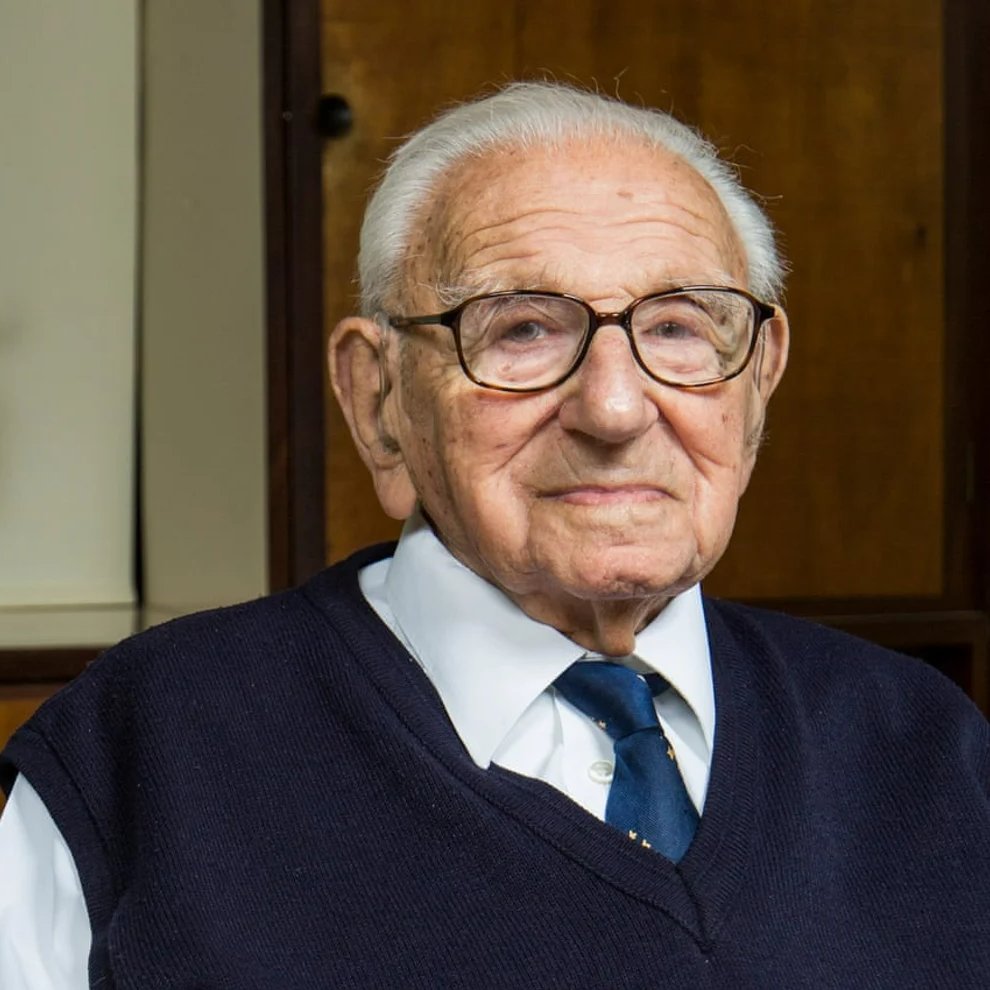
Deja que te presente a este señor mayor:
Nicholas Winton.
Cuando tenía 79 años le invitaron a la tele. De público.
Una forma entretenida de pasar la tarde.
Pero lo que le sucedió ese día es historia del sXX.
El bloqueo en #España de #telegram impide que mis estudiantes de 2BAC puedan estar informados de noticias de #ciencia que les interesan y de canales que les enriquecen
Espero que el juez entienda que su acción genera más efectos negativos que los que su auto pretendía solventar
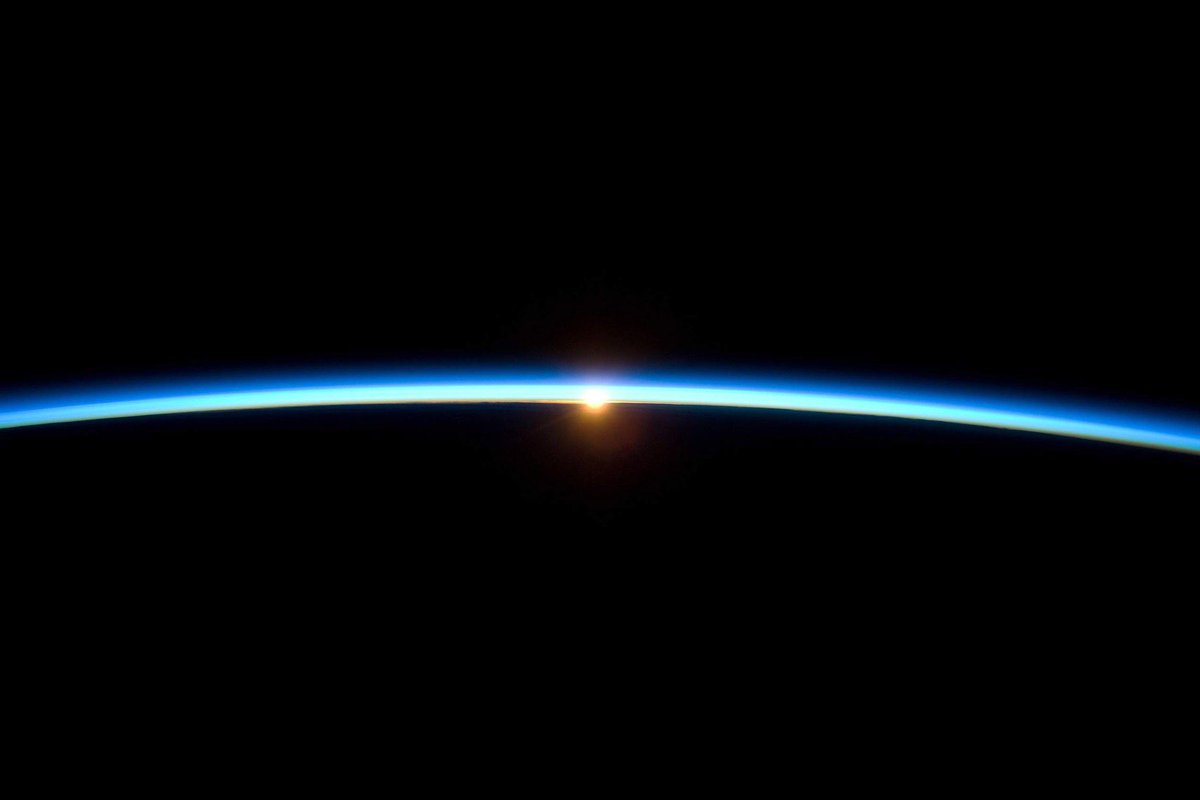
Esta delgada línea azul es la atmósfera terrestre vista desde la estación espacial internacional.
Dentro de esta línea azul solo podemos respirar en el 5% inferior
The Longest Equation in Physics
The model Lagrangian is a mathematical expression that summarizes the Standard Model of particle physics, which is the most successful theory of the fundamental interactions between elementary particles. It is composed of four different parts, each describing a different aspect of the Standard Model.
The model Lagrangian is written in a compact notation that uses symbols and operators from quantum field theory, such as covariant derivatives, field strength tensors, Dirac matrices, and gauge group generators. It also uses various constants and parameters that are determined by experiments, such as coupling constants, masses, and mixing angles.
It is one of the longest equations in physics because it contains many terms and factors that account for all the possible interactions and symmetries of the Standard Model.
It was transcribed by Thomas Gutierrez who derived it from Martinus Veltman's Diagrammatica: The Path to Feynman Diagrams.
Ayer, 16 de febrero, se cumplieron 27 años del fallecimiento de Chien-Shing Wu, física brillante que llevó a cabo uno de los experimentos más importantes de la historia: demostró que, intrínsecamente, la naturaleza distingue entre derecha e izquierda. Escribí esto sobre ella: