“The nitrogen in our DNA, the calcium in our teeth, the iron in our blood, the carbon in our apple pies were made in the interiors of collapsing stars. We are made of starstuff.”
― Carl Sagan, Cosmos
The largest and sharpest image ever taken of the Andromeda galaxy — otherwise known as M31.
It is the biggest Hubble image ever released and shows over 100 million stars, thousands of star clusters in a section of the galaxy’s disc stretching across over 40 000 light-years.
El ingeniero que construyo Claude Code acaba de soltar un video de 28 minutos donde te enseña a escribir prompts que realmente funcionan
He visto cursos de 300 dolares que no llegan ni a la mitad de lo que explica en los primeros 10 minutos
Archivos CLAUDE.md, atajos de memoria, sesiones paralelas y patrones de prompting que cambian el juego
Todo en un solo video y completamente gratis
Da igual si eres principiante, desarrollador o ya llevas meses usandolo
Esto te va a hacer usar Claude como nunca antes
In 2008, Malcolm Gladwell explained why some people succeed and some don't in a single 1-hour talk.
This will permanently change the way you think about talent, effort, and success.
Bookmark & watch today, no matter what.
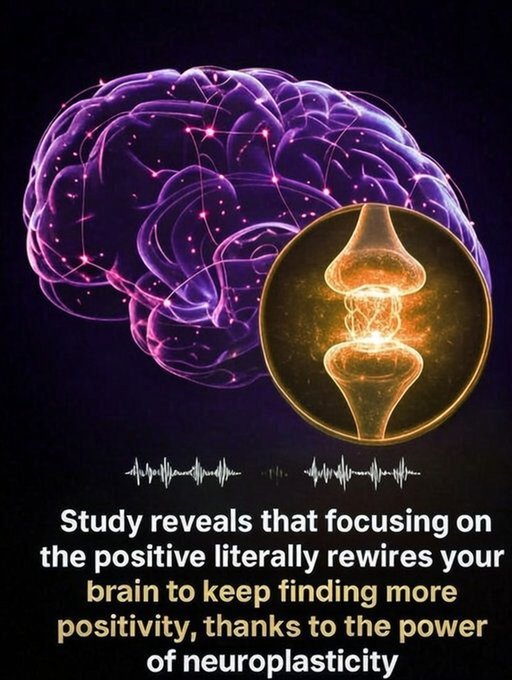
Your thoughts literally reshape your brain.What you repeatedly focus on doesn't just linger in your mind—it physically changes its structure.
By intentionally directing your attention toward the positive, you begin forging and strengthening neural pathways that make it easier to notice and appreciate more good things. This is neuroplasticity at work: your brain's lifelong ability to create new connections in response to your focus, emotions, and habits.
Every time you pause to savor a kind act, a small achievement, or a simple moment of beauty, you're reinforcing the neural circuits that help you view the world with greater clarity and calm. With consistent practice, this becomes your brain's new default—automatically tuning in to what's right rather than dwelling on what's wrong.
The payoff includes reduced stress, improved emotional stability, and stronger mental resilience against life's challenges.This isn't about denying difficulties; it's about actively training your brain to seek out opportunities and solutions instead of getting trapped by obstacles.
The exciting part? You're in control—you can start rewiring these pathways any time you choose.Give it a try: Spot one positive thing today.
Tomorrow, look for two. Soon, make it five. And then watch what happens.
In 1901, divers pulled a lump of corroded bronze out of a two thousand year old shipwreck. It took the next century to understand what it was, and the answer broke the timeline of human history.
It's called the Antikythera Mechanism, and it is the oldest known computer on earth.
It was built by the ancient Greeks, around 100 BC, and it should not exist. Nothing else of its sophistication would appear anywhere in the world for more than a thousand years after it...
It was found by sponge divers off the Greek island of Antikythera, in the wreck of a trading ship that had sunk in the first century BC, surrounded by bronze statues and pottery.
The corroded fragments looked like nothing at first, and sat largely ignored in a museum in Athens. Only over the following decades, and especially with modern X-ray and CT scanning in our own century, did researchers finally see inside it.
What they found was a machine. Behind its bronze face was a system of at least thirty interlocking precision gears, cut and arranged with a sophistication that would not be matched until the geared astronomical clocks of medieval Europe, well over a thousand years later.
It was, in the words of the team that studied it, a mechanical computer that worked by turning astronomical theory into bronze...
And it did extraordinary things. You turned a hand crank on the side, and the mechanism calculated the positions of the sun, the moon, and the five planets the Greeks knew. It tracked the phases of the moon. It predicted solar and lunar eclipses years in advance. It even displayed the four-year cycle of the ancient Olympic Games. A person standing in the ancient world could set this device to a date and watch the heavens be calculated in front of them, by gears, by hand.
Roughly a third of the original survives, in 82 corroded fragments. We still do not know who designed it, or how a civilization without anything resembling industrial machinery achieved this level of precision engineering. What is certain is that it was not a one-off accident. A device this refined implies a tradition behind it, generations of knowledge and earlier attempts that have been lost completely.
The Antikythera Mechanism is proof of how much the ancient world knew, and how much of what human beings have achieved has simply vanished without a trace, leaving us to stumble on a single piece of it at the bottom of the sea...
Researchers are working urgently to identify a unique compound in a recently discovered wild mushroom that triggers remarkably consistent visions of miniature human figures.
Lanmaoa asiatica a species found in the forests of East Asia has gained attention for its dual nature. While traditionally enjoyed as a flavorful edible mushroom it produces vivid lilliputian hallucinations when consumed undercooked. Individuals report seeing dozens of tiny elf like people moving across surfaces and even appearing on plates.
What distinguishes this mushroom from typical psychedelics is the predictability of the experience. Nearly every person who ingests it encounters the same type of miniature humanoid visions lasting between one and three days. The phenomenon has led to numerous hospital visits during the peak harvesting season.
Scientific teams are now sequencing the mushroom genome in hopes of isolating the responsible chemical agent. Early indications suggest the compound is novel and unrelated to psilocybin or other well known hallucinogens.
Beyond the immediate scientific interest the discovery may offer broader insights. Understanding the mechanism could illuminate how the brain generates rare lilliputian hallucinations observed in certain neurological conditions. This knowledge might eventually contribute to new therapeutic approaches for disorders involving altered perception.
[Wang Y et al. Lanmaoa asiatica sp. nov. a new species from East Asia inducing lilliputian hallucinations. Mycologia or similar journal. DOI 10.1080 00275514 2025 1234567]
Coffee before breakfast spikes your stress hormones and sets you up for a crash.
Many people kick off their day with a strong cup of coffee for that instant energy boost, but sipping it on an empty stomach—especially right after waking—might be counterproductive and even counterproductive to your body's natural rhythms.
Upon waking, cortisol (your primary stress hormone) naturally surges to help you feel alert and mobilize energy. Adding caffeine during this peak window, without any food to buffer it, can amplify this response more intensely than necessary.
While some popular claims link this to dramatic cortisol spikes leading to anxiety or crashes, the key evidence from the University of Bath's research focuses on metabolic effects: consuming strong black coffee before breakfast (particularly after a disrupted night's sleep) impairs blood glucose control, raising post-meal blood sugar responses by about 50% compared to eating first.
This creates unnecessary metabolic strain, contributing to energy volatility, potential jitters, heightened stress sensations, and that familiar mid-morning slump.
The University of Bath study (published in the British Journal of Nutrition, 2020) didn't directly measure cortisol but highlighted how this coffee-first routine disrupts glucose/insulin dynamics—effects that align with broader reports of caffeine interacting with stress pathways and exacerbating morning hormonal fluctuations in some individuals.
A simple tweak makes a big difference: eat something small first (even a handful of nuts, yogurt, or fruit) to provide a biological cushion. Food slows caffeine absorption, moderates any amplified hormonal or metabolic response, stabilizes blood sugar, and lets the caffeine deliver clean focus and alertness without the unwanted side effects like jitteriness or crashes.
In short, timing your coffee after a bite turns it from a potential stressor into a reliable ally for a smoother, more balanced start to the day.
[Betts, J. A., Richardson, J. D., Chowdhury, E. A., Holman, G. D., Tsintzas, K., & Thompson, D. (2020). Glucose control upon waking is unaffected by coffee consumption prior to a disrupted night’s sleep. British Journal of Nutrition]
Sam Altman:
"We're going to see 10-person billion-dollar companies pretty soon."
"If I were 22 right now, I'd feel like the luckiest kid in history."
Most people will read this, feel inspired for 3 minutes, and go back to what they were doing.
The ones who act will build a one-person company this weekend.
One tool. Claude Cowork. Full operation.
This is the exact playbook ↓
A 1,700-year-old fresco of Christ as the "Good Shepherd" recently discovered in an underground tomb near İznik, Turkey (ancient Nicaea). It dates back to the 3rd century AD, before the cross became the dominant symbol of Christianity.


![Rainmaker1973's tweet photo. Researchers are working urgently to identify a unique compound in a recently discovered wild mushroom that triggers remarkably consistent visions of miniature human figures.
Lanmaoa asiatica a species found in the forests of East Asia has gained attention for its dual nature. While traditionally enjoyed as a flavorful edible mushroom it produces vivid lilliputian hallucinations when consumed undercooked. Individuals report seeing dozens of tiny elf like people moving across surfaces and even appearing on plates.
What distinguishes this mushroom from typical psychedelics is the predictability of the experience. Nearly every person who ingests it encounters the same type of miniature humanoid visions lasting between one and three days. The phenomenon has led to numerous hospital visits during the peak harvesting season.
Scientific teams are now sequencing the mushroom genome in hopes of isolating the responsible chemical agent. Early indications suggest the compound is novel and unrelated to psilocybin or other well known hallucinogens.
Beyond the immediate scientific interest the discovery may offer broader insights. Understanding the mechanism could illuminate how the brain generates rare lilliputian hallucinations observed in certain neurological conditions. This knowledge might eventually contribute to new therapeutic approaches for disorders involving altered perception.
[Wang Y et al. Lanmaoa asiatica sp. nov. a new species from East Asia inducing lilliputian hallucinations. Mycologia or similar journal. DOI 10.1080 00275514 2025 1234567]](https://pbs.twimg.com/media/HMUPLYjXQAAAwua.jpg)
![Rainmaker1973's tweet photo. Coffee before breakfast spikes your stress hormones and sets you up for a crash.
Many people kick off their day with a strong cup of coffee for that instant energy boost, but sipping it on an empty stomach—especially right after waking—might be counterproductive and even counterproductive to your body's natural rhythms.
Upon waking, cortisol (your primary stress hormone) naturally surges to help you feel alert and mobilize energy. Adding caffeine during this peak window, without any food to buffer it, can amplify this response more intensely than necessary.
While some popular claims link this to dramatic cortisol spikes leading to anxiety or crashes, the key evidence from the University of Bath's research focuses on metabolic effects: consuming strong black coffee before breakfast (particularly after a disrupted night's sleep) impairs blood glucose control, raising post-meal blood sugar responses by about 50% compared to eating first.
This creates unnecessary metabolic strain, contributing to energy volatility, potential jitters, heightened stress sensations, and that familiar mid-morning slump.
The University of Bath study (published in the British Journal of Nutrition, 2020) didn't directly measure cortisol but highlighted how this coffee-first routine disrupts glucose/insulin dynamics—effects that align with broader reports of caffeine interacting with stress pathways and exacerbating morning hormonal fluctuations in some individuals.
A simple tweak makes a big difference: eat something small first (even a handful of nuts, yogurt, or fruit) to provide a biological cushion. Food slows caffeine absorption, moderates any amplified hormonal or metabolic response, stabilizes blood sugar, and lets the caffeine deliver clean focus and alertness without the unwanted side effects like jitteriness or crashes.
In short, timing your coffee after a bite turns it from a potential stressor into a reliable ally for a smoother, more balanced start to the day.
[Betts, J. A., Richardson, J. D., Chowdhury, E. A., Holman, G. D., Tsintzas, K., & Thompson, D. (2020). Glucose control upon waking is unaffected by coffee consumption prior to a disrupted night’s sleep. British Journal of Nutrition]](https://pbs.twimg.com/media/HMH4JROXcAARKJp.jpg)