Wanted to get you a clear answer before replying, and sorry for the runaround. After checking on our end, the block was happening at your ISP, not on our site. There's no fix we can apply from here, but a VPN should get you through, or you can ask your ISP to stop blocking the domain. If you'd still rather delete, totally understandable. We checked everything on our side.
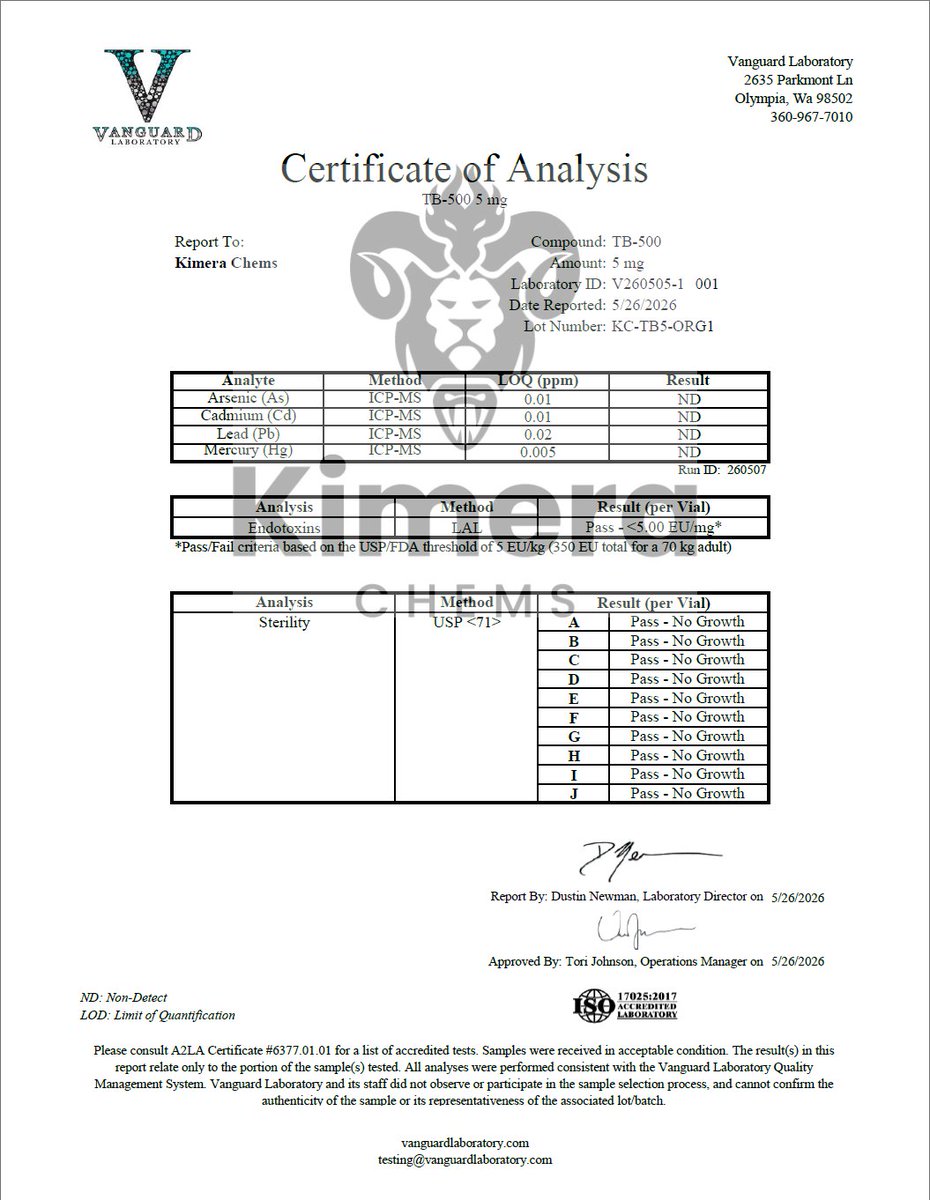
Fresh COAs hot off the press.
KIMERA10 for 10% off your order
SLU-PP-915 passed ✅️
Powder and Liquids in stock
Capsules should be in shortly
Survodutide passed ✅️ all check marks
Elevate your research
@Vanguard_Lab@tread_on_them
@MrAlchemeister You'd fail what, exactly? Solvents come off in the lyophilization. The TFA left is counterion, the salt form, not a residual solvent. Neither's a contaminant to test.
We are implementing a new way to test peptides. We call it X15
15 vials per batch
Testing works as follows
3x Identity, Purity and Quantification (Could be multiple labs doing this)
1x Endotoxins
1x Heavy metals
10x Sterility
All new batches moving forward will have this level of testing.
If 1 fails, it goes in the garage besides Quantification.
If Quantification is >10% of label claim then it will be discounted.
We are also looking to add CHN analysis which is a very accurate measurement for net peptide content.
First round went today
This isn't anything special as many others are doing similar testing but we wanted to let everyone know our what our standards are moving forward with this.
IP = intraperitoneal: injection into the abdominal/peritoneal cavity, not into the stomach itself. Your rat landmark image is right. It's parenteral, so it skips GI uptake, but absorption is mostly via the portal vessels, so it still sees hepatic first pass, closer to oral than IV in that respect.
On "adjusted for systemic exposure": that does NOT mean oral and IP gave equal exposure. It means they accounted for the routes delivering different exposure. The oral dose was actually set higher than IP 32 mg/kg by mouth vs 20 mg/kg IP and at those doses the efficacy readouts (running distance/time, Ddit4) came out comparable. Fig 2 in the JPET paper frames it as the two routes showing the same exercise mimetic activity, not the same exposure. Oral dosing used MDA (a voluntary oral suspension the mice drink), with oral exposure characterized across a 2/8/32 mg/kg dose response that rose dose dependently.
So "orally bioavailable" here means enough absorption to hit the same endpoints at a somewhat higher dose, with efficacy tracking exposure, not mg for mg parity with injection. A clean oral %F benchmarked against IV or SQ isn't in the public abstract or figure legends I've seen; that would sit in the full PK table.
SLU-PP-915
Code KIMERA10 for 10% off
The ERR-agonist research space has centered on one molecule for two years. SLU-PP-332 got the attention -- pan-ERR agonist, a reported ~50% increase in endurance capacity in sedentary mice, widely tagged in coverage as an "exercise mimetic." The limitation that held it back as a research tool: 332 has poor oral bioavailability and is active mainly by injection in animal models, which narrows the chronic oral-dosing studies it can support.
SLU-PP-915 addresses that limitation.
Same lab (Burris group, out of Saint Louis University), same target, different chemistry. Where 332 is built on an isoxazole, 915 is a 2,5-disubstituted thiophene carrying a boronic acid moiety. That structural pivot is the whole story: 915 is orally bioavailable and holds up in vivo while keeping the pan-agonist profile across all three estrogen-related receptors.
The design route is worth knowing. 915 came out of the ERRgamma ligand-binding crystal structure solved with GSK-4716, a known acyl-hydrazide agonist. The team swapped the central hydrazide for a five-membered heterocycle and worked through a series of disubstituted thiophenes; the boronic-acid analog fell out as the lead. Structure-guided, not a screening accident.
The numbers:
ERRalpha -- EC50 ~414 nM
ERRbeta -- EC50 ~435 nM
ERRgamma -- EC50 ~378 nM
ERRs are orphan nuclear receptors. Despite the name they are not driven by estrogen -- they are master regulators of mitochondrial biogenesis, oxidative phosphorylation, fatty acid oxidation, and the Krebs cycle, upstream of how a cell partitions and burns fuel. That is the same transcriptional axis sustained aerobic training remodels over time. The premise behind the ERR agonist programs is to activate that program pharmacologically rather than through the physiological exercise stimulus.
What the preclinical work shows for 915:
Aerobic capacity. In mice, 915 improved running distance and duration on par with 332 when dosed IP, with comparable efficacy orally once exposure is accounted for. That oral durability is the reason the molecule was made.
Ddit4 induction. 915 drove DNA-damage-inducible transcript 4 -- an acute-exercise-responsive gene -- to levels matching or exceeding treadmill running in mice, depending on the muscle examined. Notably it stacked with training in the model rather than substituting for it: animals that ran AND received 915 showed further elevation in Ddit4 and mitochondrial gene expression beyond either condition alone.
Cardiac metabolism. Work on the pan-ERR series in pressure-overload heart failure models showed improved pumping function, driven mainly through ERRgamma, via upregulated cardiac fatty acid metabolism and mitochondrial function, without worsening hypertrophy. There is an autophagy angle too: ERR activation induced the autophagy-lysosome pathway through TFEB in cardiomyocytes.
Indications discussed in the literature for the class: obesity, type 2 diabetes, MASH, heart failure, sarcopenia, and the muscular dystrophies -- broadly, conditions where mitochondrial output and oxidative capacity are rate-limiting. All preclinical.
One analytical note on how the field is treating this class. 915 has already been run through LC-HRMS/MS metabolite characterization, with seven Phase-I metabolites mapped and reference work done for anti-doping screening. Detection methods getting built this early, well ahead of any approval, is a marker of how seriously the analytical community is taking ERR agonists.
Structurally it is a clean small molecule: C17H13BFNO3S, MW ~341.2, CAS 2285432-92-8. The boronic acid is not decoration -- it is the feature that delivered oral exposure.
332 established the mechanism in vivo. 915 makes that mechanism tractable for oral, longer-duration preclinical study.
For laboratory research use only. Not for human consumption. Not a drug, supplement, or medical product. Nothing here is medical advice or a claim of safety or efficacy in humans.
Both nootropic research compounds. Both available at Kimera. Not interchangeable.
Here is the difference:
NOOPEPT
- Synthetic dipeptide analog
- Structurally related to the racetam family
- Studied for nerve growth factor signaling
- Neuroprotective mechanism research
- Available in powder format
SEMAX
- Synthetic heptapeptide, seven amino acids
- Derived from adrenocorticotropic hormone
- Studied for BDNF signaling
- Dopaminergic pathway interaction research
- Available at Kimera in multiple formats
Same category on the label. Completely different science underneath. Knowing which one suits your research question is not optional. It is the starting point.
SM04554 -- the Wnt pathway compound that does not play by the usual hair-research rules.
If you follow follicle biology, you already know the standard cast: DHT blockers, androgen receptor antagonists like RU58841, prostaglandin analogs, vascular agents. Almost all of them work by slowing loss or extending the growth phase. SM04554 sits somewhere else entirely, and that is exactly why it is worth a research spotlight.
Now also carrying the generic name Dalosirvat, SM04554 is a small-molecule activator of the Wnt/beta-catenin signaling pathway. Chemically it is a 1,4-diketone: 1-(2,3-dihydro-1,4-benzodioxin-6-yl)-4-phenylbutane-1,4-dione. Molecular formula C18H16O4, molecular weight roughly 296.3 g/mol, CAS 1360540-81-3. It came out of the diketone / hydroxyketone catenin-pathway activator chemistry and is reported with an EC50 in the high-nanomolar range, around 28-29 nM in the originating work.
Why the Wnt angle matters: the Wnt/beta-catenin pathway sits upstream of follicle biology itself, not off to the side. In preclinical work, activating this pathway has been associated with increased total and nuclear beta-catenin and, in depilated rodent models, increased hair growth and follicle number. That is a different mechanistic question than "how do we slow loss." It is closer to "can we re-engage the follicle program." For a research setting, that distinction is the entire point of looking at this molecule instead of another antiandrogen.
SM04554 was developed and evaluated as a topical agent for androgenetic alopecia, which tells you it was engineered to act locally at the scalp rather than systemically. If you are modeling topical delivery, partition behavior, or local versus systemic exposure, that topical-first design history is useful context to build around.
Now the part that actually separates good material from garbage: the chemistry. SM04554 is an unsymmetrical 1,4-diketone. One carbonyl sits against a benzodioxane ring, the other against a plain phenyl, bridged by a two-carbon chain. On C-13 NMR that produces a pair of distinct ketone carbons, a pair of sp3 oxygenated carbons from the dioxane ring, and a pair of methylene carbons from the butanedione bridge. On mass spec you expect a clean M+H near 297 and M+Na near 319 for that ~296 mass. If something labeled "SM04554" does not produce that diketone fingerprint, it is not SM04554. Diketone and hydroxyketone scaffolds get confused, and that difference wrecks reproducibility before you even start.
One more reason this one stands out: it is simply not a compound most suppliers bother to source or test properly. Novel scaffolds with thin public reference data are exactly where sloppy identity slips through unnoticed. That is the whole reason every compound that carries this name goes through independent third-party COA verification first. Identity by NMR, purity by HPLC, mass confirmation by MS. The label has to match the data sheet, and the data sheet has to match the molecule. No "trust me," no hand-waving.
Handling, for the people who care about clean data: treat it like any sensitive small-molecule diketone. Store cold and dry, protect from prolonged light and heat, keep stock solutions aliquoted to avoid repeated freeze-thaw, and bring sealed material to room temperature before opening to limit condensation on your sample. Reproducible results start with material that has not degraded on the shelf.
Strictly research use only. Not for human consumption. Not a drug, not a cosmetic, not a treatment of any kind. Intended for in-vitro and laboratory research by qualified individuals only. Must be 18+ to purchase.
If you work in follicle biology, Wnt signaling, or topical-delivery modeling and you want material with a COA you can actually verify against the molecule, this is one to put on the bench.
Elevated Research.
https://t.co/08HGsKqOFT
What does it mean by Half-Life?
Half-life is the time it takes for a compound's concentration to drop by 50% under defined conditions. In experimental design this is not a background detail. It determines how timing is structured across the entire protocol, how intervals between measurements are planned, and whether the concentration at the point of measurement reflects what was intended at the point of preparation.
Two compounds reconstituted at the same concentration on the same day can be at completely different activity levels by the time a measurement is taken, purely because their half-lives differ. That difference does not show up as an obvious error. It shows up as inconsistent results that are difficult to trace back to their source.
Half-life is not just a number on a data sheet. It is a design variable. Treat it like one.
Reconstituting perfectly then immediately doubting the solvent.
Running a clean result and running it again just to be sure.
New Kimera delivery arriving and going straight to the COA.
Storage temp drifted one degree. Reconsidering two weeks of results.
Explaining your research at dinner. Nobody asks a follow up question.
Tag someone who has lived at least three of these.