@PeptidePartners Great call, Purity, identity, quantity, endotoxin, sterility, and metals answer different questions. Passing one does not imply passing the others. Endotoxin results and sterility failures have been trending higher the last few months.
Good question. Low/no benzyl alcohol and sterility are related, but they are not the same test.
A sample with insufficient BA could still be sterile, but this sample did not pass sterility, and it also failed BA content.
For preservative containing samples, the preservative has to be neutralized, diluted, or otherwise removed from interfering with the sterility test. Otherwise the preservative could suppress microbial growth during the assay and create a false pass. So with BAC water, the sterility test is not asking if benzyl alcohol can inhibit growth. It is asking whether viable microorganisms are present after the method is made suitable for that matrix.
In this sample, BA was 0.08% against a 0.72–1.08% specification, so it did not meet the bacteriostatic water specification. Since sterility also failed, it did not meet sterile water expectations either.
On endotoxin: “N/A” means that parameter was report-only on this COA. The client supplied pass/fail specifications for BA, pH, and sterility. Endotoxin, conductivity, and TDS were reported quantitatively, but no pass/fail decision rule was requested for those parameters.
To be clear, if someone wants to apply USP Bacteriostatic Water for Injection endotoxin criteria, then yes, there is a limit, and this result would not meet it. The reason the COA says N/A is scope/reporting: it was reported as a quantitative result, not rendered as a conformity decision.
Labs do not automatically attach every possible regulatory limit to every result because limits depend on intended use, matrix, route, dose, and regulatory framework. Metals are a good example: Prop 65, USP, FDA, and EPA criteria can all differ. Micro limits also differ depending on whether you are evaluating a USP sterile article, nonsterile product, drinking water, environmental water, or some other matrix.
@Krysia830073@jair_aleman@peptidesdaily The sample was submitted and tested. The picture, conductivity results and pH match what we have on file but someone heavily edited the COA, and changed or omitted results on the official COA. Will post original to this thread
Portal is nearing completion. All client data is being uploaded but clients have to pre authorize us sharing data or they have to login to make COAs public. ISO 17025 has strict rules on client confidentiality, and data security which we must adhere to. In the meantime we will happily verify authenticity via email- [email protected] or phone 360-976-7010
@SolutreanDACA@tread_on_them@Krysia830073 Bottom of the page, Working on updating the website to make more clear. https://t.co/hGVCVJp2XM
all peptides/small molecules $250 purity/ID, $550 purity/quant/endotoxins/sterility, & 700 for everything plus metals. no charge for additional sterility vials. Amino Acid analysis
@BrianSuttererMD@oasishealthapp LMNT is not a client but we have tested the product after seeing these reports and it has always been well under Prop 65 limits. We actually keep it stocked in our break room for employees.
Another strong round of external proficiency testing for Vanguard Laboratory.
In LGC PHARMASSURE Round 96, Vanguard achieved:
• 6 out of 6 assessments satisfactory
• 0 questionable results
• 0 unsatisfactory results
This round included pharmaceutical and dietary supplement matrices, with successful performance in:
• HPLC active ingredient quantification in throat lozenges
• Microbiological sterility testing, including correct identification of contaminated and sterile samples under USP <71>
External proficiency testing is one of the ways we verify that our methods, instruments, and analysts are performing consistently against independent benchmarks.
Vanguard participates in proficiency testing quarterly across a broad range of analytes and technologies, including endotoxins, API quantification, sterility, aerobic plate count, E. coli, Salmonella, nitrates, water activity, pesticides, residual solvents, and more.
Our PT program supports work across LC-MS/MS, GC-FID, GC-MS, HPLC, UV-Vis, PCR, wet bench chemistry, ICP-MS, ELISA, and related instrumentation.
Consistent, accredited performance matters , especially when results are used to make real quality decisions.
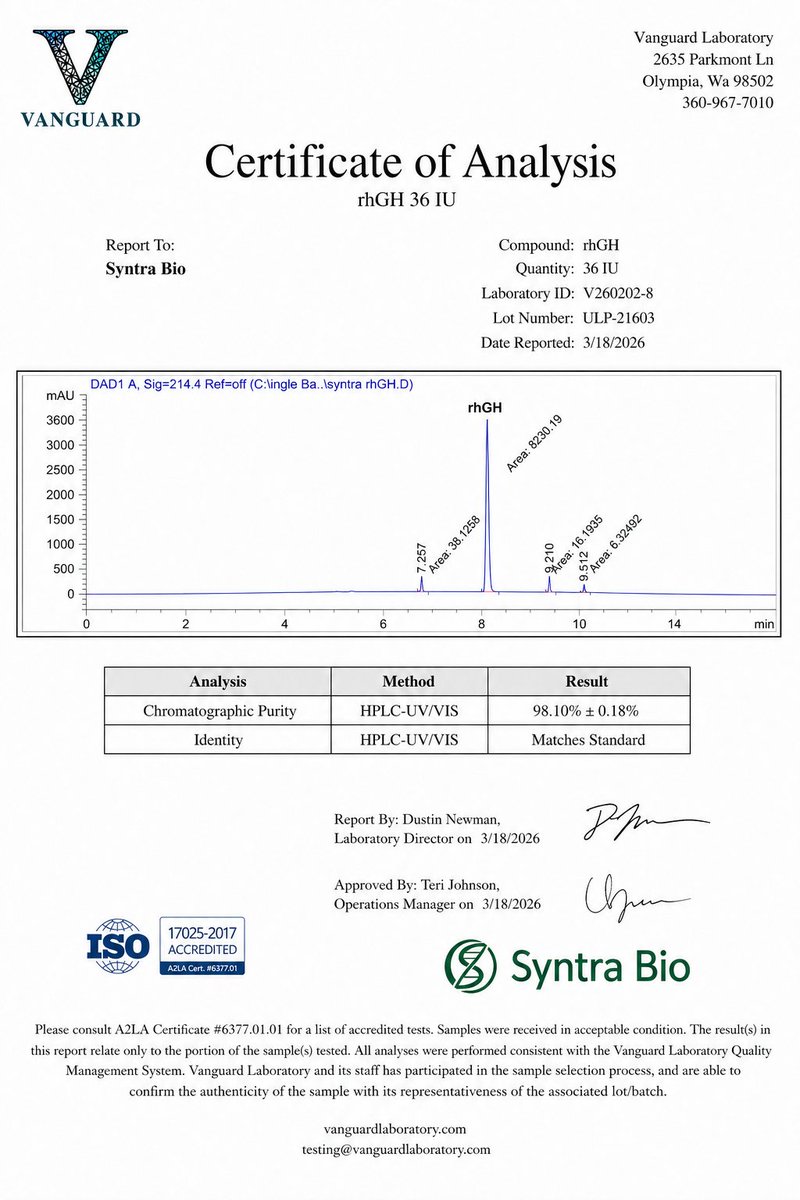
Another Forged COA. Logo is wrong, signatures forged, chromatogram altered, Iso logo not the one we use. Approved by "Teri Johnson" we have a Tori but no Teri's have ever worked at Vanguard...
Endotoxin Testing at Vanguard Laboratory
At Vanguard Laboratory, endotoxin contamination is not something we treat lightly. Even trace levels of bacterial endotoxins, specifically lipopolysaccharides from Gram-negative bacteria, can trigger significant immune responses. This includes fever, inflammation, hypotension, and other serious complications, particularly in injectable peptides, biologics, and parenteral products.
In immuno-oncology and advanced biologics work, the risk goes beyond safety. Endotoxins can directly interfere with assay performance, leading to false signals, misinterpreted immune activation, and unreliable data.
Why Endotoxin Testing Matters
Endotoxins are difficult to eliminate and easy to overlook:
They are heat-stable and can survive standard sterilization processes
They activate immune cells such as monocytes and macrophages
They drive cytokine release including TNF-α, IL-6, and IL-1
They can compromise both research outcomes and patient safety
This is especially critical for applications involving injectable peptides, biologics, radiopharmaceuticals, cytotoxic agents, and water for injection (WFI).
Without proper testing, you are taking on unnecessary risk.
How We Approach Endotoxin Testing
Our primary platform is the Endosafe® nexgen-MCS, which allows for rapid, quantitative endotoxin detection with high sensitivity and reproducibility. This system supports efficient throughput while maintaining data quality.
We also offer additional validated methods depending on project requirements:
LAL (Limulus Amebocyte Lysate) Assays
The compendial standard, available in gel clot, chromogenic, and turbidimetric formats.
Recombinant Factor C (rFC) Assays
An animal-free alternative with strong specificity for endotoxins and alignment with current regulatory expectations.
Each method is validated based on the sample matrix. We assess recovery, identify inhibition or enhancement effects, and confirm the assay is performing accurately for the specific application.
What Our Service Includes
Quantitative endotoxin detection with high sensitivity (EU/mL range)
Custom protocols tailored to sample type and matrix
Integration with peptide and biologic testing, including HPLC purity, potency, heavy metals, and sterility or bioburden
Support for depyrogenation validation and process monitoring
We test individual samples or full batches with clear, actionable reporting.
Turnaround and Quality
Our endotoxin testing is performed under ISO 17025-accredited conditions using validated methodologies. Typical turnaround time is 5 to 8 business days, depending on sample type and testing requirements.
The Vanguard Standard
We do not treat endotoxin testing as a final checkbox. It is built into the workflow from the start.
That means:
Methods selected based on real sample conditions
Validation that accounts for matrix interference
Data that holds up under regulatory and scientific scrutiny
Bottom Line
Whether you are a researcher, clinic, or manufacturer, endotoxin testing is not optional. It is a core requirement for generating reliable data and ensuring product safety.
At Vanguard Laboratory, we make sure it is done right.
Endotoxins aren’t something you want to guess on they need to be measured with precision.
We run endotoxin testing on the Charles River Endosafe nexgensystem, Widely used across pharma and QC labs for its speed, consistency, and validated accuracy. It’s a true industry standard.
The Baby Food Safety Act of 2024 is on the horizon, it's crucial to address toxic metal contamination in baby food.
Ensuring safety and vigorous testing, Vanguard Laboratory can help you achieve compliance.
Baby Warren is care free knowing his food is free of toxic metals.