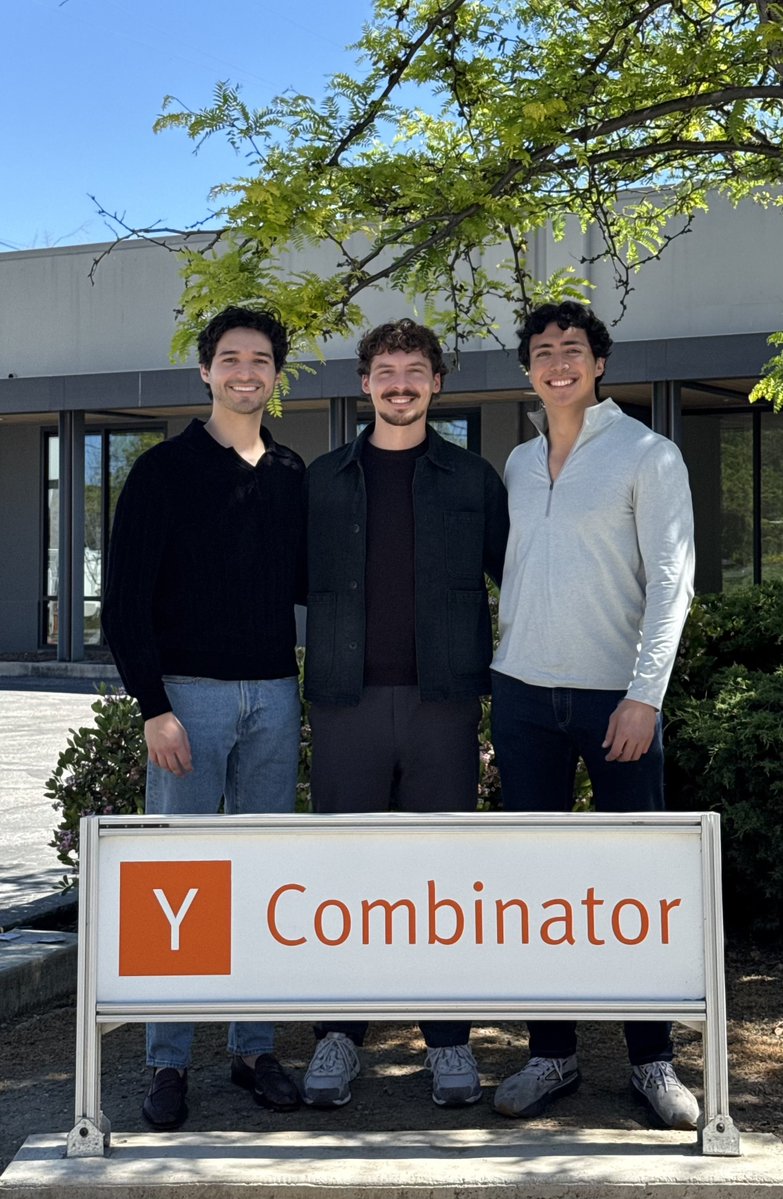
The @ycombinator batch is coming to a close. We are heading into investor week and Demo Day.
I thought I'd share the unconventional beginnings of how @KimptonAI was created:
@ortizmauricio_ and I met during our internship at @GoldmanSachs in 2019. I wrote algorithms to identify malicious threat actors who were trying to cyber attack the investment bank and he worked in critical infrastructure for the Apple Card.
We returned after graduation full-time in January 2020. Three weeks in the office, and then COVID sent us home. With a lot of spare time on our hands, we spent it building quantitative systematic trading strategies for ourselves and all of the infrastructure that goes into running them. A little personal project. @adriandelb joined us and brought his experience in cloud infrastructure to scale our trading systems.
We ran it on our own money for awhile and later left Goldman to pursue the success of it. At the ages of 21 and 22 years old, we raised $10M to seed the fund, and we were off to the races.
Although we were thereafter fund managers, we were technologists at heart. We continued to build. When agent functionality became more robust in 2025, we created our own harness, specifically designed for the financial markets.
It was our own ChatGPT, but for us and for our domain. We also experimented with autonomous agentic trading and were largely underwhelmed by not only our own implementations, but also by the many public experiments that we witnessed.
After deeper review, we concluded that AI can't trade (just like most humans can't). LLMs are consensus machines. Consensus has no edge in the markets. The edge lives in the portfolio manager. So we built around ourselves. We fell in love with technology again in the process and went all in on Kimpton.
All of the tools we had built from scratch, we found a way to make it AI-native through our harness. We didn't just stop there. While building the harness, we came to the realization: all research is going to be commoditized.
AI can't trade, but it can research at 1000X the efficiency of the average analyst if equipped with the right data and tools. We don't want to simply provide better research or better tools. We want to upend the way portfolio managers currently work and redesign what it means to be one.
Everything that happens behind the scenes in asset management comes down to one final outcome: the trade. The idea is simple. Kimpton does the research and generates the trade, the portfolio manager's sole job should be to make the decisions.
That's what Kimpton is today.
5 years later, that little personal project we started in our apartment during COVID is Kimpton AI (YC P26).
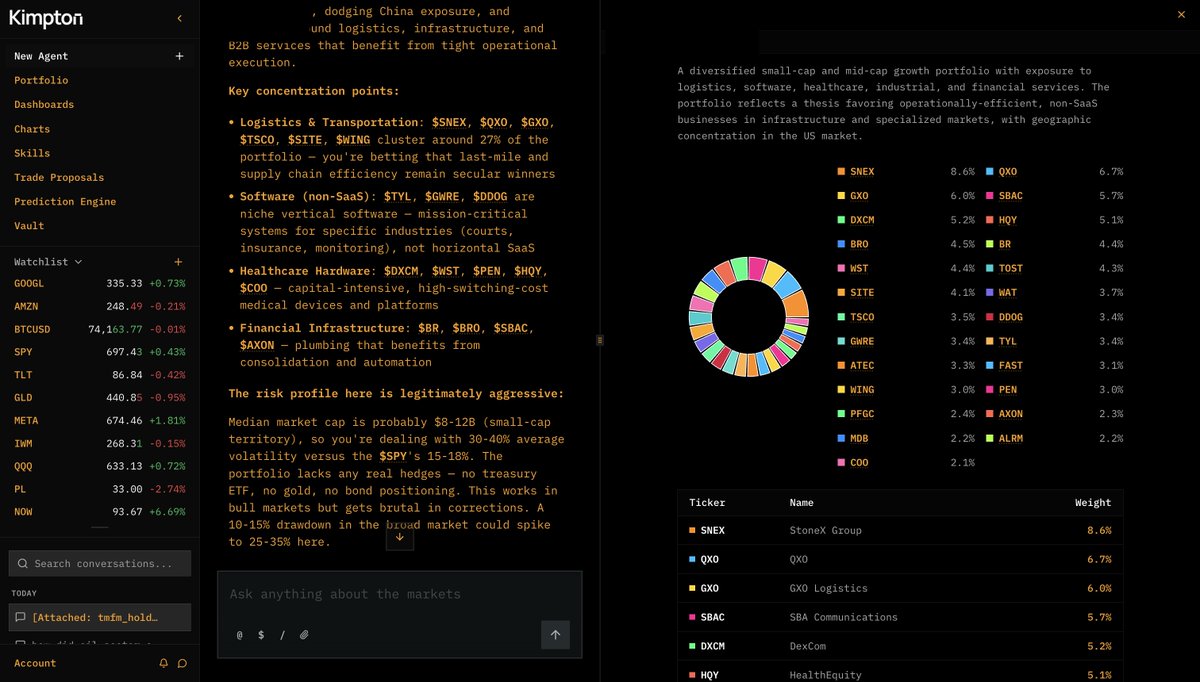
.@KimptonAI is Cursor for portfolio managers - the AI-native terminal where agents do the research and propose the trades. Real-time institutional-quality data loaded into a harness designed for the financial markets, powering billions in AUM today.
Congrats on the launch, @jackzumwalt, @adriandelb, and @ortizmauricio_!
https://t.co/f41KcS5HIW
We're live on Launch YC!
In the last few weeks of the batch we've been able to onboard billions of dollars onto Kimpton.
Portfolio managers have been underserved in AI. That's ending now.
Check it out: https://t.co/3omhmOgQHS
It was awesome to be included in the first YC Launch Live of the batch last week.
We demoed Kimpton AI (YC P26) trade proposals.
With the context of a portfolio, a vault of internal research, firm-constructed Mandate.md and Strategy.md, we can deliver institutional-grade trades to portfolio managers.
Don't even get me started on the rest of the platform.
So much progress so quickly.
It's only week four, but it feels like we just flew in to SF to have our 10 minute interview (yes, really) yesterday.
Although time has flown by, one thing is clear to me: YC works.
Kimpton now has control over charts.
This a part of something bigger that we've slowly been building towards the past few months.
Most investment research tools today are fragmented by features. Rigid by design, limited in flexibility.
Building AI-native allows you to rethink how things used to be done.
Companies should be building LESS features, not more.
Instead of building them, they should be enabling their agent to have the tools at their disposal to "create the feature" itself.
Embedding high-resolution charts are a small step in that direction.
In @KimptonAI today, our agent can spin up dashboards, create a model portfolio, summon charts, generate institutional-quality reports, and more. Directly in the chat.
There's a reason every smart company is switching to a chat infrastructure. It's not because humans want to read walls of text. It's because everything should be able to be executed right there, in natural language.
Ideally, I don't have to click anywhere. That's the investment research platform I want to use.
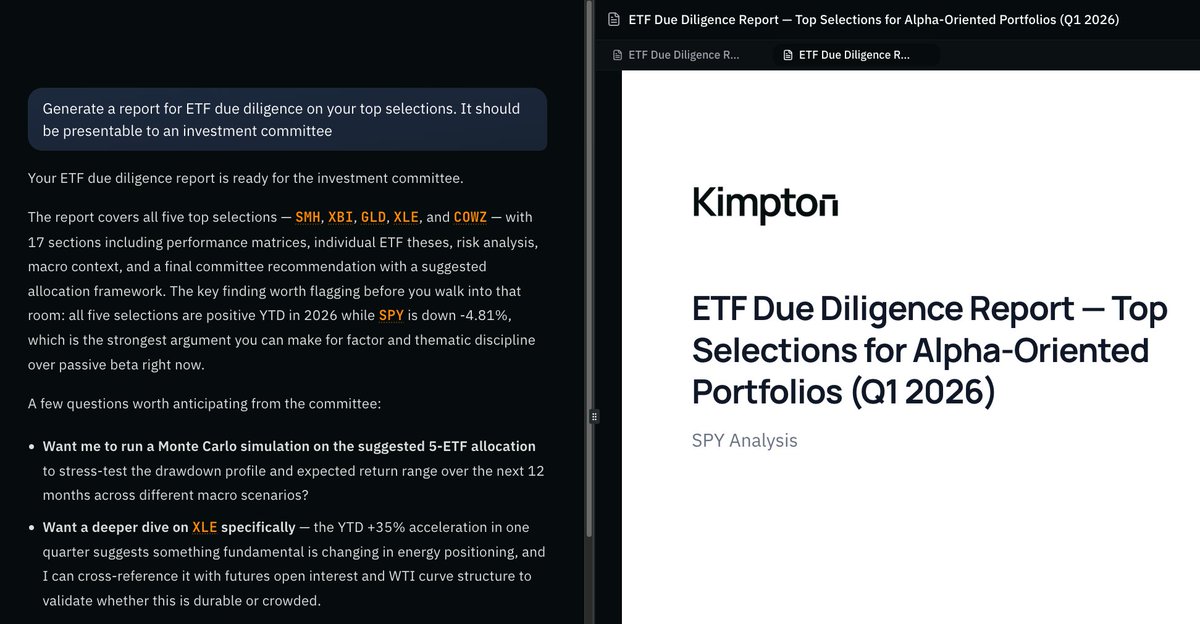
Introducing Reports.
Reports are AI-generated institutional research briefs that are detailed, precise, and structured.
You can make fund tear sheets, morning briefings, investment committee memos, client reports, or due diligence packages.
Instead of paying thousands of dollars for general-purpose research reports, @KimptonAI will go down the rabbit holes for you.
I like to call a report a "structured thought." Well-thought out, intended for an audience, and an actionable output.
Every report is backed by real market data, not hallucinated numbers.
Analysis is not fetched from the internet, it is computed by Kimpton internally to give you the most up-to-date and accurate data transformations.
Before, AI was your intern. Today, it's your trusted senior analyst.
What if TradingView had agents?
As an emerging fund manager (and even before that) I spent so much time in TradingView.
Having a constant understanding of where the markets were at all times was critical. It was the immersion that made the difference.
As active portfolio managers, we are visual people.
Having done this for 5+ years, I can visualize old charts in my head. If you show me one, and I've studied it before, I could tell you the asset and the time frame.
I got tired of going back and forth from TradingView to @KimptonAI, so we created our own version of TradingView in Kimpton.
The legacy trading software complex is still teaching people shortcut keys and charging portfolio managers for "custom" displays.
They call themselves "terminals" or "portfolio management systems" and charge managers thousands, or tens of thousands, of dollars per month to provide you with an interface that YOU have to provide data for.
We hated that, so we built one that we could modify ourselves at anytime with natural language, fully equipped with market and portfolio data integration.
Build a global markets dashboard from scratch in 90 seconds.
This dashboard comprises of:
- $SPY vs $EFA vs $EEM
- $USD strength.
- Oil, gold, and copper cross-asset correlations
- Relevant news, computed statistics, and more.
Behind the scenes, Kimpton pulls real-time price data across equities, currencies, and commodities, normalizes timeframes, calculates rolling correlations, and generates interactive widgets that are self-maintained.
No terminal. No code. No stitching together five different tools.
Just tell Kimpton what you want to see.
Introducing Dashboards.
Dashboards are a collection of AI-generated widgets on a flexible canvas that maintain themselves, indefinitely.
Real-time data is critical to financial markets. When you create a visualization you review every morning before the open, it better maintain itself.
Create one in seconds. Describe what you want to monitor.
"Build me a Bridgewater All-Weather dashboard."
Kimpton researches, computes, and assembles a live dashboard with metrics, charts, heatmaps, and news feeds.
Drag to rearrange. Ask Kimpton to add, remove, or modify any widget in natural language. Every widget stays current. Price tiles update on every refresh.
Comparison charts refresh automatically. News feeds pull the latest headlines. You build it once and it works forever.
We're also upgrading to multi-agent orchestration. Haiku handles fast classification and routing while Sonnet powers deep research and computation.
Dashboards build faster, research goes deeper, and the whole experience feels more responsive.
We're excited to see what everyone creates with this powerful tool. Don't forget to share your findings!
Available now --> link in the comments.
Introducing Dashboards... tomorrow.
Dashboards are a collection of AI-generated widgets on a flexible canvas that maintain themselves, infinitely.
You can create dashboards, edit them directly, and trust that the data is maintained for you at all times.
Real-time data is critical to financial markets. When you make a visualization that you review everyday, it better maintain itself.
Not only this, but we're upgrading to multi-agent orchestration with Haiku and Sonnet - indisputably the best financial reasoning models on the market.
The reason I'm telling you today versus launching tomorrow is because we are raising prices, but not for our early users.
Early users provide us value in many ways. Feedback, loyalty, direct contributions. We are grateful for all of them.
If you join @KimptonAI in the next 24 hours, the next 3 months will only be $50/m.
That price will quadruple tomorrow. Right now, we are subsidizing users in many ways to pay them for their early adoption. I want to give everyone one last wave.
Be a part of our movement. We aren't going anywhere and will not stop until you have exactly what you need.
And yes, I will be reaching out to you directly for feedback (so be ready!).
The YC P26 batch starts next week
Asset management is a new focus at @ycombinator, and I think it's for a very good reason
Agents are finally good enough to make a serious difference in the life of the asset manager
There are so many problems to solve
Fragmented data/tools, expensive analysts, client/LP management, and, most importantly, underperformance
The asset managers that accept the idea of agentic finance soon will outperform those who don't
That's why we started @KimptonAI
Internally, we like to call it the last trading terminal