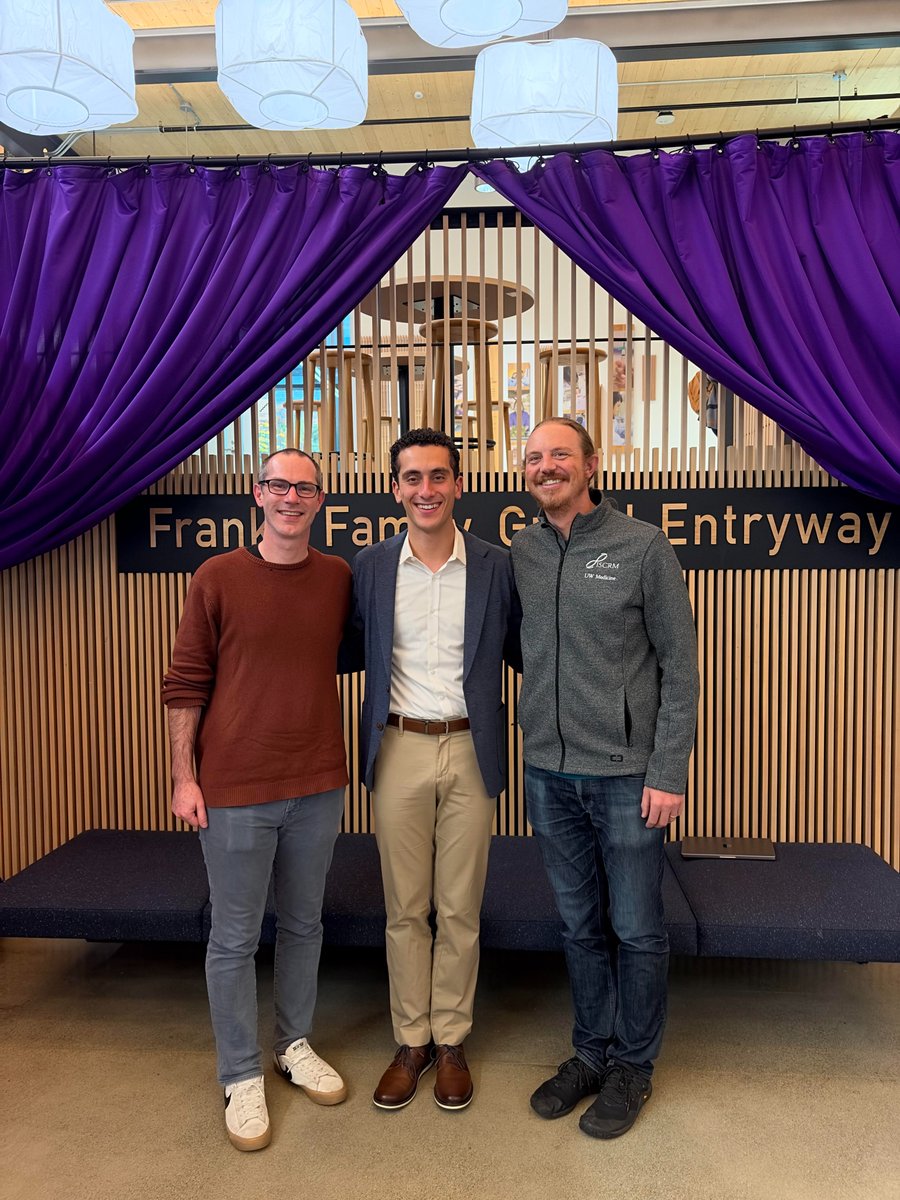
Last week the King and DeForest labs celebrated a successful defense from Dr. Cyrus Haas 🥳🍾
We're so proud of everything you've accomplished and can't wait to see what you do next!
I've seen a lot of beautiful assemblies under the microscope - stoked to put this together and show some of the design it's enabled! More quasisymmetry to come
Excited to share our latest @biorxivpreprint, led by Dr. Chelsea Fries @assemblingfries 🥳
Here, we establish multistate interface design as a strategy for engineering protein assemblies that break symmetry and switch between distinct geometries.
https://t.co/TEjb7MpGow
This is what a communal brain—a central tenet of the IPD approach—looks like in action. 🧠
We're thrilled to present RFD4-Proteina, co-developed with @NVIDIAHealth! Can't wait to see what you build: https://t.co/ezw5LPM0Bf
most protein design focuses on using the 20 amino acids for protein function. in biology, post-translational modifications such as glycosylations are essential to function. we program protein function through glycosylation👇
@biorxivpreprint These glycoproteins engage immune lectins and pathogenic bacterial adhesins through their #glycans, showing that we can now design functional glycoproteins.
🚨 pre-print alert 🚨
Glycosylation has remained outside the reach of biomolecular design, but with new all-atom methods we are now able to control the types of glycans displayed on our de novo proteins.
In our newest @biorxivpreprint, we present multiple structurally-encoded oligomannose-type glycoproteins, establishing glycans as a designable parameter!
https://t.co/PLHMh0Ci0H
🚨 new paper alert 🚨
Here we apply our protein nanoparticle vaccine platform toward a bacterial indication: uropathogenic E. coli, the primary causative agent of UTIs:
https://t.co/LO3JG5iHnT
Excited to share our new preprint:
“Computational design of membrane fusion proteins”
Huge thanks to all collaborators, co-authors, @KingLabIPD, and everyone at @UWproteindesign who contributed to this work.
Preprint:
https://t.co/5TDujafHJ9
A team presents vaccines for H5 clade #influenza based on a stabilized H5 hemagglutinin stem, which improves the breadth and depth of antibody responses and protects against #H5N1 challenge in immunized mice. @KingLabIPD@anniedosey@UWBiochemistry https://t.co/pWKNjg8lGL
🚨 new paper alert 🚨
Here we demonstrate increased anti-RBS neutralizing responses elicited by stabilized influenza H5 immunogens:
https://t.co/fmPddt0PoO
Happy New Year! We are delighted to share with you our newest @biorxivpreprint, in which we describe the de novo design of protein nanoparticles with structures tailored to specific applications. Long a dream, it is now reality!
https://t.co/ofL0Fzalmj
🚨new paper alert🚨
Here, we show how recently developed ML tools can be leveraged to design self-assembling protein nanoparticle immunogens in the absence of experimentally determined structures of the oligomeric building blocks.
Read more @PNASNews: https://t.co/ZTaO9m1X4x
🚨 new paper in @ScienceTM 🚨
Here, we describe and evaluate a "best-of-both-worlds" vaccine technology platform that combines the benefits of mRNA vaccines and computationally designed protein nanoparticle immunogens: https://t.co/E7jl0fYInN.
This week's issue of #ScienceTranslationalMedicine has arrived!
New mRNA vaccines generate self-assembling nanoparticles to enhance immunity, dual-targeting "decoys" prevent metastasis and potentiate immunotherapy against melanoma in mice, and more. https://t.co/mfA8HqzCYv