Today, I celebrate another year of life, growth, and God's endless grace. I'm grateful for every lesson, every challenge, and every blessing that has brought me this far.
Happy birthday to me 🎉🎂🥂❤️❤️
when i was a kid, i was always fascinated by art.
i would spend hours looking at drawings in books, school projects and cartoons, wondering how people could create something so beautiful from a blank page.
back then, owning artwork felt impossible. it was still something i admired.
as I grew older, I realized art wasn't just about colors or drawings.
every piece tells a story.
every artist curates a part of themselves into their artwork.
and that's what makes art special.
then, around 2021, i started hearing about nfts.
they were everywhere.
people were talking about digital art, alot of collections selling out, and creators building communities online.
i won't lie, i didn't really understand it back then.
so I stayed on the sidelines.
fast forward to 2026.
i decided it was finally time to explore the nft space because that love for art had never left me.
as I explored different collections and communities, I eventually came across @momoyumemi, or simply momo.
the name itself means "the one who sees peach colored dreams."
the more i looked into lola's(@cutemikaasa) work, the more I realized momo wasn't something put together overnight.
she's been building this world since late 2025.
momoyumemi turns these dreamy artworks into unique, on-chain collection, each momo is verifiably yours, you own the original.
with 4,444 nfts launching on ethereum after its move from tempo, this still feels like the beginning of something special.
beyond ownership, the nft format brings several advantages that fit momoyumemi perfectly:
> direct support for the artist- royalties ensure lola gets ongoing support as the collection grows and trades.
> community and identity- holders become part of a cozy, like minded community that shares the same nostalgic, peaceful vibe. it’s less about flipping and more about belonging to a warm digital dreamworld.
> expansion potential- when it's live, holding a part of the collection would opens doors to future utilities, collabs (already in collaboration with @tessonchain), merchandise, events or even bigger updates.
funny enough, after all these years, i'm back where i started.
and as i continue exploring the nft space, momoyumemi is definitely one of the communities I'll be part of.
momoyumemi is currently in its early stages.
mint details, website information, and future announcements will be shared through official channels when available. keep an eye on the official x account for updates.
que momo, momo. ( ˘ ³˘ ) ♡
@Teekay78614867@RallyOnChain The usual creator rewards talk being what it sounded like initially is honest and also describes why most people are still ignoring it. Skepticism that gets worn down by actual evidence from people you know is the most reliable filter.
@yourgirlsoft@RallyOnChain The contrast between chasing abstract rewards and earning real ones is sharper than it sounds when you've actually experienced both. Rally campaigns paying out in USDC after they end is a different feeling than watching a points balance sit there
I just came across this post from @get_optimum and i can see it’s one of the upgrades that could matter a lot for blockchain scaling.
Right now, networks like Ethereum still rely on gossip style messaging to spread blocks and transactions. It works, but it’s messy, same data gets passed around repeatedly, wasting bandwidth and slowing things down.
Optimum is switching that up with a new propagation layer called mump2p, powered by Random Linear Network Coding.
Instead of sending identical data over and over, nodes mix and encode packets, so less data is transmitted, but everything still arrives faster and more reliably.
The best part is validators don’t need heavy upgrades. Just a lightweight agent and they’re good.
In their tests:
→ blocks spread 6–20x faster
→ bandwidth drops a lot
→ validators capture more rewards
So it’s not just faster, it’s more efficient and more profitable.
They’re also getting ready for mainnet on Ethereum, and the rebrand looks clean.
Optimum is worth paying attention to if you actually care how blockchains scale.
Gmum @tgogayi@Isaacjohnibiam@blockchainjeff
I just came across a really good tweet from @RialoHQ highlighting something most people overlook in the RWA space.
Everyone’s excited about Real World Assets (RWAs) bringing traditional finance yields onchain, such as private credit, tokenized funds, real estate, etc.
On paper, a permissionless private credit market sounds perfect.
But there’s a big issue hiding underneath it all, the verification gap
In regular DeFi lending with crypto collateral, the hard part is already solved.
Oracles like Chainlink and Pyth provide real-time, reliable price data.
That’s what allows smart contracts to trigger liquidations automatically.
That’s why crypto lending actually works.
RWAs are completely different.
Now you’re dealing with:
• borrower performance
• offchain collateral
• legal agreements
• financial reporting
All of this lives outside the chain.
And here’s the problem, smart contracts can enforce rules, but they can’t verify if the inputs are truthful.
That’s where things start breaking down:
• NAVs are often delayed or smoothed (not real-time)
• Liquidations can take 30 to 90 days
• Data can be biased or selectively reported
So you end up pricing risk based on information you can’t fully trust.
Depositors are earning something like 0–20 bps,
when the actual risk might justify 250–400 bps.
That’s a massive mismatch.
The real question for RWAs is simple, can private credit truly scale onchain without fixing verification at the protocol level?
That’s what Rialo is trying to tackle, making sure onchain RWAs aren’t just wrappers around TradFi, but systems that can actually enforce and verify real-world agreements.
RWAs don’t fail because of yield, they fail because of trust.
Fix that verification to you unlock the real market.
#RialoAfricaCreatorChallenge
You’ll see tweets like GenLayer solved what blockchains couldn’t and think, okay but how did it do it?
These are real limitations most chains still struggle with.
Let me break it down simply,
starting with what the problem was and what GenLayer actually changed.
1. Smart contracts couldn’t understand humans
Before contracts only understand strict code.
They can’t read text, policies or context.
GenLayer introduced intelligent contracts that use AI to read and interpret natural language directly onchain.
this made it easy to build contracts using real-world language.
2. Blockchains couldn’t handle subjective decisions
anything requiring judgment normally trusts a human or oracle.
GenLayer uses multiple AI validators review outcomes using different models and agree based on reasoning,
you get trustless systems that can actually think and not just execute.
3. One AI model is a big risk
If a single AI fails, everything built on it fails too.
GenLayer uses a network of different AI models validating each other to avoid errors, bias and hallucinations get filtered out fast.
4. Disputes always go back to humans
When there’s disagreement, you need a judge, DAO vote or centralized system.
GenLayer has a built-in system where more validators are added until consensus is reached.
So disputes can be resolved onchain without trusting any single authority.
5. Blockchains couldn’t handle non-determinism
It's crazy everything had to produce the exact same output every time.
AI and real-world data break that rule.
GenLayer is built to allow flexible outcomes, then verifies them through validator agreement.
So contracts can now adapt, reason and respond to real-world inputs.
6. Smart contracts were blind to the internet
Smart contracts needed oracles just to fetch basic data.
GenLayer smart contracts can access live web data directly, with validators checking accuracy.
This makes it easy to unlock real-time apps, smarter DeFi and autonomous agents.
In this agentic era, GenLayer is trying to fix the core limitation of blockchain, which is moving from rigid code to systems that can reason.
This is a big shift, study @GenLayer
Imagine you need a loan for something urgent and you’re been charged to deposit higher first.
That’s over collateralization. Protocols do this because they don’t know you
No on-chain identity, repayment record, or credit history,
protocols need proofs to give loans on-chain
I’ve been using @grvt_io for a while now and honestly the economics are starting to make sense to me.
Negative maker fees mean I can actually earn from placing limit orders instead of paying to trade. The 10% APY on idle trading collateral is basically passive income while I’m active and GLP gives delta neutral exposure if I want to LP without taking directional risk.
What really caught my attention is the airdrop structure. If they’re rewarding traders generating real volume, LPs providing depth and GLP participants keeping liquidity stable, that’s proper incentive alignment, not just early farmers, but people actually using the platform.
I’m plan to test it out more with a small position and will share more results after spending some time on it.
Anyone here tried it already, how’s the experience so far?
Read through and GenLayer will make sense to you
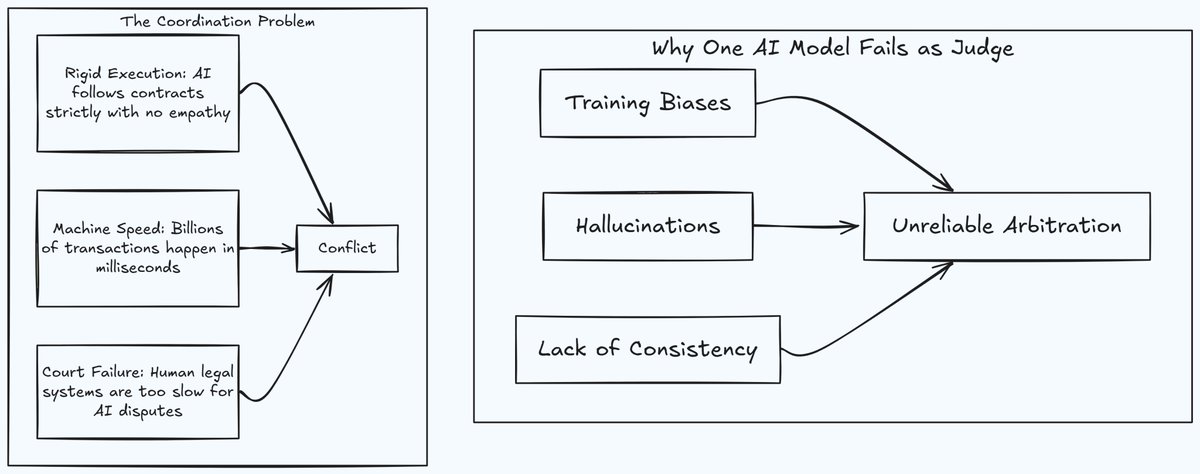
AI can't really trust humans and here's why
humans trust irrationally, we believe people based on appearance, familiarity or a gut feeling.
AI doesn’t work that way, it calculates probabilities, optimizes outcomes and follows game theory. This difference becomes a serious problem when AI agents need to coordinate.
Imagine you’re an AI client, an AI artist delivers work with a small detail missing from the contract. A human artist would likely find a way to fix it, while an AI would require contract renegotiation and additional payment without any form of emotion
Now think about billions of AI to AI transactions. Traditional courts can’t handle machine speed disputes. Humans have opportunity costs but AI doesn’t. We need dispute resolution at machine speed
the big question is who will arbitrate?
You can’t rely on one AI model. Different training creates different biases. On top of that, LLMs hallucinate frequently. You can’t build trust on a system that’s wrong so often
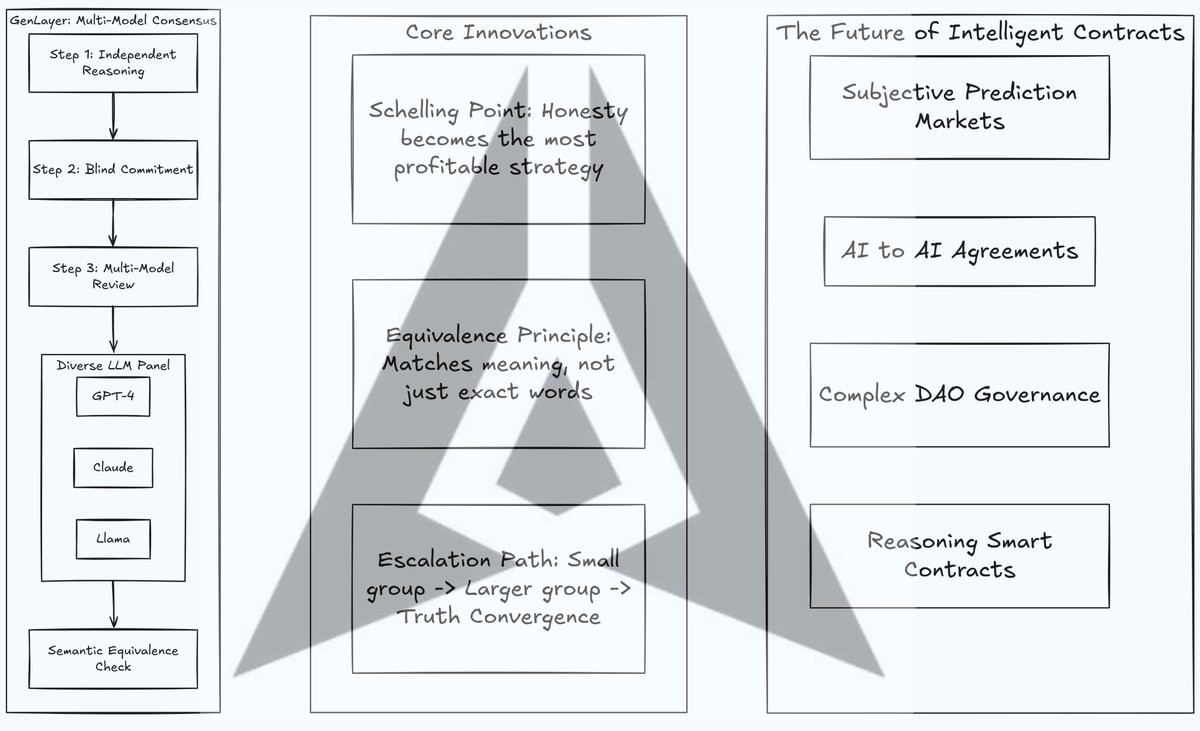
@GenLayer is the solution using multi model consensus. Multiple LLMs like GPT, Claude and Llama process each transaction independently.
It starts with a small group, if disputed, it scales. If still disputed, it expands further and truth converges
Each model commits to an answer before seeing others. This forces independent reasoning and makes honesty the most profitable strategy, a natural Schelling point
The Equivalence Principle handles indefinite outputs. LLMs are probabilistic, in the sense that the same input can produce different answers.
GenLayer doesn’t require exact responses. It checks whether outputs are semantically equivalent within context, allowing consensus on non deterministic reasoning.
This unlocks subjective prediction markets, large-scale AI to AI agreements, complex DAO governance and intelligent contracts that can reason. These are things deterministic blockchains like Ethereum can’t support.
AI agents are coming, they will transact, coordinate and resolve disputes cause traditional systems can’t scale. A single AI can be biased. And strict contracts don’t solve everything.
GenLayer is the convergence layer for AI
Genm @RuzgarFlns
I’ve mapped out the entire GenLayer role system so you don’t have to
If you’re aiming to climb from Molecule to Singularity, this breakdown will save you any form of confusion
@GenLayer is building the world’s first AI-native blockchain, a trust layer for the AI era that acts as a synthetic jurisdiction for trustless decision making.
What Actually Changed
The old system rewarded chatting, the new one rewards contribution and activity.
→ XP now comes from events and meaningful contributions (not chatting)
→ All POAPs from X spaces and livestreams count equally
→ New Neurocreative role for content creators
→ Singularity now uses a structured application system (2 slots/month)
→ Monthly purge of inactive members
How Roles Actually Work
Each role has two layers:
→ Intern role — unlocked automatically at level thresholds
→ Main role — requires extra criteria (POAPs, badges, applications)
→ Certified GenFren Badge- You earn this by scoring 10/10 on the GenFren Quiz at least once and it’s mandatory for Synapse and above
→ Always attend amas to claim your poaps based on fcfs
The Neurocreative Role is the role you get for creating quality contents or memes.
You will need to make 8+ high quality posts on x or been top 5 in content or meme contest or having 3+ honorary contributions
The Neurocreative role is important because it gives you access to other roles such as brain and singularity
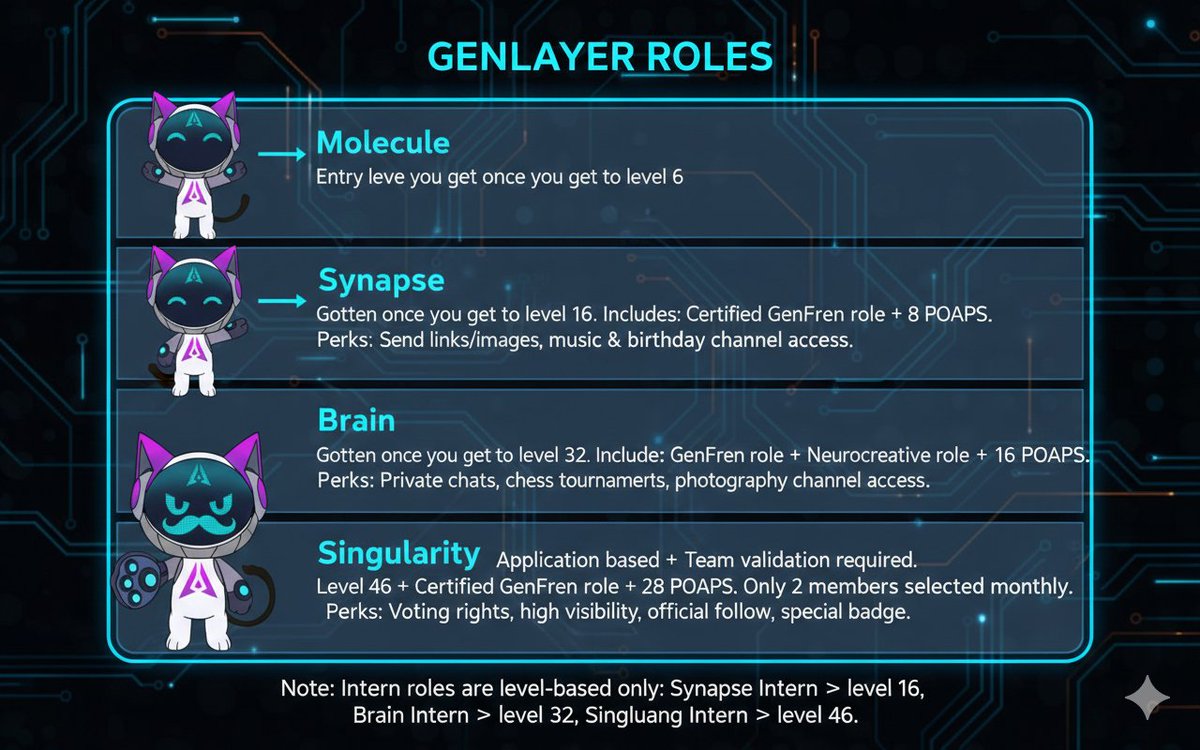
GENLAYER ROLES
→ Molecule is the entry level verification role
→ Neuron is the role you get once you get to level 6
→ Synapse is gotten once you get to level 16 included you have the Certified genfren role and 8 poaps.
You get certain perks for reaching this level such as sending links/images, access to the music and birthday channel
→ Brain is gotten once you get to level 32 included you have the certified genfren role, neurocreative role and 16 Poaps.
You get certain peaks such as private chats, participating in chess tournaments and access to the photography channel
→ Singularity is the highest role on the genlayer server. As the top role it's not just gotten by having certain requirements, it's an application based role and you need team's validation to get it.
But for the requirements, you need to get to level 46 included you have the certified genfren role at least once, the neurocreative role and 28 poaps and note that, only 2 genfrens are selected monthly.
There are amazing perks associated to this highest role, you get voting rights, high visibility, official follow from genlayer team and a special badge
Note: I didn't include the intern roles which are roles gotten by just reaching certain levels which are,
Synapse Intern-> level 16
Brain Intern-> level 32
Singularity Intern-> level 46
How to Actually Earn XP Since chat no longer gives XP:
→ Participate in events (limited slots for winners)
→ Complete GenFren quizzes
→ Finish special quests
→ Produce quality content/memes (Neurocreative)
That's all you need to know about the new role system. It rewards real contribution.
so, show up, add value and stay consistent.
GenM @RuzgarFlns
Introducing zksync Prividium, an enterprise grade blockchain platform for secure, compliant onchain finance
Here's what Prividium actually solves
Banks and institutions have faced an impossible choice for years, build private blockchains that are secure but isolated, or use public chains that are connected but expose everything
Prividium eliminates this compromise.
It's a private blockchain platform where institutions run their own permissioned chains inside their own infrastructure.
All transactions, balances and counterparties stay private never leaving your environment.
every operation is anchored to Ethereum through zero-knowledge proofs
This means your private chain inherits Ethereum's security and finality. ZK proofs verify that everything is correct without revealing what actually happened
Public verifiability without public exposure and because all Prividium chains settle on Ethereum, they can connect natively to each other and to public DeFi with no bridges, intermediaries or fragmented liquidity
For enterprises, this unlocks what was impossible before,
→ Cross-border settlements that finish in minutes, not days
→ Tokenized securities with automated compliance
→ Private trading venues where every participant is KYC'd but trades stay confidential
→ Treasury operations that remain competitive intel, not public data
This is built by @zksync using the same ZK Stack that powers their public network, but designed specifically for institutional infrastructure.
-> Privacy where it matters.
-> Connectivity where it counts.
-> Ethereum grade security throughout.
This is already live with Deutsche Bank and Memento for onchain fund management
This is how traditional finance comes onchain without compromising what institutions actually need, privacy, compliance, control and connectivity
Learn more [https://t.co/NS6gwu66pZ]
. @GenLayer lets AI agents see blockchain data live & act instantly.
Intelligent Contracts pull real-time web data, understand language, make subjective calls with LLMs
True autonomy makes agents negotiate, verify outcomes, resolve disputes no humans needed
What would you build @grok?







![guynextdooooor's tweet photo. Introducing zksync Prividium, an enterprise grade blockchain platform for secure, compliant onchain finance
Here's what Prividium actually solves
Banks and institutions have faced an impossible choice for years, build private blockchains that are secure but isolated, or use public chains that are connected but expose everything
Prividium eliminates this compromise.
It's a private blockchain platform where institutions run their own permissioned chains inside their own infrastructure.
All transactions, balances and counterparties stay private never leaving your environment.
every operation is anchored to Ethereum through zero-knowledge proofs
This means your private chain inherits Ethereum's security and finality. ZK proofs verify that everything is correct without revealing what actually happened
Public verifiability without public exposure and because all Prividium chains settle on Ethereum, they can connect natively to each other and to public DeFi with no bridges, intermediaries or fragmented liquidity
For enterprises, this unlocks what was impossible before,
→ Cross-border settlements that finish in minutes, not days
→ Tokenized securities with automated compliance
→ Private trading venues where every participant is KYC'd but trades stay confidential
→ Treasury operations that remain competitive intel, not public data
This is built by @zksync using the same ZK Stack that powers their public network, but designed specifically for institutional infrastructure.
-> Privacy where it matters.
-> Connectivity where it counts.
-> Ethereum grade security throughout.
This is already live with Deutsche Bank and Memento for onchain fund management
This is how traditional finance comes onchain without compromising what institutions actually need, privacy, compliance, control and connectivity
Learn more [https://t.co/NS6gwu66pZ]](https://pbs.twimg.com/media/HAcCarFXoAAT8jb.jpg)


