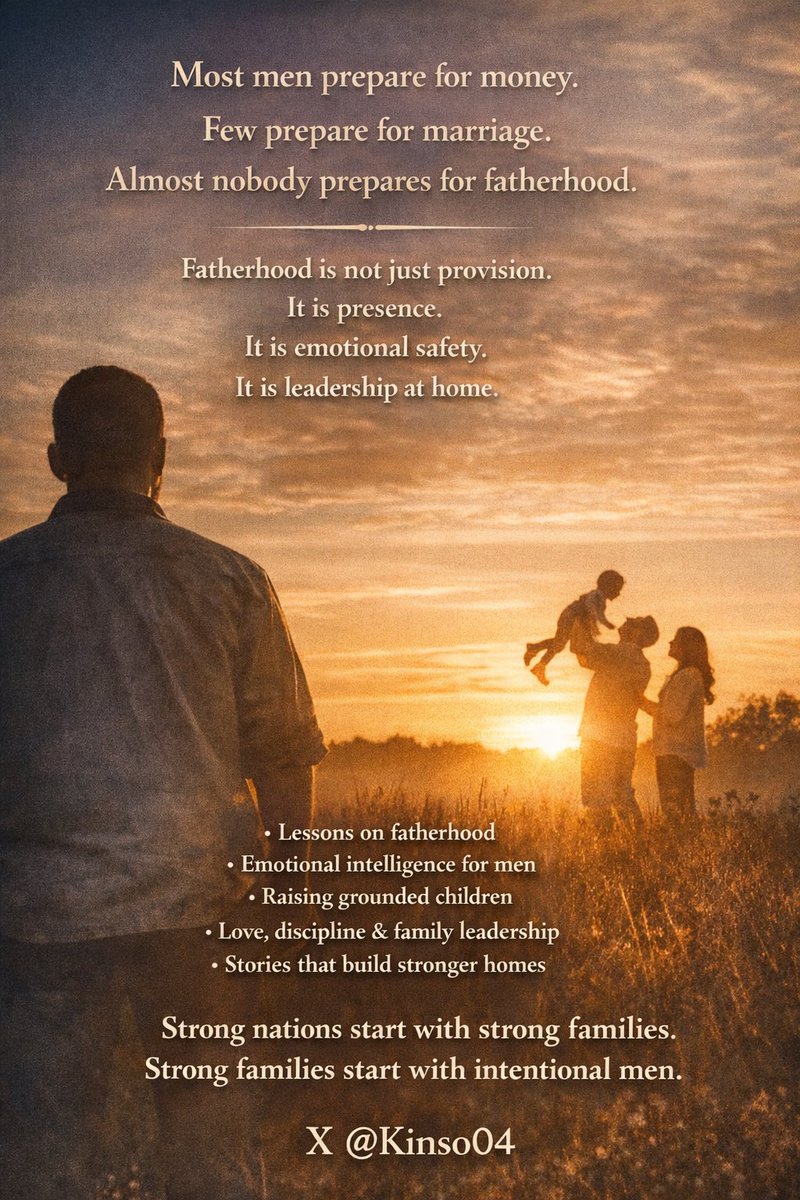
Most men prepare for money.
Few prepare for marriage.
Almost nobody prepares for FATHERHOOD.
This page is about preparing.
and acting right as a father.
A thread 🧵
I’m an Army veteran.
I believe in discipline, structure, responsibility.
But I’ve learned something important:
Authority can control a child.
Only connection can shape one.
Many of us grew up with:
• “Because I said so.”
• Correction without conversation.
• Fear mistaken for respect.
And now we are adults still healing from it.
Fatherhood is not just provision.
It is presence.
It is emotional safety.
It is leadership at home.
I don’t have children yet.
But I am intentionally becoming the man my future family deserves.
Here, I share:
• Lessons on fatherhood
• Emotional intelligence for men
• Raising grounded children
• Love, discipline & family leadership
• Stories that build stronger homes
Strong nations start with strong families.
Strong families start with intentional men.
If you believe homes matter, why not retweet and give a follow?
Let’s build better fathers before we build bigger houses.
Free to enter. Ranked on skill. Real money every gameweek.
Live on desktop only for now. Coming soon to our mobile app, stay tuned.
Read more here: https://t.co/EiuxvN4eKI
Sign up and import your FPL team now! https://t.co/XrTHtucR8d
https://t.co/H59PBO2j1W
All I know and I believe is needed to pass the assessment and get into a project is here.
Read through, if you don’t agree with it thats 👍🏾
Booking Tony Robbins today costs $1 million for a single day. this is a 21-minute tape from inside his own house, filmed over 30 years ago, where he breaks down exactly how to get anyone to say yes. same $1 million material. completely free.
this is a rare, unfiltered tape from decades before this man started charging billionaires just to be in the room with him.
people give you two excuses when they say no, he says. not enough time. not enough money. neither is true. the real reason is they don't believe it's worth it yet, and that's not a money problem, that's a state problem.
so he teaches something he calls attack and confess. instead of arguing with the objection, you confess your own. "I had a chance to go to this thing six months ago and I didn't go until two months ago," he tells the room. "I can't even imagine the time I lost." the room goes quiet. nobody argues back.
he calls it getting someone on the yes train. every small yes you get compounds into the next one, until saying no to the final ask feels harder than saying yes. by the time he asks someone to sign, he says, they've already agreed to it five times over without realizing it.
21 minutes. that's all it takes to walk away knowing the exact two moves people pay $1 million a day to learn: how to read anyone's state, and how to move it. most people spend years in sales guessing at this. he wrote it down on a flip chart in his living room in under half an hour.
a seat in that room cost $125 back then. today it's a $1 million-a-day to sit in front of him.
The tape is free right now, and the answer is in this video.
this is insane. i genuinely don't understand why ambitious people aren't shown this lecture before their careers start consuming their entire lives.
clayton christensen spent his career studying why successful companies collapse. in his final class, he asked students to apply the theory to themselves: if you keep allocating your time the same way, what life are you actually building?
he had already seen the answer in his own harvard mba class. everyone looked successful at the fifth reunion; by the 10th, 15th, 20th, and 25th, many were unhappy, divorced, and living far from their children.
work shows you the score immediately. close a sale, ship a product, finish a presentation, earn a promotion, get paid.
an hour with your child may produce nothing you can measure today; it may take 20 years to understand what that hour built. so the next free hour goes back to work, one rational decision at a time.
this is how people build lives they never planned: through hundreds of right decisions that lead in the wrong direction, day after day.
money, titles, and headcount are easy to count. christensen believed a life should be measured by the people who became better because you were there.
he died in 2020.
one question remains: if someone saw only where your time, energy, and attention went this year, what would they think actually mattered to you?
the full 19-minute lecture is in the video below.
Coca-Cola went public in 1919 at $40 a share. One year later it was $19 – down half – and the family that had owned the whole business bought it in the 1880s for $2,000
this is Warren Buffett at 68, in a room of Florida MBA students, walking through the single stock he is most identified with and explaining why the worst year was irrelevant
the point he is making is not that Coke was cheap – it is that the price collapsed 50% while the business itself was fine
he goes on to what he actually watches instead of the price – volumes, pricing power, and where the growth is coming from ten years out
no slides – no notes – no prepared remarks, and no lawyer in the room
this lecture exists because a 1970 graduate endowed a fund so the university could invite one speaker a year
bookmark & watch today ↓