Join us on June 9th for our monthly webinar! This free event will focus on eating disorders!
.
Register & learn more: https://t.co/ozOp9LVgsY
.
@UCLA#anorexia#bulimia
Yes! ASAP7y works well with both conformal immersion microscopy (CIM):
https://t.co/inwrH1oCCd
and other widefield methods including tandem lens macroscopy:
https://t.co/hrIcONFQ8p
helping to unveil fast dynamics (see video).
Congrats to the ASAP team:
https://t.co/zv1tG0CNUM
New paper online! How does plasticity at specific synapses drive specific forms of learning? Learning extradimensional rule shifts depends on strengthening long-range GABAergic projections from parvalbumin neurons to PFC-MD neurons in the contralateral PFC https://t.co/3UeyWh2TVT
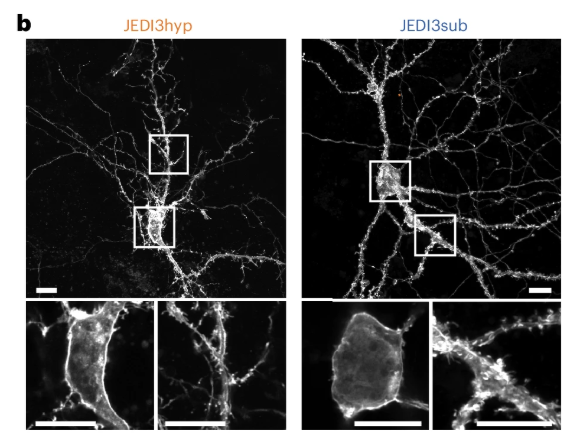
Fascinating video showing glutamate lighting up as it’s released in synapses, visualizing the neurotransmitters of the brain, made possible with the fluorescent indicator protein iGluSnFR3.
📽: Allen Institute for Neural Dynamics
Just out in @NatureNeuro! Eyelash-sized Neuropixels probes show how brief electrical bursts between seizures ("interictal spikes") arise from consistent neurons in human cortex layers, hijack neurons used for cognition, & can be predicted up to 1-sec ahead
https://t.co/9vYLC56ic8
New research published in Nature Neuroscience reveals that timing, rather than repetition, drives associative learning in the brain. This discovery shows that the nervous system prioritizes the specific delay between actions and rewards over how many times an event occurs.
https://t.co/icHffe2N3v
🏆Dr. Bryan J. Traynor (Senior Investigator, National Institute on Aging) is being honored for his discovery of the most common genetic cause of ALS and frontotemporal dementia which charted the path for new mechanistic studies of these diseases.
Watch: https://t.co/fO5BoH6kpB (2/3)
Postdoctoral openings to investigate how (i) experience-dependent actuators of inhibitory circuit plasticity mechanisms & neurogenesis contribute to memory operations (ii) how a novel lipid signaling mechanism mediates cognitive resilience and regulates healthspan. 1/2
What has changed in mama bear brain (well, actually mice) to make her risk her life to attack a potential threat and protect her young? Oxytocin is the key! Happy to share our new study led by two awesome postdocs: Takashi Yamaguchi and Rongzhen Yan.
https://t.co/wInz2rVo8M