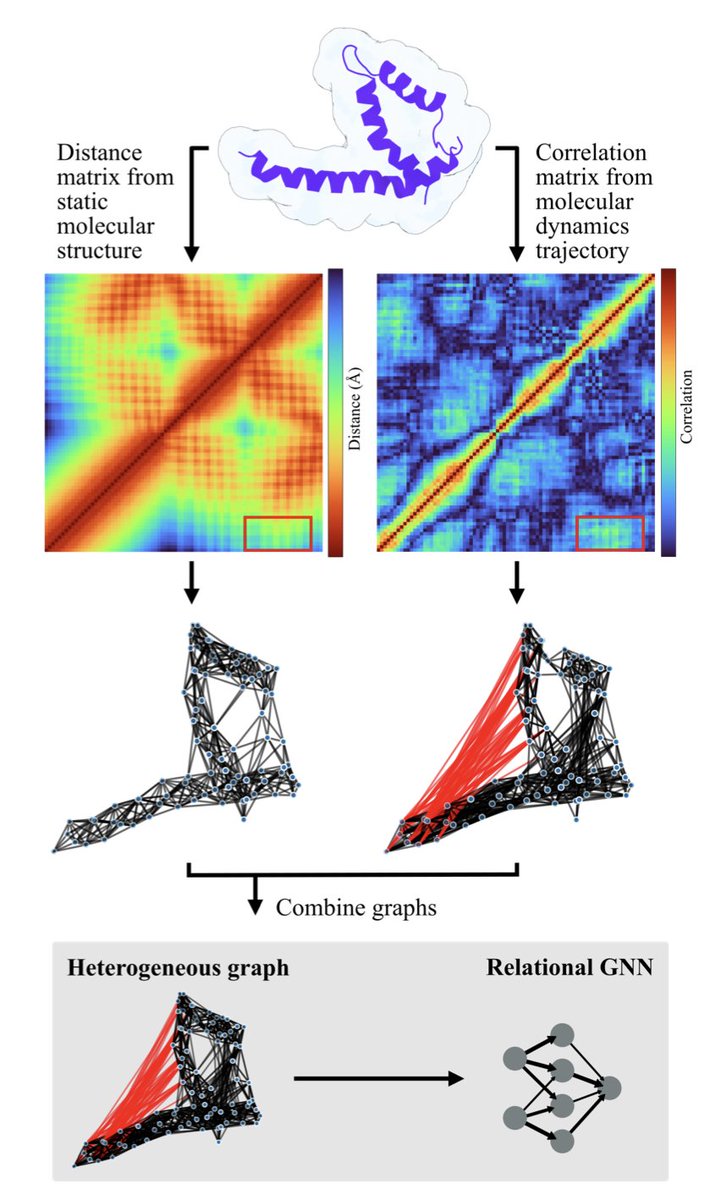
Here’s my prediction: in 5 years, any
paper that uses only static protein structures will become outdated and overlooked. The MD trajectory data is sitting right there in databases like MISATO, and most researchers have been ignoring it.
The fact is that combining static + dynamic info gives crazy massive improvements (up to 0.73 Pearson correlation vs previous methods).
But here’s where I’ll go controversial: I think this approach is going to largely affect the current pharma playbook. The billion-dollar drug discovery pipelines built on static modeling are at big risks. Companies that don’t pivot to dynamic modeling approaches are going to get absolutely crushed by startups that do.
The advantage here is so massive that early adopters could literally monopolize entire therapeutic areas while their competitors are still fumbling with static structures like it’s 2005.
However it is still decently expensive to use MD modeling - which is why there won’t be a massive shift. I guess since these big pharma companies are able to afford the expensive computations, we might just see them thrive more.
#ProteinFolding #DrugDiscovery #MachineLearning
Boosting Protein Graph Representations through Static-Dynamic Fusion
1.This work introduces a new graph representation that combines static structural data with dynamic correlations derived from molecular dynamics (MD) trajectories, enabling richer modeling of protein behavior.
2.Unlike most protein GNNs that rely only on static structures, the authors incorporate motion correlations between residues or atoms, allowing the network to capture functionally relevant long-range interactions.
3.Their fusion approach constructs heterogeneous graphs by connecting nodes through both spatial proximity (distance edges) and dynamic correlation (correlation edges), effectively rewiring the protein graph.
4.Relational Graph Neural Networks (RGCN and RGAT) are employed to handle these heterogeneous edges, assigning different weights to structural vs. dynamic relations.
5.On three tasks—atomic adaptability prediction, binding site detection, and binding affinity prediction—the combined graph consistently outperforms both structure-only and dynamics-only approaches.
6.For atomic adaptability (a measure of atomic flexibility), dynamic correlation edges alone already show strong performance, but fusing with static structure yields even higher Pearson R (up to 0.73 with RGCN).
7.In binding site detection, integrating dynamics helps detect motion-coupled but spatially distant residues, improving F1 scores across all tested architectures.
8.For binding affinity prediction, combining dynamics and structure allows models to better represent both conformational plasticity and geometric constraints, leading to higher correlation and lower error.
9.The paper demonstrates that the benefits hold across multiple GNN backbones: RGCN, RGAT, R-EGNN, R-GPS, and R-SS-GNN, emphasizing the method’s generality.
10.A key insight is the importance of aligning MD trajectories to remove rigid-body motion—this significantly enhances correlation graph quality and model performance.
11.This fusion framework enables better utilization of growing MD datasets like MISATO, unlocking their value for downstream learning tasks in structural biology and drug discovery.
12.The approach opens new directions for modeling protein dynamics, including potential integration with generative models to simulate or augment MD data.
📜Paper: https://t.co/zEHtNLeMKE
#ProteinDesign #GraphNeuralNetworks #MolecularDynamics #ComputationalBiology #DrugDiscovery #MachineLearning
OpenAI dropped o3-pro on June 10th with impressive benchmarks and a new “4/4 reliability” metric. Here’s what i think:
The 4/4 reliability scores are a little bullish: o3-pro hits 90% on competition math but drops to 80% consistency. These models are unreliable even on problems they supposedly “solve.”
“Responses take longer than o1-pro” and “waiting minutes is worth the tradeoff” = brute-forcing reliability with compute time, not the intelligence they claim.
94% on PhD science turns into 76% when you need consistency. That’s just expensive Monte Carlo sampling with a reasoning label.
OpenAI is solving reliability with latency and cost. Every “pro” model is just burning more tokens for the same inconsistent results.
The future shouldn’t be longer thinking, but first-try accuracy. This approach is a dead end in my opinion.
Nvidia IsaacSim open sourced from today
And it is a game-changer.
It allows the build of custom RL environments, connect to distributed training pipelines, and even plug in physics engine solvers for sim2real transfer.
Take a look:
https://t.co/ESEzggYofq
Anthropic on Lovable is insane.
I was messing around with the new Anthropic model on Lovable’s “AI Showdown” event - and it performs exponentially better than the Google and OpenAI models.
Go take a look.
Announcing The AI Showdown
OpenAI, Anthropic, and Google are partnering with Lovable to host The AI Showdown this weekend: a public comparison of the world’s leading AI models.
During the weekend everyone will have unlimited free access to Lovable (with occasional rate limiting during high demand). For the first time, users will be able to switch between these AI models and see how each performs at vibe coding inside Lovable compared to each other.
The goal of The AI Showdown is to see beyond traditional benchmarks and instead surface public perception. By opening up access and encouraging public analysis, we aim to bring transparency to one of the most important questions in software today: Which AI is best at writing code?
To support this, we’re launching two open competitions:
- Content challenge ($25,000 prize): Create the best model benchmarking content focused on comparing the capabilities of the models across practical use cases.
- Build challenge ($40,000 prize): A build challenge to showcase what each model can create inside Lovable.
Winners will be selected by Lovable, OpenAI, Anthropic, Google, and our board of judges. You can participate and follow the live model comparison dashboard at: https://t.co/Mu6mDkCPVI
It officially starts this Saturday at 8AM CET.
🧬 From zero to enzyme in 35 designs 👀
Riff‑Diff uses diffusion to scaffold catalytic motifs, spinning out retro‑aldol & MBH biocatalysts that match lab‑evolved rates (no huge screens)
It's an RFdiffusion‑powered workflow that “locks” hand‑picked catalytic arrays into de novo backbones for functional protein design
Boltz-2 just dropped: open-source AI that predicts both protein complex folds ✚ binding affinities in one shot 🚀
This is a win for protein AI, but let's not forget MSAs, the bioinformatics backbone many structure models lean on.
We still don't actually understand how most proteins actually work in their native context. Maybe we should master the basics before cataloging every transcript in existence.
Genomics revolution? More like stamp collecting.
Hot take: Single-cell RNA sequencing is the most overhyped technique in modern biology.
We're drowning in scRNA-seq data while basic cell biology questions remain unanswered. Measuring transcript levels ≠ understanding cellular function.
Test-time compute is the new scaling law! Models are getting smarter by thinking longer at inference.
BUT it's massively expensive, and most tasks don't need PhD-level reasoning.
We're trading training costs for inference costs and most companies aren't ready for that flip.
RL is the new AI scaling paradigm!
Reasoning models are getting better AND cheaper through RL.
BUT it's inference-heavy (hundreds of rollouts vs single responses) and engineering environments is the real bottleneck.
This could be the last shift before AGI.
Everyone's obsessing over MACE and NequIP with their fancy E(3) symmetries, but AIMNet2 just delivered what computational chemists actually need - a model that works on real molecules at realistic scales without a supercomputer.
AIMNet2 - https://t.co/fUfuTlbwjN
The MLIP that actually matters while everyone chases equivariant hype.
- DFT accuracy @ force field speeds
- Handles charged species
- Scales to 100k+ atoms.
Should be the standard, but it'll get ignored for being practical over flashy.
#ML
The Neural Charge Equilibration is genuinely clever - they solved charged species without the QEq nightmare that makes other approaches unusable. Meanwhile the "cutting-edge" equivariant models still can't handle a simple ionic system efficiently.
The Foundation Models framework changes everything for iOS developers
Apple just gave us direct access to the LLM powering Apple Intelligence.
This is Apple's answer to OpenAI's API dominance.
Local-first AI is the future.
https://t.co/OjkVPrxpbq
Darwin Gödel Machine - AI that continuously improves itself by modifying its own codebase.
SWE-bench: 20% → 50% performance
Polyglot coding: 14.2% → 30.7%
Outperforms hand-designed agents
Take a look:
Paper: https://t.co/TCMyT8SgVI
Code: https://t.co/8PR5XtULiU
Claude is now being listed as an author on arXiv papers
A response paper to Apple's "Illusion of Thinking" work just dropped with Claude Opus as first author, critiquing their experimental design and arguing the reasoning collapse was actually just token limit constraints.
3/ The generative AI wave is actually two waves.
The first wave was imitation learning; the second is reinforcement learning.
@ScottWu46: "The really cool thing about reinforcement learning is you basically can solve any benchmark, which is insane to think about." 🤯