Thank you very much @IntAdsSoc, i am honoured. Thank you to all the organizers of this poster conference.
And a special thanks to all my colleagues from LPACO2 who helped me with this work!
Congratulations to @KlausRichard5 on your excellent poster! @wilkins_ns will contact you on your registered e-mail address about your prize and certificate.
@DavidDanaci The experiments start at high vaccum with fully regenerated sorbent. Normally the very first peak is the one with the highest amount of heat transfer because we usually start with around 5000Pa for the first equilibrium pressure. Our equiment can't measure very low pressures atm.
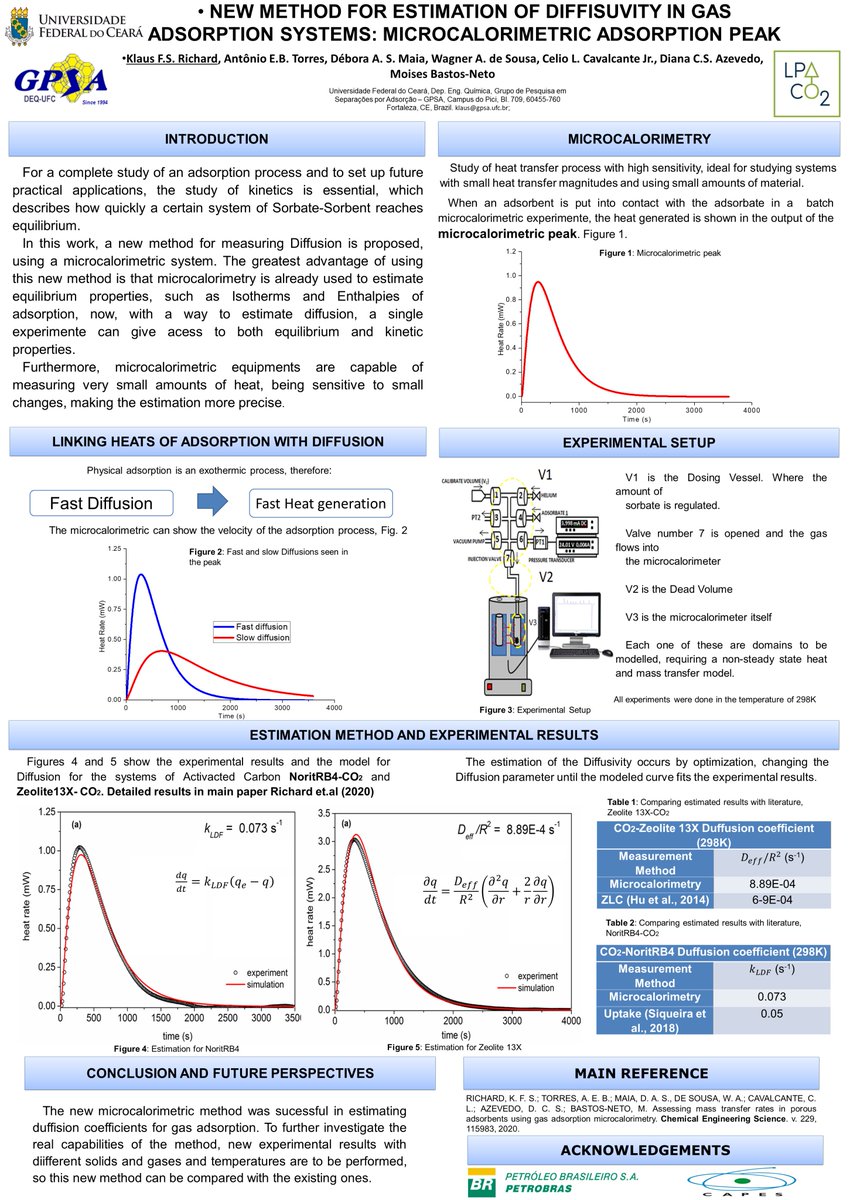
Very pleased to submit our work named "Assessing mass transfer rates in porous adsorbents using gas adsorption microcalorimetry" showing a new method for estimating the Diffusivity in gas adsorption! #IASTwitterPoster#Adsorption#Diffusion#Brazil#Microcalorimetry
@IsabelMoritz Right of the back the next tests would be with hydrocarbons, such as octane, as they have an extensive literature about the diffusivity in many sorbents, and they also diffuse slowly, which makes measurements easier. Its possible to install mixtures but so far we focus on pure
@LapshinDmitry But if there are large heat transfer resistances, or additional resistances to the mass transfer(Like a valve), than the sensitivity drops considerably. So, actually, the sensitivity of the method will vary whenever these external conditions change.
@LapshinDmitry The sensitivity of the method will depend on the system tested overall. Since the heat generation comes from adsorption, there are both heat and mass transfer resistances. If the convective or conductive resistances are low. Than the method can measure up to Deff/R² = 0.1 s^-1
@SandraPioquinto We currently have unpublished results for other gases, and it fits, but in principle, the method is supposed to work with any gas, provided that it diffuses slow enough. CO2 tends to diffuse quickly, so, in fact, good results for CO2 suggests that it could work with many others.
@wilkins_ns Hello Nicholas. We have tested it in a slow sytem with n-butane, and it worked aswell. Actually both the model and the experiment benefit from slower diffusion, as the mass transfer resistance becomes the dominant process, making the estimation more precise.