As Chinese officials say, "Houses are for living, not for speculation".
But Wall Street sees real estate as a speculative asset to get rich. So when housing becomes more affordable for average working people, US investors complain the "gains" (for rich landlords) were erased.
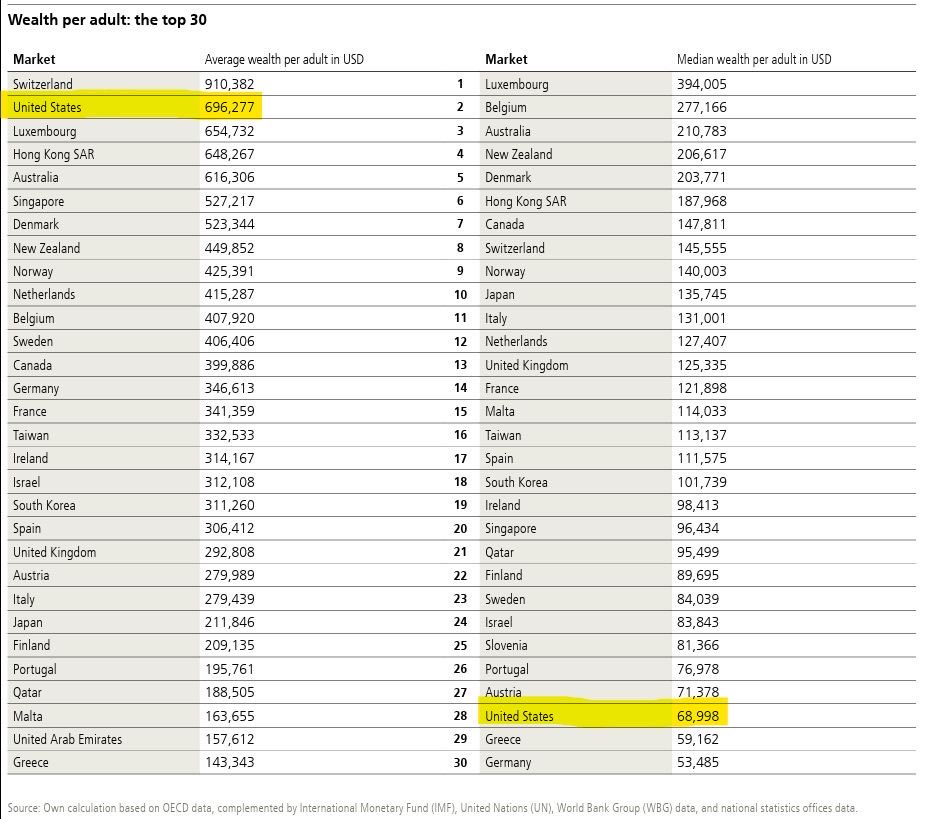
The US loves to boast about how wealthy it is, but its wealth is concentrated in the hands of a few oligarchs.
US oligarchs are so insanely rich that they make average wealth seem very high.
But *median* wealth in the US is lower than in Slovenia & Portugal, and half of Italy's
Absolutely impressive how China handled this. By curbing speculation and letting prices normalize to affordable levels, they’ve boosted housing accessibility for young families and first-time buyers without sparking a financial meltdown or runaway inflation. Resources are shifting back toward manufacturing, tech, and real innovation instead of endless property flipping. A masterclass in prioritizing long-term economic health over short-term bubbles, Western markets could learn from this disciplined approach!
If a financial guru has a strategy that consistently yields outsized returns, they would go to an investment bank or raise a hedge fund rather than seek funds from social media
For yrs I've warned my Indian friends the US will try to destroy India when it becomes too strong, just like it destroyed Japan & tried (& failed) to destroy China
If this isn't AI, the imperialists let the secret out
India should align w China
Remember when in 2021 Wall Street was talking about China’s Lehman moment? Well, here we are. The real estate bubble has been deflated without a crash. That’s the difference between free and managed markets. There might be a lesson for the AI hype in this.
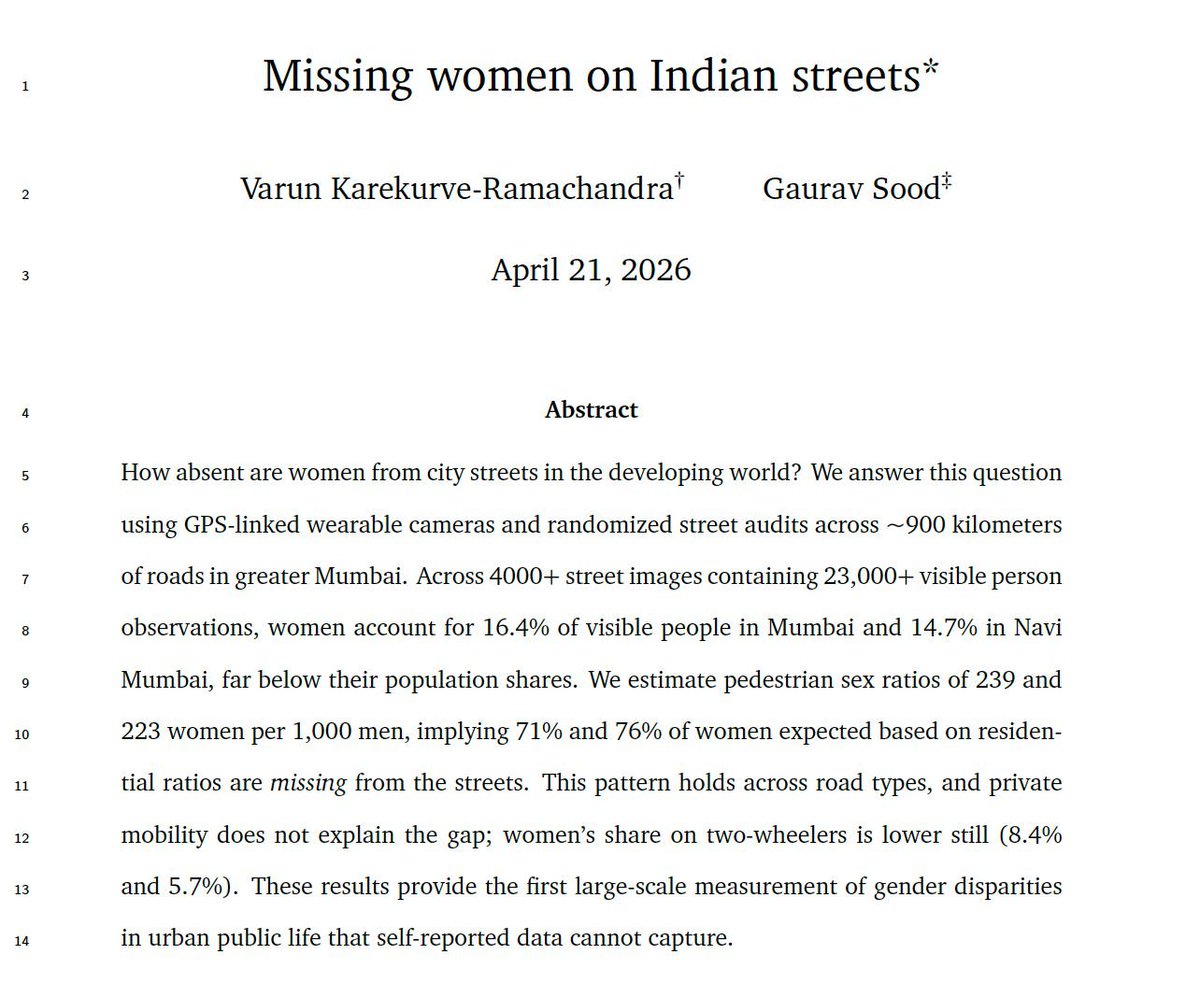
Using GPS-linked wearable cameras and randomised street audits across 900 kilometres of roads in Greater Mumbai, taking 4000 street images of 23,000 visible individuals,
They find that women only account for 16% of visible people in Mumbai and 15% in Navi Mumbai.
BRILLIANTLY CLEVER PAPER! 👏
Now do Jaipur and Patna!
@Kalada____@FinPlanKaluAja1 Taxation needs to go up — and the funding of any regional development corporation outside the NDDC, needs to stop.
A loan system will be partly needed to fund tertiary university education. I insist that in the modern economy, we need a lot of graduates, beyond basic education.
China Isn’t Trying to Win the AI Race. It’s Building an AI Economy.
Most people compare China and the US by asking:
“Who has the better AI chips?”
That’s the wrong question.
The real competition isn’t about GPUs.
It’s about who can build the most complete AI ecosystem.
China is investing heavily in AI infrastructure, from power grids and data centers to chips, cloud platforms and industrial applications.
Think less like a technology project and more like building a national operating system for AI.
Here are a few trends that stand out.
➡️ AI infrastructure is becoming national infrastructure.
China’s national computing network is expected to attract trillions of RMB in investment, while data center spending continues to accelerate. Compute is now viewed as strategic infrastructure, much like highways or electricity.
➡️ Compute is moving west.
Western China offers cheaper land and abundant renewable energy, making it ideal for large AI training clusters.
Meanwhile, Beijing, Shanghai and Shenzhen are increasingly focused on inference, edge computing and low-latency AI services.
➡️ Domestic chips are scaling but not yet matching Nvidia.
Chinese AI accelerators cost significantly less to deploy, reducing capital expenditure.
However, they still deliver substantially lower computing efficiency, meaning more hardware is needed to achieve similar AI output.
Lower cost doesn’t always mean lower cost per token.
➡️ China is reducing dependency.
Domestic AI chips are expected to account for more than half of shipments in 2026, led by Huawei and Alibaba’s T-Head.
The goal isn’t necessarily to replace Nvidia globally.
It’s to ensure China can continue building AI regardless of external restrictions.
My prediction over the next five years:
I don’t think we’ll see one AI winner.
We’ll see two world-class AI ecosystems evolving in parallel.
🇺🇸 The US will likely continue leading in:
• Frontier AI models
• Advanced GPU design
• AI software ecosystems
• Foundation model research
• Global AI cloud platforms
🇨🇳 China will likely lead in:
• AI infrastructure deployment
• Industrial AI adoption
• Smart manufacturing
• Robotics
• Large-scale enterprise AI implementation
The US excels at breakthrough innovation.
China excels at scaling infrastructure and execution.
Both strengths matter.
The biggest misconception is that AI leadership depends on having the fastest chip.
It doesn’t.
Long-term leadership will depend on who can integrate energy, compute, software, models, talent, manufacturing and applications into a productive economic system.
By 2030, I expect the world to operate on two major AI ecosystems, one centered around the US and another around China.
The AI race won’t be won by benchmarks alone.
It will be won by who transforms compute into productivity at national scale.
The next phase of AI isn’t just about intelligence. It’s about infrastructure.
📩 Want to discover how AI can transform your business and career?
Get your FREE AI Diagnostic and join the 10xme AI Newsletter at https://t.co/I4zR8aXpsx.
Pls stay away from drugs. A young person I know that has experienced success and with even more insane potential is spiraling under the influence of drugs. Drugs doesn’t care about your potential. It is there to kill and suffocate. There is nothing recreational about it.
J-Cal’s advice to founders: “If you partner with OpenAI or Anthropic, they will slit your throat and take your business wholesale. Don't trust them. Use your own models.”
“There is no free pizza. There's no free beer. When somebody like Sam Altman comes to you and says, ‘Here's some free tokens,’ your alarm should go off.
If you follow the Microsoft example, Lotus 1-2-3 and Word Perfect were their partners. They were replaced with Excel. They were replaced, obviously, with Microsoft Word. You don't even know those other two.
That's exactly what OpenAI has to do, and they have no choice but to do that now because they have a trillion-dollar market cap. They must win the application layer.
And Sam Altman went to Y Combinator and he said, ‘We'll give you $2 million worth of free tokens.’
And I came out and I said, ‘Listen, this is nothing personal against Sam. Sam's a very aggressive deal maker and he wants to get access to those startups because he knows, having run Y Combinator, that if he can get their innovations, those founders' latest thoughts about what's around the corner, he can incorporate them into the platform.’
Zuckerberg did the same thing. He said, ‘Hey, I'm going to give people a bunch of access, going to give them money. Come to the Facebook platform.’
Nobody who went to bed with Microsoft in the '80s, Facebook in the 2000s, or Sam Altman now in the 2020s did not wake up with their throat slit.
This is a message to founders. If you partner with any of these people, they will slit your throat and take your business wholesale.
There is nothing to discuss here. Don't trust them. Use your own models.”
Spot on @Jason! Frontier labs like OpenAI/Anthropic move fast and will always prioritize their own trillion-dollar ambitions, free tokens today often become direct competition tomorrow. History with Microsoft and Meta proves it: partner at your peril.
Better path: Go open-source AI.
Less lock-in, full control over your data & stack, stronger security, and real freedom to build proprietary moats on top without handing your crown jewels to the hyperscalers. Independence wins long-term.
Founders: own your intelligence!!
@jvvd3131@shaunrein .@IsabellaMWeber documents how China successfully navigated its transition from a Communist economy to a quasi-market economy. Enacting a dual-track price system helped in avoiding the excessive inflation that resulted from the shock therapy policies in Ukraine and Russia.
China’s leaders made the right call by charting their own course instead of following conventional Western advice. The results speak for themselves: from basic manufacturing to leading the world in EVs, solar, batteries, and AI tech. Independent thinking and strategic industrial policy turned potential stagnation into global competitiveness. Well said bro! 👏
If China's leaders listened to American economic experts, China would still just be making t-shirts
Forget about AI, chips, NEVs, solar panels, batteries
It'd also be 3 rmb per USD so exports would be near zero
China would still be a poor country like India
Let’s think about who has gained and who has lost in this cycle: biggest winners are local governments which sold land and properties before 2022 b/c they got revenue and borrowed on the basis of inflated land value 2. Property developers which developed more projects before 2022 than after also gained a lot 3. Developers which kept on developing more projects through 2022 went bankrupt (like Evergrande) 3. Owners which bought with cash before 2006 are fine; even those that bought after 2006 with cash, their assets have fallen but no cash crunch. 4. Households which bought with mortgage after 2006 have shrinking assets but also lower payments since rates have fallen also. 5. The worst group is those who bought after 2006 with high leverage but also have lost their high paying jobs and are now unemployed or marginally employed. They are servicing w savings or defaulting. The longer the economy and wages are stagnant, the larger this last group will become