🚨 WARNING: SOMETHING TERRIBLE JUST HAPPENED
China's stocks just crashed by over 40%.
The AI bubble is officially COLLAPSING.
To stabilize the market, China is dumping over $100 BILLION in U.S. Treasuries.
That's the largest sell-off since 2007.
Meanwhile, China's gold reserves have climbed to a record $325 BILLION.
Chinese stocks are dumping.
Exposure to U.S. debt is declining.
Gold reserves are expanding.
Yet the biggest issue is barely getting any public attention.
China is using GOLD to strengthen the yuan's position in the global financial system.
It's building alternative payment networks and financial infrastructure that operate outside the U.S. dollar system.
In July 2026, Hong Kong's government-backed gold clearing system entered trial operations.
And it's directly connected to the Shanghai Gold Exchange.
China is establishing an international network of gold vaults to expand the yuan's influence across global finance.
But that's just one piece of the puzzle.
China is also actively developing blockchain payment infrastructure.
The mission is clear:
BREAK THE WORLD'S DEPENDENCE ON THE U.S. DOLLAR.
And GOLD is at the center of this strategy.
China has now bought gold for OVER 23 CONSECUTIVE MONTHS.
At the same time, the global financial system is undergoing a major transformation:
→ China's stock market has entered a BEAR MARKET
→ China's gold reserves continue to grow
→ South Korea has resumed gold purchases after 13 YEARS
→ Countries are cutting their U.S. Treasury holdings
→ Gold allocations are increasing
→ Central banks are rethinking their reserve strategies
THIS IS FAR BIGGER THAN THE AI BUBBLE.
This is about a fundamental economic shift involving MULTIPLE countries.
And the consequences will be massive.
Gold has overtaken U.S. Treasuries as a leading global reserve asset.
Germany, the Netherlands, and France are moving their massive gold reserves OUT of the U.S.
Countries aren't just accumulating gold.
THEY ARE REDESIGNING THEIR FINANCIAL STRATEGIES.
They're relocating their reserves.
They're changing how international payments are settled.
Here's how the pieces connect:
Falling Chinese Stocks → Growing Gold Reserves → Fewer U.S. Treasuries → Reduced Dollar Dependence → Alternative Payment Networks → A NEW GLOBAL FINANCIAL ORDER.
As more nations adopt this strategy, pressure on the U.S. dollar will intensify.
This is how the global financial system changes.
Slowly.
Quietly.
Then all at once.
PAY ATTENTION.
Because by the time most people recognize what's happening, the collapse will already be underway.
I've spent over 12 years studying markets and calling major tops and bottoms.
If you want to be among the TOP 1% and survive the 2026-2027 cycle, follow and turn on notifications.
A lot of people will regret not paying attention sooner.
🚨ACABA DE PASAR ALGO EXTREMADAMENTE MALO
Japón ha vendido $71.000 MILLONES en bonos del Tesoro de EE.UU. para defender el yen.
China ha vendido otros $62.000 MILLONES después del desplome de su mercado bursátil.
Eso son $133.000 MILLONES en bonos vendidos.
Ambos países han pulsado el botón del pánico.
Pero esa ni siquiera es la parte más preocupante.
Lo que viene después podría ser MUCHO peor.
Japón lleva tiempo vendiendo bonos del Tesoro de EE.UU. para apoyar al yen y tratar de evitar una crisis mucho mayor.
China, mientras tanto, está internacionalizando el yuan mediante ORO, nuevas infraestructuras de pago y alternativas al dólar estadounidense.
Y exactamente al mismo tiempo, ambos países están aumentando sus reservas de oro.
Eso no parece una coincidencia.
Japón está vendiendo activos denominados en dólares mientras mantiene todo su oro.
China lleva MÁS DE 20 MESES CONSECUTIVOS comprando oro.
La razón es sencilla.
Japón necesita defender el yen.
Para hacerlo, está utilizando sus enormes reservas internacionales para intervenir en el mercado.
Y los bonos del Tesoro estadounidense son uno de los principales activos que puede vender.
China tiene otro objetivo:
Conseguir una mayor independencia del dólar estadounidense.
En julio de 2026, el sistema de compensación de oro respaldado por el Gobierno de Hong Kong comenzó sus operaciones de prueba.
El sistema está conectado directamente con la Bolsa de Oro de Shanghái.
China está desarrollando una red global de bóvedas de oro diseñada para reforzar el papel del yuan dentro del sistema financiero mundial.
Y esto es solo una parte de la estrategia.
China también está desarrollando infraestructura de pagos basada en blockchain junto a países BRICS.
El objetivo está claro:
REDUCIR LA DEPENDENCIA DEL DÓLAR ESTADOUNIDENSE.
Y el ORO está en el centro de todo.
Ahora estamos viendo a dos de las mayores economías del mundo moverse en la misma dirección:
→ Japón vende bonos del Tesoro de EE.UU.
→ Japón aumenta sus reservas de oro
→ China vende bonos del Tesoro de EE.UU.
→ China aumenta sus reservas de oro
→ Más países reducen su exposición a bonos estadounidenses
→ Aumenta la exposición al oro
→ Las estrategias de reservas globales están cambiando
Esto ya no son ventas aisladas de bonos del Tesoro.
Es un cambio mucho mayor en la forma en la que las principales economías gestionan sus reservas.
Los países no están simplemente comprando y vendiendo.
Están MOVIENDO sus reservas.
Están cambiando DÓNDE las almacenan.
Están cambiando CÓMO liquidan sus transacciones.
Y están construyendo alternativas al actual sistema financiero basado en el dólar.
La reacción en cadena es cada vez más difícil de ignorar:
Más ventas de bonos → más presión sobre el mercado de deuda → más intervenciones monetarias → más acumulación de oro → menos dependencia del dólar → más sistemas de pago alternativos → una nueva estructura financiera
China no está simplemente comprando oro.
ESTÁ CONSTRUYENDO TODO UN SISTEMA FINANCIERO A SU ALREDEDOR.
Japón no está intentando provocar un crash.
Está intentando sostener el yen y evitar una crisis financiera mucho mayor.
Pero las medidas que está tomando tendrán consecuencias en los mercados globales.
La presión sobre el dólar estadounidense y el mercado de bonos podría seguir aumentando.
Así es como empiezan a cambiar los grandes sistemas financieros.
No ocurre de la noche a la mañana.
Primero sucede poco a poco.
Y después, de repente.
El sistema global de reservas está cambiando delante de nuestros ojos.
Llevo más de 10 años siguiendo Bitcoin y los mercados.
Y os estoy avisando ahora.
Si quieres estar preparado para lo que pueda venir durante el ciclo 2026-2027, sígueme y activa las notificaciones.
Puede que dentro de unos meses muchos deseen haber empezado a prestar atención antes.
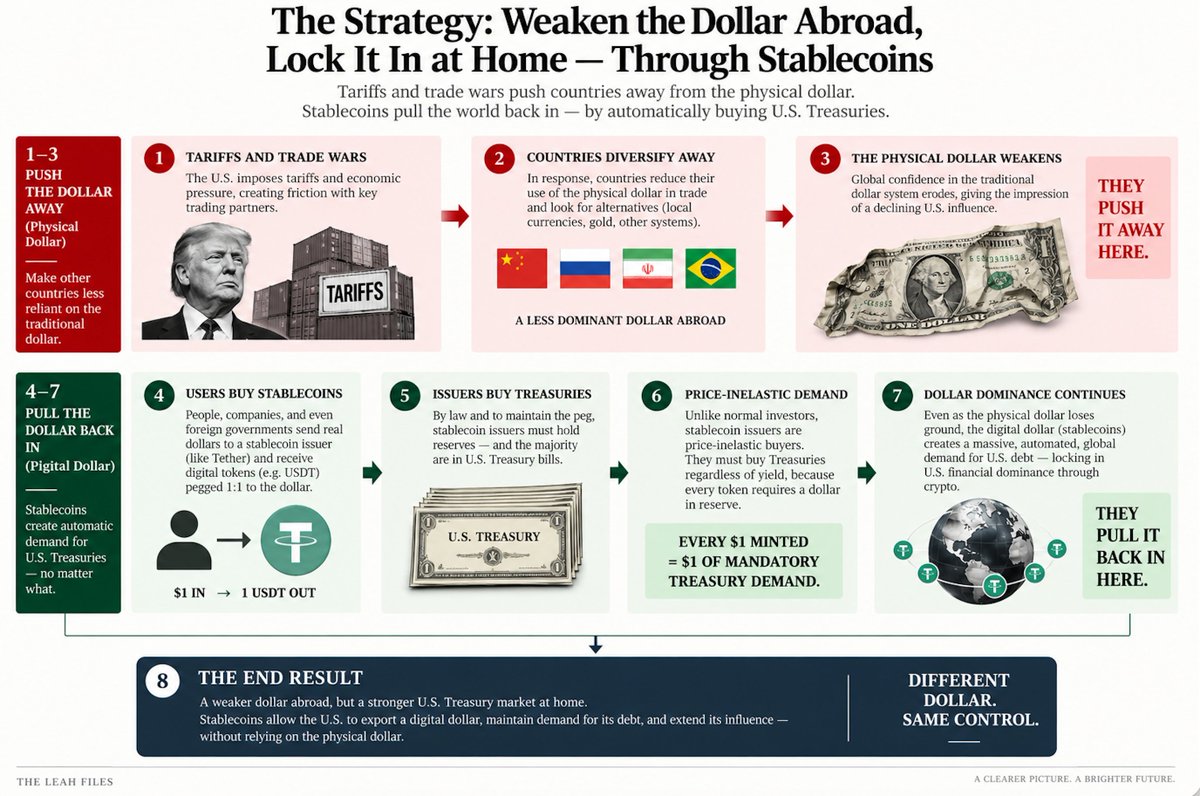
I figured out what they are doing with the dollar. They are swapping it. Push the old one out, pull a new one in, and the new one hurts Americans and pays the elite every time it moves.
Here is how it works:
Step 1: Weaken the physical dollar abroad through Tariffs, Trade wars. Create so much friction that countries stop using the dollar in trade. They move to local currencies, gold, other systems. The dollar index drops 12.6 percent in one year. Steepest decline in thirty years. BRICS accelerates away from dollar reserves.
That part looks like incompetence but if there is one thing Scott Bessent is not, it's incompetent.
Step 2: Ban the government from making a digital dollar. Trump issued an Executive order in January 2025. No federal agency is allowed to build one, so the public option...the competition to a private one, is dead.
Step 3: Pass the GENIUS Act. The law that creates a legal framework for private companies to issue digital dollars instead. And here is the key, the law requires every stablecoin issuer to hold reserves in short-term US Treasury bills. Lutnick and Bo Hines wrote the GENIUS Act to benefit Tether.
Fun fact: Howard Lutnick's Canto Fitzgerald owns 5% of Tether and Bo Hines left shortly after the GENIUS Act was signed to be CEO of 21st Century, Canto Fitzgerald's crypto arm that Tether now owns.
That means every digital dollar that gets minted automatically creates one dollar of mandatory demand for government debt. Unlike normal investors, stablecoin issuers are price-inelastic, they buy Treasuries regardless of yield because the law says they have to. Brookings projects $2.3 trillion in captive Treasury demand by 2030.
So you push the physical dollar out and countries stop buying Treasuries. Then you pull it back in through private digital dollars that are legally required to buy Treasuries instead.
Different dollar with the same control. Except now it is not a public system, it is a private one, and the private company at the center of it takes a cut on every dollar that moves. The private company is also incorporated in the BVI's so no regulator has jurisdiction.
That company is Tether. $183 billion in dollars running through it, $13 billion in profit last year. It has never passed an audit. Co-founded by Jeffrey Epstein's crypto advisor. Reserves custodied by the Lutnick's family firm. Protected by a law that was championed from inside the White House by a man who quit one month after it passed and became the company's CEO.
Scott Bessent said that stablecoin firms could buy up to $1 trillion in government debt. The European Central Bank warned this "effectively outsources parts of the national debt to the crypto sector."
So in turn, our dollar gets weaker, our groceries cost more, our 401k buys less, and every time that happens, demand for the private digital dollar goes up. They get richer and we absorb the cost.
That is the trade, and the people who set it up are the ones collecting on both sides.
Full investigation is on my Substack. Link in bio.
🚨 If Tether’s USDT Failed, It Would Have Collapsed The U.S. Treasuries Market
Tether Printed Fake Dollars. Washington Bought the Real Ones.
They couldn’t let Tether fail.
For more than a decade they printed digital dollars USDT out of thin air. No full public audit. Just “trust us.” Meanwhile the entire crypto market quietly chained itself to one private printer.
Every new USDT was a claim on a real dollar. That real dollar didn’t sit in a vault with your name on it. It got swept into U.S. Treasuries. Print the token. Park the cash in Washington’s debt. Repeat. Billions. Then tens of billions. Then over a hundred billion in government paper sitting behind a coin the street treats like cash.
By the time anyone demanded the books, it was already too late. Exchanges priced everything in it. Liquidity lived inside it. A depeg wouldn’t just smash crypto, it would force a fire sale of Treasuries to meet redemptions.
So the system did what systems always do when the machine gets that big:
It became too big to fail. Not that Tether “saved crypto.” That crypto, and then a slice of the dollar-debt market, became dependent on a printer that spent years operating in the dark.
Once the tokens were everywhere and the Treasuries were on the balance sheet, collapse stopped being an option. It became a national-interest problem.
They didn’t audit it because they couldn’t afford the answer. Then they couldn’t kill it because they couldn’t afford the wreckage.
Ask yourself who actually needed Tether to keep printing. Was it traders… or the people selling them the Treasuries?
And now they’re planning something bigger… Using stablecoin economy to “grow out of $40 Trillion Debt.”
🚨 THE NEXT MONETARY WAR BETWEEN THE U.S. AND CHINA HAS ALREADY STARTED
THE U.S. IS BETTING ON DIGITAL DOLLARS (STABLECOINS) - CHINA IS BETTING ON PHYSICAL GOLD.
Trump and the Treasury have now said the quiet part out loud.
Treasury Secretary Scott Bessent: "We will keep the dollar as the world's reserve currency and will use stablecoins to do it."
Trump's January 2025 order put dollar-backed stablecoins at the center of U.S. policy. The GENIUS Act then formalized the structure: compliant stablecoins must be backed 1-for-1 by cash, T-bills, and Treasury repos.
THAT'S THE KEY. AMERICA CAN'T PRINT GOLD. BUT IT CAN CREATE NEW DEMAND FOR ITS OWN DEBT.
Here's how it works:
Billions of people who may never open a U.S. bank account can still hold a digital dollar token. As stablecoin supply grows, issuers need more reserve assets - including short-term Treasuries. Dollar demand gets pushed onto crypto rails, helping extend the reach of the dollar beyond the traditional banking system.
IT'S NOT A GOLD STANDARD. IT'S CLOSER TO A DIGITAL T-BILL STANDARD WRAPPED IN CRYPTO.
Meanwhile, China is moving in the opposite direction.
The PBOC just posted its 21st straight month of gold buying. Official holdings: ~2,366 tonnes. They're accumulating physical metal at a remarkable pace.
Hong Kong has already opened the first offshore Shanghai Gold Exchange vault. The city is targeting 2,000+ tonnes of storage, while additional vault locations are being explored in Singapore, Dubai, Riyadh, and Moscow.
The idea is simple: hold yuan, then convert it into gold that can actually be delivered. Physical collateral. Offshore vaults. Yuan-linked settlement backed by metal rather than promises.
TWO DIFFERENT STRATEGIES. ONE BIG PROBLEM.
At the same time, the London Metal Exchange's Treasury chief has moved to a crypto firm focused on tokenized commodities - while China continues building out a yuan-gold settlement network.
ONE SIDE IS DIGITIZING THE DEBT - THE OTHER IS ACCUMULATING THE METAL.
The real question is which system the rest of the world will trust more when the next major shock arrives!👀
🚨 THE NEXT MONETARY WAR BETWEEN U.S. and CHINA HAS ALREADY STARTED
The U.S. is betting on Digital Dollars (Stablecoins) while China is betting on physical gold.
Trump and the Treasury just admitted the quiet part out loud.
Treasury Secretary Scott Bessent: We will keep the dollar as the world’s reserve currency and will use stablecoins to do it.
Trump’s January 2025 order made dollar-backed coins official policy. The GENIUS Act locked the mechanism in: every compliant stablecoin must sit 1-for-1 on cash, T-bills, and Treasury repos.
That’s the escape hatch. America can’t print gold. It can print demand for its own debt.
How it works:
Billions of people who will never open a U.S. bank account can hold a dollar token. Every new token forces the issuer to buy short-term Treasuries.
Dollar demand gets exported on crypto rails.
The reserve currency survives even if SWIFT loses corridors because the world is still holding a claim on U.S. paper.
It’s not a gold standard. It’s a digital T-bill standard wearing a crypto costume.
Meanwhile China is doing the opposite:
The PBOC just posted its 21st straight month of gold buying. Official holdings: ~2,366 tonnes. They’re stacking metal like the clock is running out.
Hong Kong already opened the first offshore Shanghai Gold Exchange vault. The city wants 2,000+ tonnes of storage. More vaults are being scoped for Singapore, Dubai, Riyadh, Moscow. The pitch is simple: hold yuan, convert it to gold you can actually take delivery of.
That’s the old-school play. Physical collateral. Offshore vaults. Yuan contracts settled in metal, not promises.
Two strategies. Same problem.
The London Metal Exchange (LME) Treasury Chief Just Quit London For The Crypto Firm “Ripple” For Tokenized Commodities on XRP Ledger As China Builds a Yuan-Gold Vault Settlement System.
That product is already live. Assetiko gold XAUa and silver XAGa on the XRP Ledger. Swap metal to native XRP on @Trensik_com without leaving the book.
The U.S. is trying to keep the dollar’s privilege by turning private coins into a global bid for Treasuries.
China is trying to leave the privilege by stacking gold and building a vault-and-settlement network that doesn’t need Washington’s permission.
One side is digitizing the debt. The other is hoarding the metal.
Watch which one the rest of the world actually trusts when the next shock hits.
Article Summary by Grok:
Hong Kong is making its most credible push yet to become a global precious-metals trading hub, on par with London and New York, after years of failed attempts.
The city has long been a major jewellery trading centre (Chow Tai Fook, Chow Sang Sang, etc.) thanks to duty-free status and proximity to mainland China, the world’s biggest gold consumer, importer and producer. Officials set a formal goal two years earlier to build a full trading, clearing and storage ecosystem, but scepticism was high because similar past efforts had fizzled.
Momentum shifted in early July 2026 with the trial launch of a government-owned central clearing and settlement system (Hong Kong Precious Metals Central Clearing) plus an initial “Delivery Connect” link with the Shanghai Gold Exchange.
⭕️That combination lets participants use gold holdings to settle trades across both markets and is meant to turn Hong Kong into a “superconnector and super value-adder” between the mainland’s physical market and international capital, banks, insurers, traders, legal services and multi-currency hedging.
⭕️The timing is favourable: geopolitical shocks (Ukraine war, later Middle East conflict) plus de-dollarisation and record central-bank buying have driven gold prices sharply higher and increased demand for non-dollar, Asian-time-zone pricing and storage.
Hong Kong is expanding vault capacity (banks and logistics firms such as ICBC and SF Express are building facilities), launching a local price ticker (HAU), exploring tax incentives, refining capacity, an industry association and easier MPF access to gold ETFs. Foreign banks have already participated in the first trial settlements.
The article argues these pieces—policy backing from Beijing, infrastructure build-out, foreign-bank involvement and the structural shift away from dollar-centric markets—give the city’s ambitions more credibility than previous attempts, even as it still competes with Singapore and must prove it can attract lasting liquidity and price-discovery volume.
From December 1972 to December 1974 the U.S. stock market suffered one of its worst postwar bear markets, while gold and silver rose sharply as inflation, currency turmoil, and the oil shock drove investors toward hard assets.
U.S. stocks
The Dow Jones Industrial Average closed December 1972 at about 1,020. By December 1974 it was around 616, a drop of roughly 40%. The S&P 500 fell from about 118 to about 68.5 over the same span (also ~42%). Peak-to-trough the decline was steeper: from early-1973 highs the Dow lost more than 45% by its 6 December 1974 low of 577.60. The period is known as the 1973–74 crash. It was driven by the end of Bretton Woods, the 1973 oil embargo, double-digit inflation, recession, and the collapse of the high-valuation “Nifty Fifty” growth stocks.
Gold
Gold ended 1972 near $64–65 per ounce. By December 1974 it was trading around $184–187. That is nearly a threefold increase (roughly +180–190%). Monthly averages rose from about $64 in December 1972 to about $184 in December 1974. The move reflected the floating of the dollar after the Nixon Shock, accelerating inflation, and anticipation that private U.S. gold ownership would become legal again on 1 January 1975.
Silver
Silver closed 1972 at about $2.03 per ounce and ended 1974 at about $4.47. That is more than a doubling (+120%). It had already risen strongly in 1973 and spiked further in early 1974 (briefly above $6) before giving back some of those gains by year-end. Like gold, it was treated as an inflation and currency hedge.
In short: equities lost roughly two-fifths of their value while gold nearly tripled and silver more than doubled. The contrast is a classic example of stocks falling in a stagflationary bear market while precious metals rallied.
Fair point. @clkleinmonaco The simplistic rule that “higher rates automatically mean lower gold” is historically wrong. But the crucial distinction is between nominal and real rates—and whether the central bank is getting ahead of inflation or merely chasing it.
From 1977 through 1979, the effective federal funds rate rose sharply, but inflation accelerated alongside it. The dollar also came under severe pressure in 1978, while confidence in US monetary policy continued to deteriorate. Higher nominal rates therefore did not initially translate into convincingly restrictive real rates; instead, they often signaled that the Fed was still behind the inflation curve. That was highly supportive of gold and other hard assets.
The second oil shock following the Iranian Revolution then intensified the inflationary surge. The US embassy hostage crisis and the Soviet invasion of Afghanistan added geopolitical risk and further increased demand for monetary safe havens. Gold climbed from roughly $217 in September 1978 to $850 in January 1980. Silver approached $50, although its rise was significantly amplified by the Hunt brothers’ leveraged attempt to corner the market, so silver was not a clean macro example.
The subsequent reversal proves why this distinction matters. Volcker changed the Fed’s operating regime in October 1979 and allowed monetary conditions to become genuinely restrictive. Gold peaked on January 21, 1980, whereas the federal funds rate did not peak until 1981. Once markets began to believe that the Fed would accept a recession to restore price stability, gold reversed even though nominal rates remained extraordinarily high.
So I agree with your historical observation, but I would frame the lesson more precisely: rising nominal rates can coexist with—and sometimes accompany—a commodity bull market when inflation is rising just as fast or faster and policy credibility is deteriorating. Rising rates are not inherently bullish for gold; rates that remain behind the inflation curve can be. Rates that outrun inflation and restore positive real returns represent an entirely different regime.
The oldest financial trick in history is being used on you right now. Ancient Rome couldn't stop using it either, and it played a part in bringing down the whole empire...
For two hundred years the Roman denarius was one of the most trusted coins in the world: under Augustus it was struck from silver that ran around 95% to 98% pure, a small disc of real metal that a soldier or a shopkeeper could hold and believe in. It held its value across the whole Mediterranean because there was something genuinely valuable inside it.
Then the emperors discovered a trick that every government since has been tempted by. If you melt down the coins, mix in a little cheap copper, and mint them again, you get more coins out of the same silver. To the eye, nothing has changed. The face on the front is the same. But now the state has more money to spend, and it costs them nothing to make.
Nero began it after the great fire of Rome in AD 64, dropping the silver to about 90%. It was barely noticeable, which was precisely the point. But once the door was open, no emperor could resist walking through it. Each one who needed to pay the army or fund his ambitions shaved off a little more.
By the reign of Septimius Severus the denarius was down to about half silver. His son Caracalla went further, and by the time of Gallienus in the 260s the coinage that had once been nearly pure held around 5% silver. It had become a copper token dipped in a thin silver wash, and everyone knew it...
The result was exactly what you would expect, and exactly what we fear today: prices spiraled. The more coins the mint stamped out, the less each one was worth, and the cost of everything climbed to catch up. Trust in the money collapsed so completely that soldiers began refusing to be paid in it and demanded grain and goods instead.
The same thing is happening to your money right now: according to the U.S. Bureau of Labor Statistics, the dollar has lost more than 96% of its purchasing power since 1913, the year the Federal Reserve was created. What a single dollar bought then takes more than thirty dollars to buy today.
The coin was silver and the modern equivalent is paper, but the pattern is the same that ate the denarius: a slow, relentless erosion of value that the people holding the money can feel but cannot stop.
Keynes called it by its real name: theft. "By a continuing process of inflation," he wrote, "governments can confiscate, secretly and unobserved, an important part of the wealth of their citizens." And Milton Friedman put it even more bluntly: "Inflation is the one form of taxation that can be imposed without legislation."
This is one of the most important lessons Rome has to teach: a currency almost never dies in one dramatic stroke, it is always worn away a little at a time by rulers who tell themselves that this once, in this emergency, it will be fine, and by citizens who do not notice until the coin in their hand is copper wearing a thin coat of silver. As Ludwig von Mises, who watched the great European currencies collapse in the twentieth century, put it:
"Government is the only agency that can take a useful commodity like paper, slap some ink on it, and render it totally worthless."
The Last Time Europe Looked Like This Was 2008
France, Germany, Italy, Spain and Portugal now have 10 year government bond yields that, taken together, have not been this high simultaneously since October 2008.
France is near 4.16%, Germany 3.31%, Italy 4.15%, Spain 3.76% and Portugal 3.66%. October 2008 was the last period when all five were around or above where they stand today.
Energy Is Driving Much Of The Repricing
A large part of the synchronized move appears tied to the Iran conflict, disruption around the Strait of Hormuz and the inflation repricing that followed.
Before the war, Germany’s 10 year was around 2.7%. It is now near 3.3%. Spain and Portugal have risen by similar amounts. France and Italy have experienced the same broad move with additional fiscal and political risk layered on top.
Germany does not share France’s fiscal problems. If Bund yields are rising alongside peripheral yields, the dominant force is still a broad repricing of inflation, ECB policy, sovereign issuance and term premium.
Brent is already near $90 while Gulf energy flows remain materially below prewar levels.
The bigger issue may arrive this fall and winter.
Governments have spent months using emergency inventories to bridge the physical shortage. Most global strategic reserves will not literally be empty by winter, but that misses the point. The relevant question is how much immediately usable supply governments remain willing and physically able to release without compromising national security.
Markets will reprice energy long before those reserves reach zero.
If Hormuz remains impaired while strategic inventories continue falling, European gas storage begins seasonal withdrawals and winter heating demand arrives, traders will increasingly price the disappearance of the government backstop.
That could move oil through $100 quickly, while diesel, heating oil, LNG and electricity potentially move even more violently.
The 2008 Parallel
Oil surged toward $150 in 2008, euro area inflation reached roughly 4%, and the ECB remained focused on second round inflation. It even raised rates in July despite an already weakening financial system.
Then Lehman failed in September.
By October, funding markets were under acute stress. Oil subsequently collapsed from nearly $150 to below $40 by December as demand destruction overwhelmed the original inflation shock. German and French yields fell sharply as recession replaced inflation as the dominant concern.
The lesson is that an energy shock can keep central banks restrictive long enough for hidden financial weakness to surface.
France Is The Warning
Europe is not yet experiencing another 2011 sovereign crisis. During that episode Germany became the safe haven while Italian, Spanish and Portuguese yields exploded hundreds of basis points above Bunds.
Today Germany is still selling off with everyone else, pointing to a synchronized duration shock rather than outright sovereign fragmentation.
France is different.
France now trades roughly 84 basis points above Germany and near Italy. In October 2008, France traded only about 30 basis points above Germany. Markets are assigning a much larger premium to French fiscal and political risk.
The real regime change would come if German yields suddenly begin falling while French and Italian yields remain elevated or rise further.
That would mean investors had stopped selling European bonds broadly because of inflation and started seeking safety inside Europe.
If the energy shock persists into winter, higher costs will drain household purchasing power, compress corporate margins, weaken consumption and make it increasingly difficult for the ECB to ease.
Eventually the market may stop fearing inflation and start fearing contraction.
That is when long term yields can fall violently.
Europe again faces an external energy shock pushing inflation and yields higher as strategic buffers shrink and vulnerabilities build.
Scott Bessent looks to be intentionally crashing the $.
I studied currency collapses and found that there were 7 indicators that preceded every major currency collapse in modern history.
I then measured the US dollar against those 7.
And as of right now, based on what Scott Bessent did last week, we have hit all 7 indicators.
No country in modern history has met all 7 and avoided a currency collapse. None.
And this doesn't look to be happening to us, it looks to be being done to us, by the people who swore an oath to prevent it. And they are getting rich while they do it.
Full article is up on Substack now (link in bio and it's free). I also give the things I am eyeing to hedge it and what we can do to fight it.
🚨 China Is Officially Moving It’s Yuan Onto A New Gold Standard
China Internationalizes the Gold-Backed Yuan and Payment System for the First Time Ever.
Hong Kong’s government-owned gold clearing system launched trial operations in July 2026, providing unallocated OTC settlement linked to the Shanghai Gold Exchange to strengthen its position as an Asian gold hub.
Bloomberg Research revealed that China is building a global network of gold vaults to anchor its Yuan to the gold.
China has also announced blockchain-based payment system with BRICS, away from the dollar and backed by gold.
China Is Hoarding Gold Like There’s No Tomorrow, buying it for 20 consecutive months.
The UK, China, Japan, South Korea and India all sold U.S. Treasuries in July and re-started buying gold. South Korea started buying gold again after 13 long years.
Gold has now surpassed U.S. Treasuries as reserve asset.
Venezuela's $4 BILLION, 31 TON gold reserve is leaving London after EIGHT years.
While Hong Kong advances its central gold clearing links with Shanghai, Assetiko has issued a tokenized gold product ($XAUa) on the Blockchain that offers on-chain exposure with possible physical delivery options in the region, trade-able on RWA Marketplaces like @Trensik_com, including tokenized U.S. stocks and commodities.
The CCP’s Golden Endgame: Crash the Fiat System, Launch the Gold Yuan.
This was exactly outlined by the famous City Of London banker @LordBelgrave at the start of the year.
Washington will have no choice but to debase the U.S. dollar to get out of its debt trap.
It’s all planned for Gold.
Britain restored the gold standard in 1821, pegging sterling at £3 17s 10½d per troy ounce, and the following decades gave you one of the most instructive experiments in monetary history: falling prices coexisting with explosive real growth.
Prices fell. Roughly 50% between 1820 and 1850 by some price indices. The textile mills of Manchester kept expanding. Railway track mileage in Britain jumped from virtually zero in 1820 to over 6,000 miles by 1850. Real wages climbed. The orthodox panic about deflation, the kind you still hear from central bankers today, would have predicted stagnation. Instead you got the industrial revolution, accelerating.
The mechanism is simple once you strip away the Keynesian fog. Deflation under a gold standard reflects genuine productivity gains: producers squeeze more output from the same inputs, and prices fall because goods become cheaper to make. This is healthy deflation, not demand collapse. The cotton spinners of Lancashire caused falling yarn prices through innovation.
Sound money advocates have always stressed this distinction. Falling prices from productivity growth reward savers, keep capital costs honest, and force businesses to earn their profits through efficiency rather than inflating their way to margins.
The British experience between 1821 and 1850 is an inconvenient data point that modern central bankers quietly ignore: a hard currency, shrinking prices, and the fastest sustained economic expansion the world had yet seen. Simultaneously.
Why is silver heading to $1,000? I break down the indicators that really matter. Data from COMEX, Shanghai, Lease Rates, ETF holdings and swap rates prove that the physical silver shortage is not a future threat. It is already here. https://t.co/2h4kNEWE5R