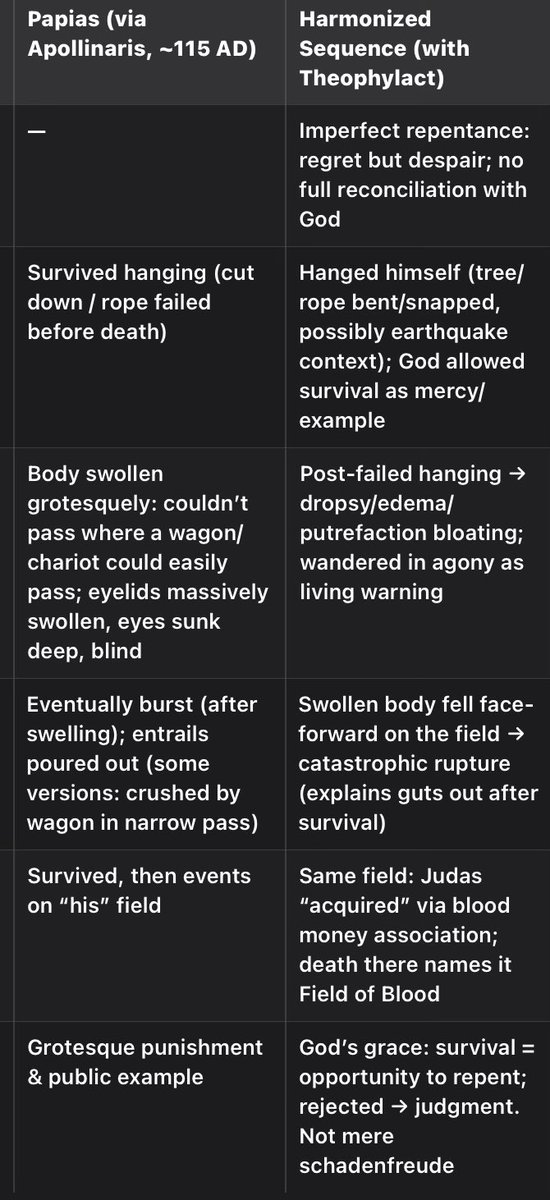
@BerkanKucuk01@muslimorthodoxy It’s not necessarily a contradiction with Matthew’s account. Here are my thoughts about those Papian stories, assuming they really are from him. https://t.co/BwYnWTRC9g
@JWS846893322695@JoelMCurzon It’s about having a presumption of innocence (i.e. a non contradictory hermeneutic) and a view that the early Christian communities were sufficiently conversant in their own affairs as to presume that they were correct in assuming a harmonist perspective.
@Cheersup2God In my research I’ve come to believe that Papias writes of a proto-Gospel with a genealogy attached. Jerome saw it as similar to Greek Matthew. I’ve incorporated my thoughts, similar to yours so far, in a video response to a skeptic. It can be found here: https://t.co/wyBFZk4hEr
@AEnjoyer447201 I disagree with the majority of naysayers. I have a whole series of videos dedicated to giving reasons for believing the resurrection of Jesus happened in space time history. Open some good wine and watch. https://t.co/uKepKGJraS
@UncleFisherman@BroadbentChris @AtheistTakes I think you will often get the Christian reply that the account of Judas’ demise, claiming to be from Papias, wasn’t really from his works. But I did a video in which I take it as a plausible oral memory with some bad interpretation connected with it. https://t.co/FVu0UzRBrD
@SenMarkKelly Where is the compassion for Persians oppressed by the IRGC? Just war ethics could theoretically back regime change in Iran (like stopping a repressive regime that's been killing protesters, persecuting minorities including Christians and exporting terror via proxies.
@sccarlson @JasonMHicks Ok, I stand corrected! I view literary tropes as a frame, not necessarily a fabrication; it tells us how the community interpreted the event, not that the event was made up. I have a video on the subject of Judas’ demise here: https://t.co/GNnX1b4myR
@sccarlson @JasonMHicks Another perspective is how the 11th century Greek Orthodox historian and theologian, Theophylact, harmonized Judas’ story as both a tragic figure and a theological lesson on repentance.
@maklelan If we only have Matthew’s "hanged himself" (ἀπήγξατο ) and Acts’ "falling headlong" (πρηνὴς γενόμενος), we have two disconnected points. However, Papias provides the connective tissue—the "interrupted hanging"—that allows these two points to exist on the same line.
@RobertC83522680 @OwnerSomal56346 @JockoBocko3@MatthewHartke I’m skeptical of how those scholars interpret the traditions as necessarily being contradictory. Jerome, who definitely had Papias’ books, didn’t find the "martyrdom" account scandalous or worth noting—he simply didn't read it as an execution.
@philotheis49253@LeoHaydock@MatthewHartke Acts describes Judas as "falling headlong" (πρηνὴς γενόμενος ). The bursting open could be the result of trauma endured from an interrupted hanging attempt described by Papias. Imagine the potential for severe internal injuries & complications following such an event.