A third consecutive positive surprise on US job creation in an environment of hot inflation is understandably boosting Fed rate hike expectations, but there is a lack of breadth to the jobs story and household finances are under intensifying pressure…https://t.co/nmD536rn4G
.@Knightleyeco talks to @Reuters about why he doesn't agree with the OECD's forecast that US inflation will hit 4.2% this year due to soaring oil prices.
'Unlike in 2022, higher oil prices will erode spending power & that could actually lower inflation.'
https://t.co/pjA05DB54y
Higher energy prices could hardly come at a more pivotal time for central banks.
Join our webinar next week, where we'll discuss how high energy prices would need to rise – and how long they’d need to stay elevated – to trigger central bank rate hikes.
https://t.co/zrke0oKH3W
🇺🇸 Rising global energy prices threaten to squeeze US household spending power and delay Federal Reserve rate cuts.
Read @Knightleyeco's analysis of how the Iran war could impact the US here:
https://t.co/r1SPbBje6c
In theory, the new universal tariff rate of 15% should mean a slightly lower average tariff rate. In practice, a simplified tariff structure could lead to a higher realised rate. @Carstenbrzeski and @Knightleyeco explain
https://t.co/i7Qtj5xoKW
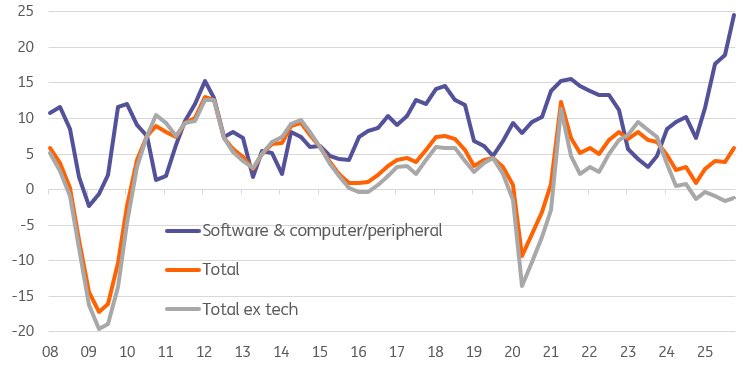
US 1.4% GDP growth was held back back the government shutdown with a bounce back expected for Q1. But the data showed non tech related business capex is being cannibalised as firms seek to stay ahead of the game on AI. Five consecutive YoY% drops!
Very firm US Jan ISM manufacturing index. Production was the strongest since Feb ‘22 and with new order and order backlogs increasing this points to further output increases in coming months. But firms remain reluctant to hire with employment contracting for a 28th straight month
Chair Powell’s robust defence of the need for central bank independence and firm US macro data argue against further near term rate cuts. Nonetheless, the cooler jobs story suggests there is scope for action later in the year under a new Chair… https://t.co/mqTUezxT1Q
Consumers + tech spending are the two main reasons why we think the US economy will continue to do well next year.
Yet the gap between high earners and others is widening. And @knightleyeco says concerns about job losses aren't going away.
Watch: https://t.co/VyagiqChxG
Today’s US GDP report was boosted by a strong performance from net trade but the underlying story remains growth is driven by tech investment and high income consumers. https://t.co/0ntbtYEoNJ
On the face of it a great report that suggests US inflation pressures are being tamed, giving the Fed scope to push on with cuts. But scepticism is understandable given the scale of the downside miss and the role of the shutdown. https://t.co/wignHNGw1J
The Fed was wary that the market was too confident that interest rate cuts would just keep coming. Job concerns are real though and there are factors that will mitigate the effects of tariffs. A Dec cut remains our view. https://t.co/LaGspJmP8X
The U.S. government shutdown has put its highly anticipated jobs report on hold at a time of major economic uncertainty. Still, @Knightleyeco tells me there are other tea leaves economists can read to figure out where the U.S. stands.
Today’s weak jobs report confirms that the Fed will be meaningfully cutting interest rates over the next 6M. 25bp remains our call for September, but the chances of an initial 50bp move are growing. https://t.co/j95dFk8vbg
🎙️In this week's THINK aloud, ING's @Knightleyeco and @marketsgarvey discuss the implications of Trump’s efforts to steer monetary policy - and the economic narrative - through high-profile firings at the Federal Reserve and Bureau of Labor Statistics.
https://t.co/pDN1mEf2yS
Today’s job openings shows the number of unemployed Americans now exceeds the number of job vacancies. Excluding the pandemic, this hasn’t happened for seven years and offers more evidence that labor market slack justifies the Fed stepping in with economic support via rate cuts.
"The credibility of U.S. economic data is under the microscope—and for good reason."
James Knightley @Knightleyeco, Senior International Economist at ING, joins us to unpack the ripple effects of weak job reports, data revisions, and a potentially shifting political narrative.
The July US jobs report has completely changed the story on the health of the economy. It no longer looks as “solid” as Chair Powell suggested with the Fed under increasing pressure to act quickly to turn things around… https://t.co/oHJMtl8XuZ
The President and Fed Chair Powell appear to be on collision course once again as the head of the central bank hints that rate cuts shouldn’t be taken for granted… https://t.co/xrCawYdaT9