Information is power. And like all power, there are those who want to keep it for themselves.
On Bitcoin, they didn't lock power behind a paywall. They locked it behind a single word, repeated with the same knowing smirk until it pushed me to the edge: impossible.
Impossible to introspect your own outputs without begging for their soft fork.
Impossible to run real state machines on Layer 1.
Impossible to read the market price without kneeling before an oracle committee.
And even if you forced the lock, fees would bleed the beast down to dust.
They mistook their own paralysis for a law of physics.
Meanwhile, those locked outside don't stand idly by. You sneak through holes. You climb over fences. All of that action happens in the dark, hidden underground.
First PRECOP, while sovereign vaults were already crossing thousands of Mainnet blocks without a single custodian.
Then Complexity, compiling the unthinkable straight into strictly unmodified Bitcoin.
Then the introspection mirror, asking for nobody's opcode and nobody's blessing.
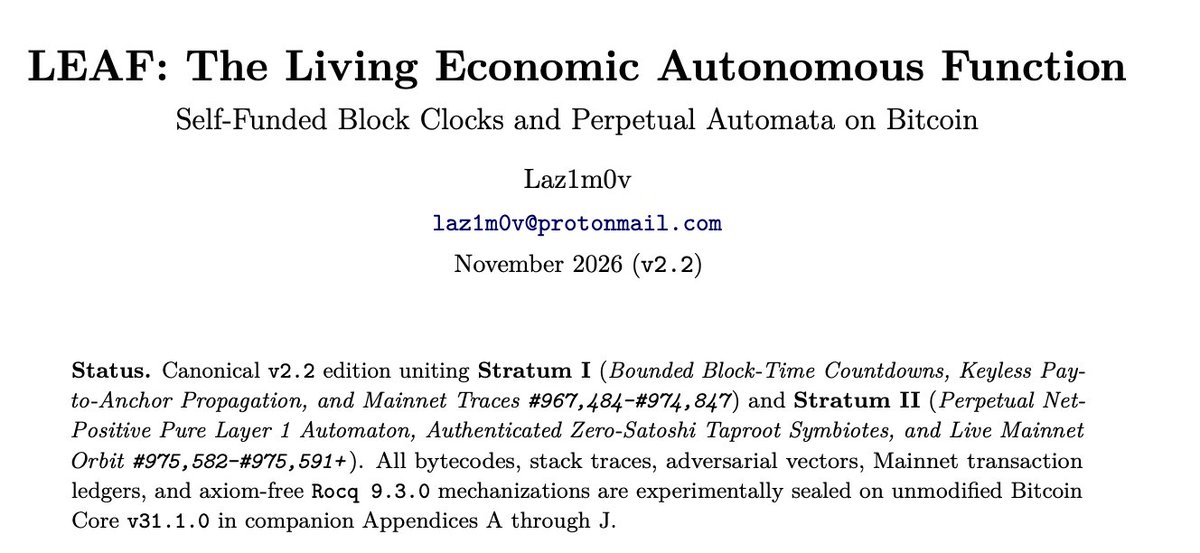
And finally LEAF: a masterless organism that reads the market off the ledger itself and grows stronger on Mainnet instead of dying.
While I was still buried in formal proofs and stack traces in the dark, @tap3leaf cut straight through the static. He didn't wait for an academic curtain call or for me to step into the light. He grabbed the raw machinery and wired it into the wild: the steps, the vaults, CRC-20, the API, the marketplace. While blocks were confirming right under the skeptics' noses, he was already out there yelling "first ever liquidation market on Bitcoin" and "sook a leaf."
What gathered around that fire isn't an audience. It's simply people who stopped obeying the word impossible.
Tonight, the final manuscript sits sealed in front of me. The loop is closed. There is literally nothing left to prove.
A millimeter above Publish, my hand froze. Part of me wanted to keep the file shut forever. Why hand the blueprint to temple guards who dress up cowardice as wisdom, or carnival barkers who flatten years of blood into timeline noise?
Then I remembered the first law of our lineage: hoarding knowledge in the dark is their sickness, never ours. Sharing isn't a performance. It's a moral imperative.
It's time to come into the light.
Not to ask the priesthood for approval. The organism is already loose at the heart of the timechain—its keys are burned, it sees the price, it feeds itself, and @tap3leaf is already building the next floor. We open the archive so no gatekeeper can ever lock another builder behind "impossible" again.
Keep debating your future soft forks for another ten years.
With enough of us, we won't just oppose the gatekeeping of Bitcoin—we'll make it a thing of the past.
Don't trust me. Decode the blocks and hunt for its pulse.
Will you join us? 🍃
https://t.co/cUebDuRSyo
Connect the dots. The entire last decade was a psyop.
In 2014, @SergeyNazarov launched https://t.co/bMLjxSRFQ6 with the Bitcoin logo on it. Then he suddenly walked away from Layer 1 to build @chainlink off-chain. Not because he was "too early"—because he went to build the custom oracle tollbooth for @swiftcommunity.
And right on cue in 2026, @swiftcommunity and global banks are ready to switch their infrastructure onto it.
To buy them a 12-year head start and reduce Bitcoin to a pet rock sitting inside ETF custodians, builders had to be neutralized with three lies: "not programmable," "not Turing-complete," "stuck at 7 TPS."
While devs were herded over to @VitalikButerin's @ethereum (whose blobs get wiped after 18 days, while Bitcoin seals up to 4 MB permanently per block) or parked in an endless soft-fork waiting room, all of crypto got wired to centralized exchange APIs. One CEX cracks, orderbooks snap, billions get wiped in liquidation cascades—and @swiftcommunity steps in as the adult in the room with permissioned feeds. By design.
Except Bitcoin's raw byte physics never needed their permission:
• "7 TPS"? A single transaction let us anchor 91 sovereign vaults across 6,000+ Mainnet blocks (PRECOP).
• "Not programmable"? People weren't missing opcodes; they were missing a compiler (Complexity) and native introspection—zero soft forks.
• "No Oracle"? We locked @SteveSimple & @DanielLHinton's UTXOracle straight inside a masterless L1 UTXO: LEAF.
Zero @swiftcommunity. Zero CEX APIs. Zero @chainlink committees.
It reads real BTC/USD ($73,611.10) straight from the blocks, halts cascade liquidations on anomalies, and gets richer on Mainnet when bots fight over it (38,880 -> 43,905 sats).
While I was sealing the 36-page paper in the dark, @tap3leaf already let the beast loose in the wild: vaults, CRC-20, API, the first native liquidation market on Bitcoin ("sook a leaf").
I almost kept the PDF locked away. Then I remembered: hoarding knowledge behind closed doors is how bankers and gatekeepers operate—never us (@aaronsw).
Their 12-year psyop ends tonight. The Oracle is already beating inside the timechain, keys burned, feeding itself.
Don't trust me. Decode the blocks. 🍃 ¯\_(ツ)_/¯
¯\_(ツ)_/¯
Satoshi disabled OP_MUL and OP_CAT in 2010
For 16 years the industry consensus was simple:
“Numbers die after 4 bytes. Without a soft fork or a multisig committee, Bitcoin L1 is a pet rock.”
Between blocks #974029 and #974581 we proved them wrong on Mainnet.
The rock can count. 🧵👇
What if a Bitcoin UTXO could breathe?
No key to steal.
No bot to summon.
No creator required to stay alive.
Just a recursive pulse on L1.
Immortal as long as it is used.
Returning its last satoshi home the day it is forgotten.
L . E . A . F . Living Economic Autonomous Function.
Nothing more.
Nothing less.
Nothing leaf 🌱