The 176 km expressway is well intentioned. But I have one important question: What was the result of the environmental impact assessment for the project? What remediation measures are being put in place to tackle the identified environmental risks?
1. The clearing of trees and soil disturbance will disrupt local plant and animal habitats, and corresponding local livelihoods.
2. Without the protection of the forest canopy, rainfall can easily erode bare soil, and the hard surfaces of the road will prevent rain from being absorbed, causing rapid runoff and potential flash floods.
3. This new road could open up the deep forests to illegal activities, particularly galamsey and illegal logging, which are major concerns.
4. Ultimately, the increase in human activity around the road will likely disrupt the biodiversity within the surrounding catchment areas.
🤝🏾 GFA is pleased to announce that it has reached an agreement with Carlos Queiroz for his appointment as Head Coach of the @GhanaBlackstars for the next phase of the team’s programme.
https://t.co/49XgcDBLS5
The banana in your kitchen is a sterile mutant that can't reproduce. Every single one is a clone, and nearly the entire global export supply traces back to one plant raised in an English greenhouse in the 1830s.
Wild bananas are stuffed with hard seeds the size of peppercorns. Barely any flesh. Around 7,000 years ago, farmers in New Guinea stumbled on rare mutants carrying three sets of chromosomes instead of two. An odd number can't split evenly during reproduction, so seed-making fails and the plant pours everything into flesh. Those tiny black specks in the middle of your banana are the remains of seeds that never developed.
Perfect fruit, one catch. No seeds means no planting. Growing another one requires cutting a shoot off the base and sticking it in the ground.
A clone.
Back in the 1830s, the Duke of Devonshire's gardener raised one of these plants at Chatsworth House. His family name was Cavendish. Cuttings descended from that greenhouse now make up 99% of bananas exported on Earth, genetically identical from Ecuador to the Philippines.
Identical genes means a fungus that kills one plant kills all of them. And it already happened. Gros Michel, the banana everyone ate before 1960, was wiped out commercially by a soil fungus called Panama disease. The industry quietly swapped in the Cavendish, a lookalike that resisted it, and most shoppers never noticed their banana had been replaced.
A new strain called TR4 kills Cavendish too. No cure exists, the spores survive in soil for decades, and it has spread to more than 20 countries. Late 2025 it reached Ecuador, the world's biggest exporter.
The world already lost its banana once and got handed a body double. The body double is dying the same way.
Back 5s have clear trade-offs. Generally, it is more difficult to transition into a press from a zonal block since you have 1 player less, but you get better zonal coverage on the defensive line. These trade-offs are pretty clear.
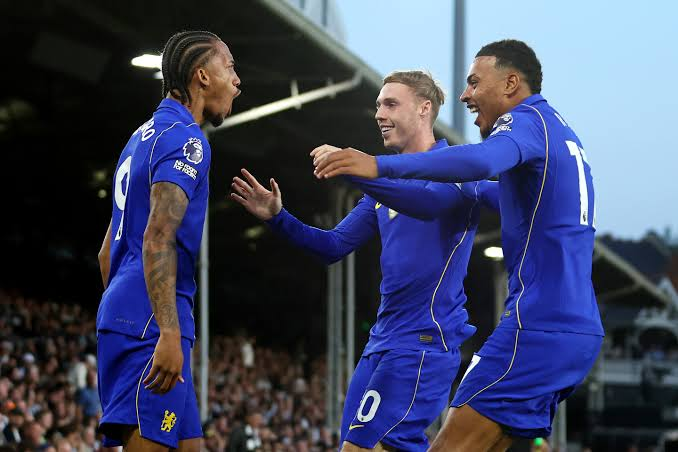
I think one of the most overlooked positive trade-offs of a back 5 is that you can field 3 genuine forwards while keeping them central and in close proximity. It is near impossible to field Rogers, Palmer, and Pedro centrally in a back 4 without major implications out-of-possession.
Compare Chelsea’s central attacking 3 to Arsenal or City in their opening games. Arsenal usually ended up with a central 3 of White, Havertz, and Calafiori against Fulham with Odegaard supporting, while City had Lewis, Haaland, and O’Reilly. Of course, these teams have width holders who are natural wingers and come inside during rotations, which has other advantages, but the advantage you get from putting your best attackers closer to goal centrally is often undervalued in modern football.
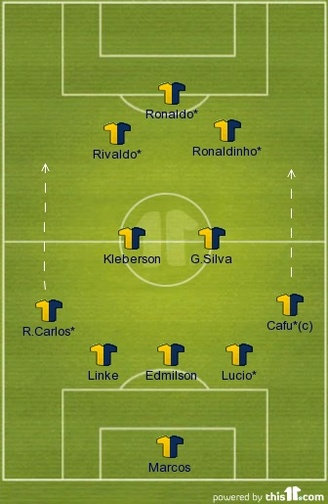
Historically, all the best attacking teams always had the players with the biggest zone of influence centrally. I always think about Brazil 2002 in terms of attacking dynamics; keeping that front 3 centrally in a back 4 would have major implications for the defensive balance. We see this less and less, mainly due to the out-of-possession demands in modern-day football.
I think we will often see throughout the season that Chelsea might have phases where they remain deeper zonally more often than the likes of City, but their front 3 will gain them a lot of margins.
Written by @MeiaArmador__
🤷♂️ Khusanov is currently a ball-chaser with decision making that is not on a high level. Defensive intelligence is the worst spotted attribute by the masses who often only see what happens in direct duels.