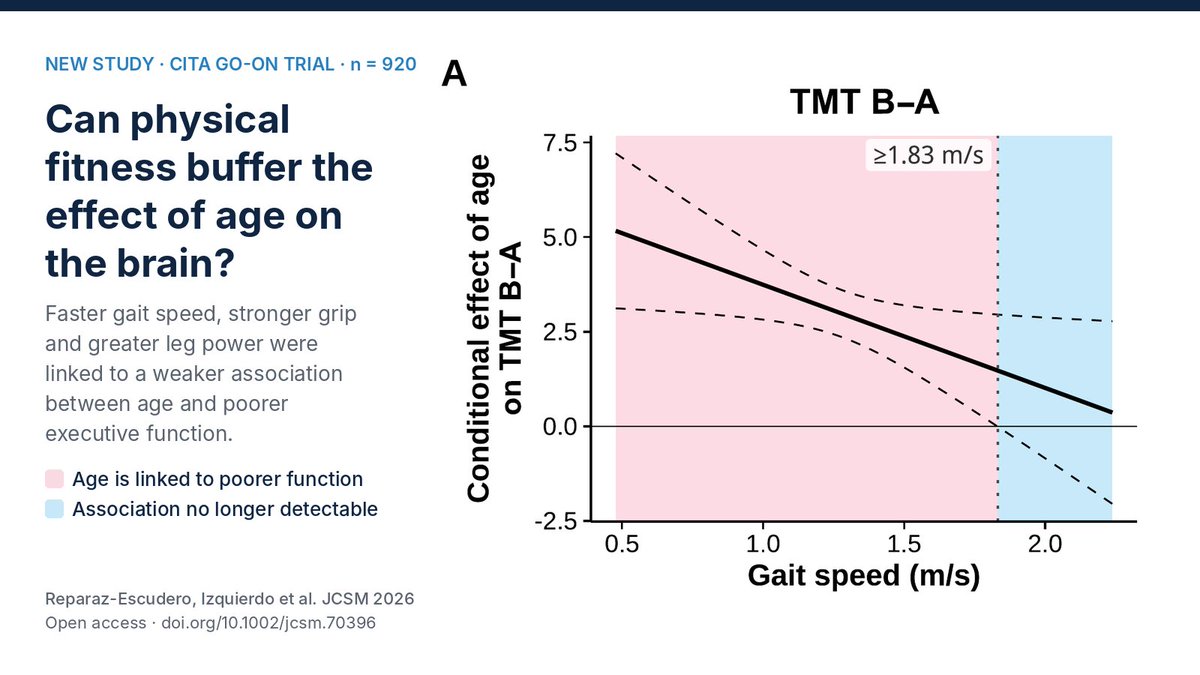
🏋️♂️🏃📢 Can physical fitness buffer the effect of age on the brain?
In 920 older adults at elevated dementia risk (CITA GO-ON trial), faster gait speed, stronger grip and greater leg power were associated with a weaker age–executive function link, independent of SES, depression, BMI and cardiometabolic factors. Gait speed was the most consistent marker.
Cross-sectional, and the Johnson-Neyman thresholds are sample-specific, not clinical cut-offs. Longitudinal studies are needed.
📄 Open access in #JCSM: https://t.co/1qPTjeumUJ
#Ageing #Dementia #ExecutiveFunction #GaitSpeed #Sarcopenia #ExerciseIsMedicine @DementiaUK@DementiaAus@raulmarcus@CIBER_ISCIII@EricTopol
Meta-analysis of 21 randomized trials of exercise interventions in adults with cancer showed significant association with OS, DFS, cancer-specific and all-cause mortality. More benefit seen with higher adherence, aerobic exercise, early-stage disease.
https://t.co/HYHgV2Fcf4
A massive new meta-analysis @Nature of 67 datasets and over 8,000 people found that moving 🏃🏾♀️more in daily life is consistently linked to feeling more energetic, positive, and generally good.
Interestingly, #physicalactivity was tied to feeling more energetic and positive but less calm, while it showed no reliable link to negative emotions like sadness or anxiety.
The effects were comparable to other daily activities like listening to music, and they varied between people with older adults and those with higher BMI showing weaker positive emotional responses to activity.
Movement and #mood appear to reinforce each other in everyday life, and understanding this loop could help shape more personalized health strategies.
https://t.co/MjrsuI52rN
🚨 Different daily step count and stepping pace combos may all lower risk of early death 🚶♂️ 👣
This brand new original research article is a #MustRead 📄 ✅
Link ➡️ https://t.co/jpryJMa2Mp
Intensity matters. 🚶♂️🚴♂️🏃♂️
~510 min/week light, 150 min moderate, or just ~12 min vigorous activity showed similar associations with lower mortality.
More intensity = more health per minute. Observational ≠ causal.
https://t.co/BjOBGr0p4Z
Effects of Resistance Training Sets on Cognition and Brain-Derived Neurotrophic Factor in Cognitively Impaired Individuals: A Quasi-Experimental Study https://t.co/mecwgJwHQ7 @DrGustavoDuque#Vivifrail
Among cognitively unimpaired older adults, very high plasma #PTau217 levels were associated with a 38% risk of progression to #CognitiveImpairment within five years.
https://t.co/Z8hvfQAknZ
「1日の歩数が少なくても、"歩くペース"を上げるだけで死亡リスクを下げられる可能性がある」という論文。 British Journal of Sports Medicine誌の研究(n=6万4743人)によれば、1日の歩数と「歩く強度(ピーク30分の歩行ケイデンス)」を組み合わせて解析したところ、1日5000歩未満でも速いペースで歩く人は全死亡リスクが約28%低く、7500〜1万歩では1分あたり約100歩のペースで最もリスクが低下することが明らかになった。
つまり「歩数が稼げない日は、少しだけ速歩きを意識する」だけでも効果が認められるようだ。








![copellist's tweet photo. 📕運動でがん患者の生存率は改善するか?
・メタ解析 [21件のRCT]
計画的運動は通常ケアと比較し,
🔹全生存期間:死亡リスク23%低下(HR 0.77)
🔹無病生存期間:再発リスク17%低下(HR 0.83)
🔹全死因死亡リスク18%低下(RR 0.82)
🔹がん特異的死亡リスク26%低下(RR 0.74)
✅サブグループ解析(以下の条件でより大きな効果)
・実施率が高い(≧70%)
・有酸素運動 / 複合運動
・早期がん
がん患者に対する運動の効果は、
最も重要なアウトカムである
『死亡リスク』にも及びます😲](https://pbs.twimg.com/media/HTzwZaaaQAAXS_V.jpg)