Hay una frase que cambia de significado por completo dependiendo de en qué momento de tu vida la leas.
"No busques que las cosas sucedan como quieres, sino desea que sucedan como suceden." — Epicteto
A los veinte años suena a resignación. A los cuarenta, después de haber peleado contra realidades que no cambiaron por mucho que insistieras, empieza a sonar más a sabiduría ganada con dolor que a simple pasividad.
There are only 12 reasons your business isn’t growing:
1. your pricing is off
2. you’re serving the wrong customer
3. you're solving the wrong problem
4. you offer too many things at once
5. your profit margins are too thin
6. you’re the only person who can sell
7. you don’t trust your team to make decisions alone
8. your ideal clients don’t know you exist yet
9. you don’t have written processes or SOPs
10. you talk yourself out of problems instead of fixing them
11. you want lifestyle, scale, and an exit all at once
12. your business became your identity
Every business is constrained by two of these at a time.
Si quieres conseguir un trabajo decente en software, te van a pedir que sepas escribir; cuanto más y más rápido, mejor.
Alguien tuvo la decencia de crear esta página para que practiques como toca:
https://t.co/hdmdxlVxu4
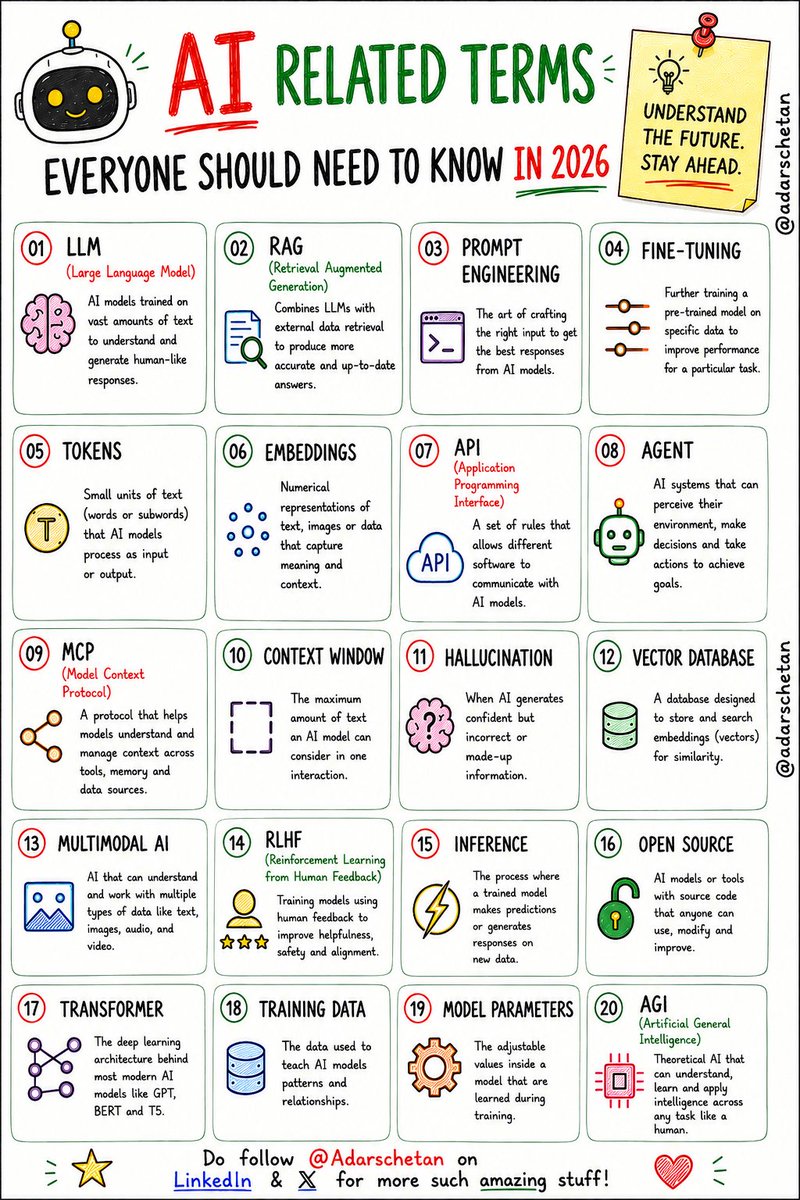
20 AI TERMS YOU SHOULD KNOW IN 2026
AI is moving fast. If you understand these terms, you’ll understand a big part of today’s AI ecosystem:
1LLM — Large Language Model trained to understand and generate human-like text.
2RAG — Combines LLMs with external data retrieval for more accurate, up-to-date answers.
3Prompt Engineering — Crafting effective inputs to get better AI responses.
4Fine-Tuning — Further training a model on specific data for a particular task.
5Tokens — Small units of text processed by AI models.
6Embeddings — Numerical representations that capture the meaning and context of data.
7API — Rules that allow software applications to communicate with AI models.
8Agent — An AI system that can perceive, decide, and take actions toward goals.
9MCP — Model Context Protocol for connecting AI models with tools, memory, and data sources.
10Context Window — The amount of information an AI model can consider in one interaction.
11Hallucination — When AI produces confident but incorrect or fabricated information.
12Vector Database — Stores and searches embeddings based on similarity.
13Multimodal AI — AI that works with text, images, audio, video, and other data types.
14RLHF — Reinforcement Learning from Human Feedback to improve model behavior.
15Inference — The process of using a trained model to generate predictions or responses.
16Open Source — AI models/tools whose source code or components can be accessed, modified, or improved.
17Transformer — The deep-learning architecture behind many modern AI models.
18Training Data — Data used to teach AI models patterns and relationships.
19Model Parameters — Adjustable values learned during model training.
20AGI — Artificial General Intelligence; a theoretical form of AI capable of broad, human-like intelligence.
📌 Save this cheat sheet. These are the building blocks behind modern AI.
Which AI term do you want explained next?
Do Follow @AdarshChetan for more such amazing stuff
The one prompt blueprint you’ll ever need for ChatGPT + Claude 🔥
**6 core pieces (ranked by impact):**
1) **[Task]** → Lead with a verb (draft, build, critique, summarize…)
2) **[Context]** → What’s going on + what “good” looks like + where it’ll be used
3) **[Exemplar]** → A sample, template, or framework to mirror
4) **[Persona]** → “Act as a senior PM at Apple…”
5) **[Format]** → Bullets, table, email, markdown, TL;DR, etc.
6) **[Tone]** → Crisp, warm, bold, witty, formal…
Do this and “meh” responses become polished, senior-level output—consistently.
Bookmarking it? Hit 👍 if you’re testing it today.
Follow @SharminNahar401 for more
LIST OF 40 WEBSITES TO FIND REMOTE JOBS
1. Linkedin. com
2. Indeed. com
3. Glassdoor. com
4. FlexJobs. com
5. weworkremotely. com
6. Remote. com
7. Upwork. com
8. Freelancer. com
9. Fiverr. com
10. Guru. com
11. Toptal. com
12. AngelList. com
13. Hubstafftalent. com
14. Simplyhired. com
15. Remotive. com
16. Virtualvocations. com
17. workingnomads. com
18. Hired. com
19. cloudpeeps. com
20. taskrabbit. com
21. talent. com
22. Remote OK - remoteok. io
23. DRemote - dremote. io
24. Jooble - jooble. org
25. stackoverflow. com/jobs
26. jobspresso. com
27. onlinejobs. ph
28. simplyhired. com
29. themuse. com
30. skipthedrive. com
31. zirtual. com
32. justremote. com
33. hireable. com
34. remoteworkhub. com
35. jobbatical. com
36. freelancewritinggigs. com
37. contentwritingjobs. com
38. problogger. com/jobs
39. behance. net
40. designhill. com
Don't forget to follow @Tanaypawar27 to get more insightful Ai related tools and update.
Andrej Karpathy spent 8 years at OpenAI and Tesla.
Last month he put everything he knows into one free 2-hour lecture.
People pay $15k for bootcamps that teach half of this.
You probably don't have 2 hours right now.
Don't let it get buried in your feed.
Watch it, then read the graph engineering guide below and build your first loop ↓
Andrej Karpathy:
"Prompting is slowly fading away
Delete everything else and keep the graph"
In a 1-hour lecture, he explains how to build graphs and why they're the layer that survives
The part most people overlook:
LLMs → Prompts → Agents → Graphs
Everything before the graph is just another step
The graph is where the system eventually ends up
Watch it first
Then read the full guide on graphs below
Instead of spending 2 hours on a movie...
Spend 1 hour watching this Anthropic Claude for Finance lecture.
It might be the most valuable free resource on quant AI available right now.
Bookmark it, make time for it today, and thank yourself later.
"Everydayness is the hallmark of excellence in every domain."
You can't wait for inspiration or motivation.
If you want to write a book, sit down every day. When nothing comes, write it badly, but don't get up.
@GioValiante explains ...
WARREN BUFFETT EXPLAINS THE 2008 CRISIS
Warren Buffett wired $5 billion to Goldman Sachs 8 days after Lehman Brothers died.
10 years later a WSJ crew set up 2 lights in an Omaha office and asked him to explain what actually happened.
Navy suit. Wooden armchair. No notes.
The first thing he does is refuse to name a villain. Some were foolish, he says, some were crooked, some were both. Everybody got caught in it.
Then the numbers. 75 million homeowners. 50 million mortgages. When the bubble broke it reached roughly 40% of households in the country. Fear moved through September 2008 like a tsunami.
His picture of it is a Cinderella party. Everyone knew the coach turns back into a pumpkin at midnight. Nobody wanted to leave until 1 minute before. Then the whole room ran for the same door.
The part nobody talks about: he says he learned nothing new in 2008.
What got confirmed was speed. There is a fog of war, and there is a fog of panic. In panic the data is wrong and the rumors are loud. Wait until you know everything and you are already late. Washington did the right things, not the perfect things, and that gap is why the train got back on the track.
Then the line that should have been the headline. The people who ran the big institutions went away rich. Disgraced, maybe. Rich, certainly. And 10 years on, he says the incentive system hasn't improved much.
One American banker served prison time for the crisis. Kareem Serageldin, 30 months, for mismarking bonds at Credit Suisse. Buffett's Goldman preferred paid 10% a year with warrants struck at $115. That trade cleared about $3.1 billion.
His entire crisis framework fits on a napkin. The economy is a train with no last stop. It derails sometimes. Panic is not information. Right beats perfect. Factories, farmland and skills never disappear, only the system that idles them.
5 minutes of video, free. A $200,000 MBA will not teach you this part.
And you are sitting in cash this week, waiting for the picture to get clear, exactly like the 40% did.
The train is still moving. Most people are still on the platform.
Eddie Woo, Australian high school maths teacher:
"a trader who makes 50% then loses 50% thinks he is flat. he is down 25%. that gap is a logarithm, and it is why most accounts quietly bleed to zero."
this free high school lesson holds the entire "log returns" every 2026 quant thread is selling you.
your account does not add, it multiplies. win 20%, lose 20%, and you are not back where you started.
the log is the tool that turns that multiplying into adding, so you can finally measure the truth of a P&L instead of the story.
Eddie Woo teaches it to teenagers with a marker and a whiteboard. no jargon, no terminal.
every serious trader sizes positions to grow the average of their log returns, not their dollar returns. that one shift is the whole line between compounding and blowing up. it has a name, the Kelly criterion, and it is this lesson wearing a suit.
I put aspects of this lecture into practice and developed a strategy that generates income, and the results surprised me.
By August:
$220 → $37,401
84% win rate.
I'm giving away the full configuration of my bot for free. 24 hours only.
Here's how:
>Like and Follow me
>Send me a direct message with the word “Bot”
All you need to do to get the information is send me a single word!
STEVE JOBS GOT FIRED FROM APPLE.
Then he walked straight into MIT and dropped the most raw, unfiltered 60-minute business masterclass ever recorded.
Zero PR bullshit. Zero image to protect.
Just pure, brutal honesty from the man who built Apple once and was about to rebuild it even bigger.
Stop scrolling.
Watch this tonight instead of Netflix.
Bookmark it. Come back to it.
MIT, July 1986. A course MIT later killed, and the tapes outlived it by nearly twenty years.
Hal Abelson and Gerald Jay Sussman stood in front of a room of Hewlett-Packard engineers and taught the whole of 6.001, MIT's introductory computer science subject, in one compressed run. Hewlett-Packard Television filmed all twenty lectures professionally.
They were not made for the public. In July 1986 there was no public to make them for.
Sussman opens by telling the room that the name of the subject is wrong. Computer science is not a science, and it is not about computers, in the same way geometry is not about surveying instruments.
What it is about is how to describe a process precisely enough that something with no judgement at all can carry it out.
The course follows from that one sentence. Nobody is taught a language for its own sake. They use Scheme, which has almost no syntax, precisely so that there is nothing to hide behind.
They build abstractions. Then they build the machinery that runs abstractions. Then, near the end, the students build an interpreter for the language they have been writing in all along. The course finishes by handing you the thing you have been standing inside.
Now the part that gives the tapes their strangeness.
6.001 became MIT's introductory subject in 1980 and ran for twenty-seven years. Sussman gave the final lecture after the autumn term of 2007, and MIT retired the course.
His own explanation is the interesting bit. He said the curriculum no longer matched what engineering had become. In the eighties you built large systems out of small parts you fully understood. Now, he said, programmers work with hardware and libraries nobody can fully see inside, so the job has shifted to poking at something to find out what it does.
MIT replaced it with a course built around Python and robots.
And the recordings kept going. The course they document has been dead since 2007. The tapes are still being watched by people who were not born when they were filmed, and courses built on that textbook are still taught at universities that never dropped it.
They are free. All twenty lectures, plus the complete textbook, plus a licence that lets you reuse them.
What it costs you is watching two men in 1986 teach a subject as a way of thinking, and then working out how much of what you know is just poking.
My friend makes around $1.1 million a year as an Anthropic engineer
I asked him how he got so good at prompting
He sent me a video that was never meant to be released
The exact prompting playbook their core team actually uses
You probably won't find a better resource on prompting than this video
I watched it last night
Halfway through, I realized I'd been using Claude wrong for the past 18 months
Watch it and save it