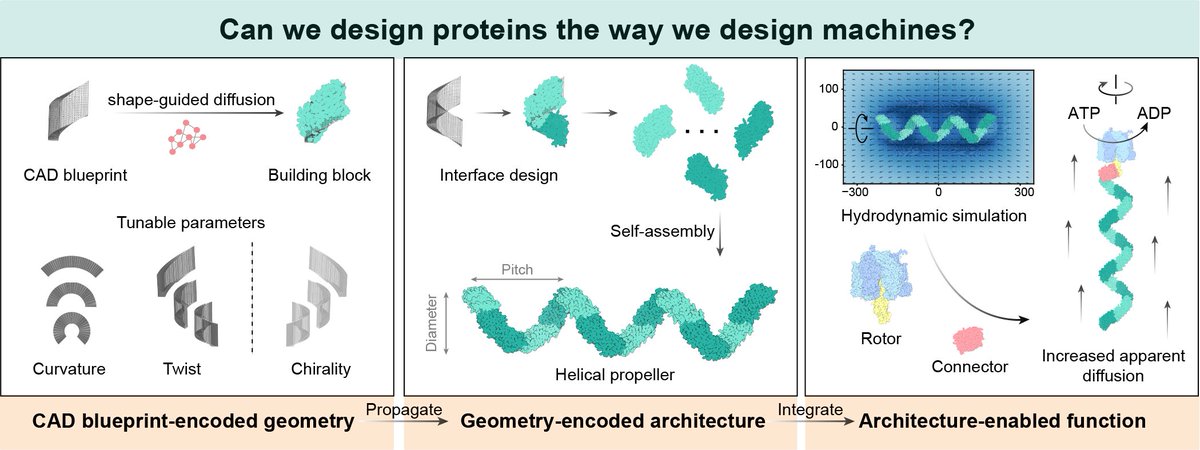
@MolecularCell Getting there will require overcoming key challenges, including designable protein dynamics, multi-step functionalities, and non-equilibrium systems. The field is advancing quickly, and we’re excited for what comes next! (3/3)
@MolecularCell AI-guided de novo protein design has advanced remarkably in recent years, especially for binder design. We propose that the next frontier lies in integrating designed molecular functions into reaction networks, so we can program emergent cellular behaviors. (2/3)
Excited to share our preprint from @KortemmeLab, where we establish protein shape as a programmable design layer using CAD blueprint-guided diffusion. By programming shape across scales, we explore a path toward designing proteins more like machines. (1/7)
https://t.co/INRAkxKkWY
Excited to finally release ProteinZen, an SE(3) equivariant all-atom protein generative model enabling unconditional all-atom monomer generation and SoTA all-atom motif scaffolding performance!
Preprint here: https://t.co/TFhc8T2CXr
🧵1/n
Model weights have been uploaded to zenodo. Fine-tuning and analysis code to be released soon. Work by @BenOrr_, Stephanie Crilly, @DenizAkpinaro, Eleanor Zhu, @keiser_lab, and Tanja Kortemme. (9/9) https://t.co/l1lBLzVmEL
We are excited to share our new preprint, “An improved model for prediction of de novo designed proteins with diverse geometries”. (1/9) https://t.co/BkqL0Gefpg
This work highlights how augmenting existing models with informative experimental data, as presented here, could expand our exploration of designable protein space and ultimately enable more challenging design problems to be addressed than currently possible. (8/9)
We showed new modes of motions are accessible to de novo design, enabling new functions & compatibility with natural states, allowing one to engineer non-native dynamics into existing biological systems! Work by @amyguo1997, @DenizAkpinaro, MJS Kelly & T Kortemme (6/6)
Physics-based simulations further uncovered the molecular origins of the observed dynamics and modulation, which we used to further tune the conformational landscape (5/6)