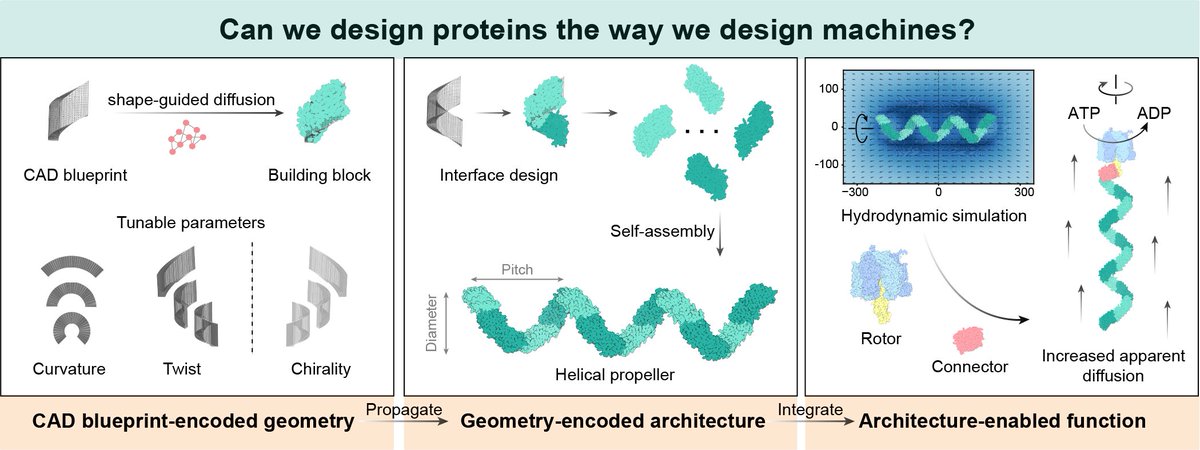
Together, this work establishes protein shape as a programmable design layer linking geometry, architecture, and function. Huge thanks to all our co-authors and collaborators who made this possible! (7/7)
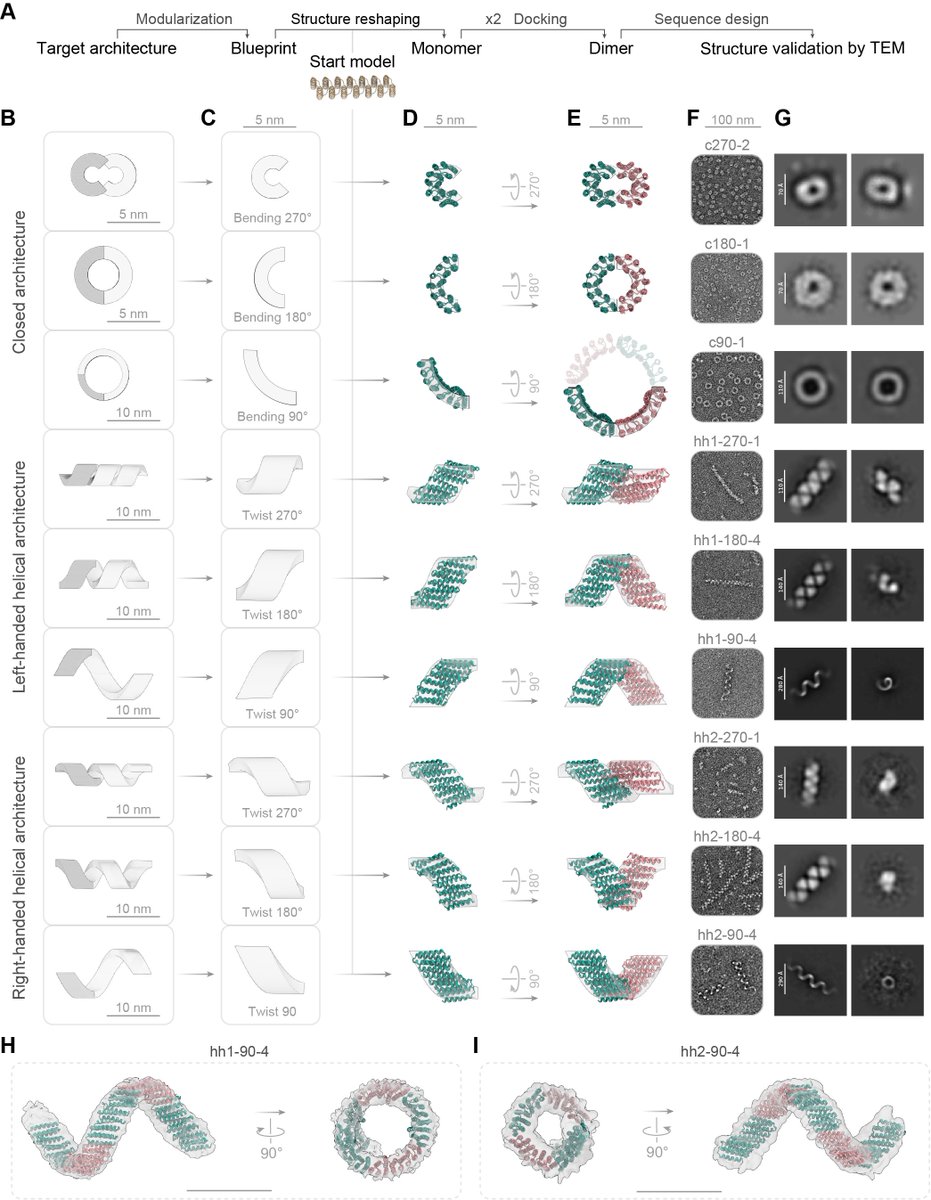
We then extended shape programming to assemblies by co-designing building-block geometry with target architecture. Curvature, twist, and chirality encoded in shared building blocks directly determined the formation of different assemblies. (5/7)
As a proof of concept for shape-encoded function, we coupled fluid-flow-optimized helical propellers to an F₁-ATPase rotor, yielding a prototype ATP-dependent molecular swimmer. (6/7)
We next asked whether existing proteins could be redirected into rare shape states without changing their underlying fold topology. Shape-conditioned diffusion reshaped α/β backbones toward unusual left-handed twist states while largely preserving their topology. (4/7)
We developed a shape-guided diffusion framework in which user-defined CAD blueprints guide backbone generation through an auxiliary shape potential. Starting from noise, the model generates proteins that conform to prescribed global shapes. (2/7)
Using this framework, we generated de novo proteins spanning a variety of simple predefined shapes. X-ray structures and biophysical characterization supported the intended global shapes. (3/7)
Excited to share our preprint from @KortemmeLab, where we establish protein shape as a programmable design layer using CAD blueprint-guided diffusion. By programming shape across scales, we explore a path toward designing proteins more like machines. (1/7)
https://t.co/INRAkxKkWY