Discovery tools score reach. They can't score trust. And trust is the only variable that decides whether a paid promo converts. The best data point in creator selection is still the boring one: has this creator actually sold something before, and for whom.
Creator discovery tools are selling marketers a dangerous illusion:
That creator selection can be solved with DATA.
It can't.
Most discovery platforms are ultimately built on some combination of:
��� Platform APIs
→ Licensed/partner data
→ Publicly available data
→ Crawling/indexing
→ Historical content + engagement data
→ Audience estimation models
→ ML/AI classification
Then they turn that data into:
→ Engagement rate
→ Avg. views
→ Audience demographics
→ Growth rate
→ Affinity scores
→ Similar creators
→ Brand safety
→ Creator rankings
Useful? Absolutely.
But here's the problem:
Almost every one of these metrics describes WHAT HAS ALREADY HAPPENED.
Creator marketing is increasingly about figuring out WHAT IS ABOUT TO HAPPEN.
An API can tell you:
→ A creator got 2M views.
It struggles to tell you:
→ WHY people suddenly care about them.
A database can detect:
→ Follower growth.
It can't reliably understand:
→ Whether this is a temporary spike or the beginning of cultural momentum.
AI can classify:
→ “Tech creator.”
A great marketer might notice:
→ This creator is becoming the voice of an entirely new AI-native audience.
And filters definitely won't tell you:
→ Which meme is spreading
→ Which format is emerging
→ Which creator suddenly owns a conversation
→ Which community is becoming culturally relevant
→ Which weird creator × brand combination could become a breakout campaign
This is the difference between DATA DISCOVERY and CULTURAL DISCOVERY.
And cultural discovery still requires humans.
The best creator marketers I've worked with have one unfair advantage:
They consume an ABSURD amount of internet.
YouTube.
Instagram.
TikTok.
X.
Reddit.
Podcasts.
Newsletters.
Comments.
Not casually.
Obsessively.
Because creator marketing is not only a database game.
It's an ATTENTION ARBITRAGE game.
Tools help you SEARCH.
Data helps you VALIDATE.
AI helps you SCALE.
But HUMAN TASTE identifies the opportunity.
And by the time every discovery tool tells you a creator is trending...
the cheapest attention may already be gone!
@ecomchasedimond Curious how these hold up for creator-led copy. In our experience the creator's native voice breaks most persuasion templates — the moment it reads like a framework, audience trust drops. Do you see brands forcing templates onto creators?
@andrewjfaris Brands get this backwards: they use AI to replace the vetting (the cheap part) and keep humans on the busywork. Flip it — automate the follow-ups, keep a human on fit. One wrong creator does more damage than one slow inbox.
@mrsharma The pattern nobody mentions: the channels that scale past Meta are the ones where trust is pre-built — TV, creators, podcasts. You can't arbitrage trust. You can only borrow it from whoever already holds it with that audience.
@lorenzo_pravata The failure mode on the influencer side is the same volume without ownership: brands commission dozens of one-off creator posts and wonder why nothing compounds. Variants compound. One-offs don't.
@shaharan_akram The same math kills most creator campaigns. Brands hire 30 creators and hand them 30 different briefs. The winning brands do the reverse: one big idea, 30 creators iterating it in their own voice. Volume of variation, not volume of strangers
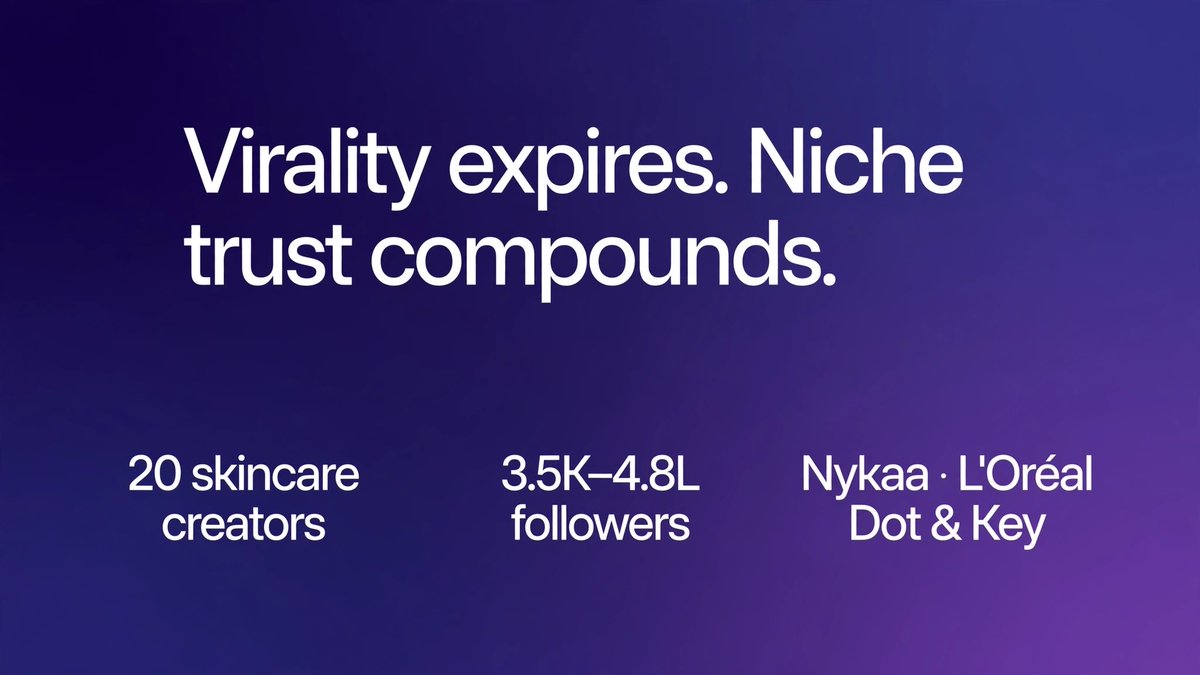
Beauty brands keep asking for 'viral creators.' Our answer: a 20-creator skincare bench, 3.5K–4.8L followers, with work history at Nykaa, L'Oréal, Dot & Key. Virality expires. Niche trust compounds. We run a 134-creator network. DMs open for October brand slots.
@EllaTech0@WithAmplify AI can post every day. It can't be trusted on day one. Trust is earned in public over years — that's the one thing no model can generate. Distribution without trust is just spam with better lighting.
@DavidRunsAds Perfect is the tell. The moment an ad looks expensive, the thumb moves. A girl yapping to her camera is a FaceTime — and nobody skips a FaceTime.
@buildwithtasvir Trick question — UGC isn't the alternative to Meta Ads, it's the fuel for them. The $0→$10k winners aren't choosing between the two, they're running creator content as the ad creative.
@kyanbuilds 5 creators posting daily is the easy part — everyone's running this playbook now. The edge is kill speed: which 4 concepts die by day 7 and which 1 gets the budget. Most founders keep funding all 5.
A post with 500 saves and 40 DMs but only 2,000 likes gets called a flop. You got buying signals and judged the applause instead. Measure what converts, not what impresses.
Brands haggle usage rights down to save a few thousand, then spend lakhs shooting their own ads that nobody trusts. The creator's post already did the job. Reusing it costs less than reshooting it. Stop fighting over rights. Start asking for them.