SaaS companies are buying developer attention on the wrong platforms.
For developer-first SaaS, GitHub is one of the most underutilized user acquisition channels on the internet.
The data:
• 180M+ developers
• 395M public/open-source repositories
• 1.12B public/open-source contributions in 2025
• 4.3M AI-related repositories
• 1.1M+ public repos importing an LLM SDK
But the real goldmine isn't REACH.
It's INTENT.
On social media, a developer liking your post tells you they liked your content.
On GitHub:
• Star = interest
• Fork = experimentation
• Issue = active problem
• Pull request = participation
• SDK import = actual product adoption
That is much closer to product behaviour than advertising behaviour.
The GTM playbook is simple:
Open-source useful tools
→ SDKs
→ Templates
→ Integrations
→ Starter kits
→ Community
→ Paid product
This creates a distribution loop:
DISCOVERY → UTILITY → TRUST → ADOPTION → PAID
Stop treating GitHub as a place where engineers store code.
For technical SaaS, GitHub can become a user acquisition engine where your ICP is already BUILDING.
Social media rents attention.
GitHub can embed your product into the workflow.
This is how I'd build it too. One change.
I'd start at 5, not at 1.
"Why should they care" gets saves from people who already care. The deal is stuck on a sentence from a real call. We tried this. How long does it take. Why not hire it in house. That sentence is the post.
I pull those off the last calls before I write anything else. If it didn't come up on a call, I don't post it. The case study comes next, because now they believe the problem and they still don't believe you. What happens after they pay comes right after that. Most of the fear on the call isn't the price. It's not knowing week one.
I run those three for a few months. I don't judge it on likes. I judge it on whether that objection stops showing up on the next calls.
Creator discovery tools are selling marketers a dangerous illusion:
That creator selection can be solved with DATA.
It can't.
Most discovery platforms are ultimately built on some combination of:
→ Platform APIs
→ Licensed/partner data
→ Publicly available data
→ Crawling/indexing
→ Historical content + engagement data
→ Audience estimation models
→ ML/AI classification
Then they turn that data into:
→ Engagement rate
→ Avg. views
→ Audience demographics
→ Growth rate
→ Affinity scores
→ Similar creators
→ Brand safety
→ Creator rankings
Useful? Absolutely.
But here's the problem:
Almost every one of these metrics describes WHAT HAS ALREADY HAPPENED.
Creator marketing is increasingly about figuring out WHAT IS ABOUT TO HAPPEN.
An API can tell you:
→ A creator got 2M views.
It struggles to tell you:
→ WHY people suddenly care about them.
A database can detect:
→ Follower growth.
It can't reliably understand:
→ Whether this is a temporary spike or the beginning of cultural momentum.
AI can classify:
→ “Tech creator.”
A great marketer might notice:
→ This creator is becoming the voice of an entirely new AI-native audience.
And filters definitely won't tell you:
→ Which meme is spreading
→ Which format is emerging
→ Which creator suddenly owns a conversation
→ Which community is becoming culturally relevant
→ Which weird creator × brand combination could become a breakout campaign
This is the difference between DATA DISCOVERY and CULTURAL DISCOVERY.
And cultural discovery still requires humans.
The best creator marketers I've worked with have one unfair advantage:
They consume an ABSURD amount of internet.
YouTube.
Instagram.
TikTok.
X.
Reddit.
Podcasts.
Newsletters.
Comments.
Not casually.
Obsessively.
Because creator marketing is not only a database game.
It's an ATTENTION ARBITRAGE game.
Tools help you SEARCH.
Data helps you VALIDATE.
AI helps you SCALE.
But HUMAN TASTE identifies the opportunity.
And by the time every discovery tool tells you a creator is trending...
the cheapest attention may already be gone!
No on the "0 exceptions."
Shipping every week and talking to users is a good rhythm. It is not a law, and naming Cursor, Lovable, and Higgsfield is not a receipt. He didn't show the calendar.
The only line that is a test is the last one. 10,000 impressions on people who already know the product beats 100,000 on strangers. The other seven steps are how you chase the first number. They do not show that anyone paid.
If the weekly ship does not change who pays, it is a content calendar.
$3K MRR from 50 users sounds attractive.
But I’d only consider buying it if those 50 users are buying a SOLUTION — not renting a FEATURE.
Here’s what I’d check before making an offer:
→ ARPU
$3K MRR ÷ 50 users = $60 ARPU.
That’s more interesting than thousands of free users because someone is already willing to pay $60/month to solve the problem.
Vanity users don’t pay invoices.
→ Revenue Concentration
50 customers means nothing if 3 customers generate 50% of the revenue.
One cancellation can rewrite the entire business.
Before discussing valuation, show me the revenue contribution of the top 5 customers.
→ Cash Flow > ARR Hype
At this size, I wouldn’t value it like a venture-backed SaaS company.
I’d value the actual cash-generating machine:
• Gross margin
• Churn
• Profitability
• Customer concentration
• Growth rate
• Founder dependency
If the founder disappears and revenue disappears too, you’re not buying an asset.
You’re buying yourself a job.
→ Retention Is the Real Moat
Can customers leave easily?
Can competitors replicate the feature?
Can the product operate without the founder?
Does revenue expand or contract over time?
Durable retention + transferable product knowledge = an asset.
Everything else is just a spreadsheet with an expiry date.
50 paying customers can absolutely be valuable.
But I’d rather buy 50 customers who NEED the product than 50,000 users who merely LIKE it.
Founders are falling for a marketing agency trap and the playbook is surprisingly simple.
Here’s how it works:
→ Find a well-funded AI startup with a big marketing budget.
→ Convince the founders to allocate serious money to “guerrilla marketing” often flashy offline stunts like auto-rickshaw campaigns that generate attention, but have weak attribution to actual user acquisition.
→ Spend more money securing awards and recognition from credible media platforms.
→ Amplify those awards through paid media and PR: “How we successfully launched X and won Y award.”
→ Use that perceived success as the case study to acquire the next funded startup.
And the cycle repeats.
My take:
Attention ≠ distribution.
Virality ≠ acquisition.
Awards ≠ product-market fit.
Creative campaigns aren’t inherently bad. But founders should be extremely careful about heavily funding channels where traffic, sign-ups, activation, retention, and revenue cannot be meaningfully attributed.
A launch shouldn’t just look successful.
It should be measurable enough to prove that it actually was.
ManyChat has fooled marketers into thinking COMMENTS = USER ACQUISITION.
→ “Comment LINK”
→ Get 10,000 comments
→ Screenshot the engagement
→ Celebrate the campaign
→ Ignore the actual CTR
Meanwhile, a simple “Link in bio” can quietly drive MORE clicks.
Why?
ManyChat adds friction:
→ Comment
→ Wait for DM
→ Open DM
→ Find the message
→ Click the link
Link in bio:
→ Visit profile
→ Click
That’s it.
ManyChat is great for:
→ Lead capture
→ Qualification
→ Nurturing
→ Building DM lists
But for pure user acquisition?
I would NEVER assume Comment-to-DM beats Link-in-Bio without testing both.
The creator marketing industry is becoming obsessed with manufacturing engagement instead of measuring intent.
10,000 “LINK” comments might look sexy on Instagram.
1,000 high-intent clicks could be worth far more to the business.
Comments make campaigns LOOK successful.
Clicks make businesses successful.
Stop confusing ACTIVITY with ACQUISITION.
One of the worst ways brands waste money on YouTube creator marketing:
Buying the wrong 60 seconds of a great creator.
Many US creators sell 3 sponsorship slots:
→ Pre-roll
→ Mid-roll
→ End-roll
Pre-roll is expensive.
So smaller brands often settle for mid-roll or end-roll thinking:
“At least we’re getting access to this creator’s audience.”
No.
You’re not buying the creator’s audience.
You’re buying the audience that is STILL WATCHING when your integration appears.
A creator might get 1M views.
But if your sponsorship appears when only a fraction of those viewers remain, your actual addressable audience is dramatically smaller.
Then comes the brutal math:
Smaller audience → fewer clicks → fewer conversions → harder CAC recovery.
And the worst format?
Creators stacking multiple sponsors back-to-back like TV commercials.
Ad 1.
Ad 2.
Ad 3.
That’s not creator-native advertising.
That’s a commercial break with a famous face.
My rule after years of running creator campaigns:
Don’t negotiate only on CPM, views or creator size.
Negotiate PLACEMENT.
Look at the creator’s audience-retention graph and negotiate your integration around where meaningful watch time still exists.
For performance campaigns, I generally want the integration within the first 4–5 minutes often earlier.
Because in creator marketing:
You’re not buying views.
You’re buying ATTENTION AT THE TIMESTAMP YOUR AD APPEARS.
And those are two completely different things.
No. The $100M line is the poster's, not a receipt. The number that holds is the one on token costs.
For an AI product, LTV on revenue is a lie. Take inference out first, or the ratio looks healthy while the margin is gone. A 1:1 LTV to CAC is only fine if you raised money to be inefficient on purpose.
What goes wrong: teams copy "start paid now" and "fire the marketing team," skip the tracking he says 90% skip, and call it his playbook.
In six months the ones still spending can show gross-profit LTV after inference. The ones who shipped 500 ads cannot.
The test: name gross profit per acquired user after token cost, before you scale the budget.
He is the growth architect behind 3 of the fastest-growing companies (Superhuman, Wispr Flow, and Viktor).
He built their $100M growth engines.
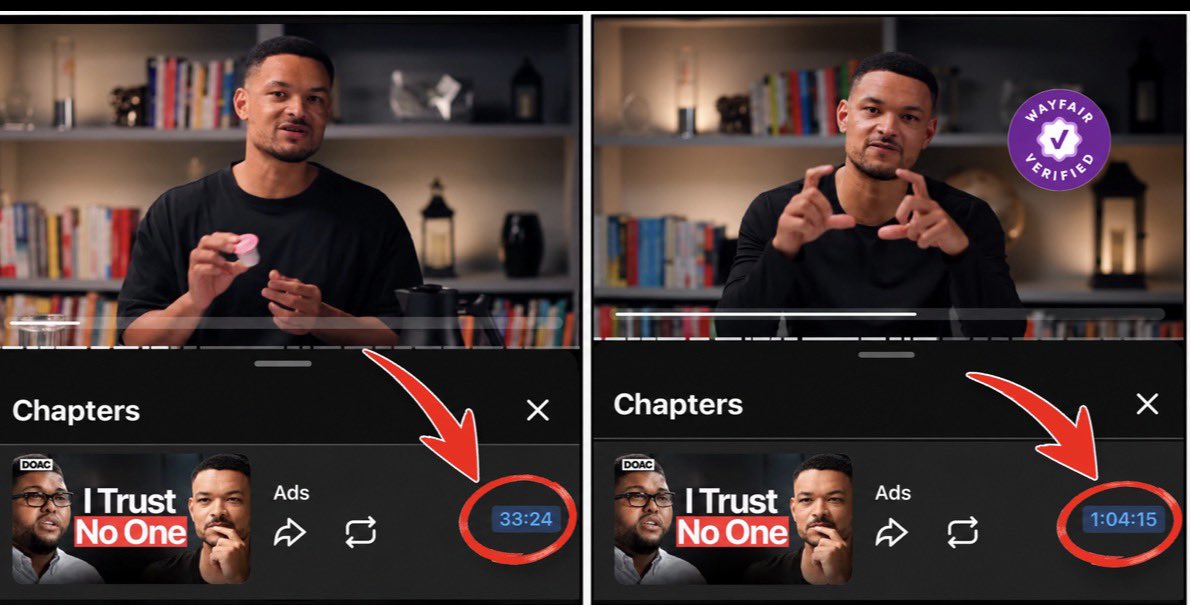
I just watched his 1 hr. 21-min podcast with Harry Stebbings (@HarryStebbings).
Here are my top 30 takeaways:
1.) Matt (@MattSwulinski) believes the E-commerce playbook is the correct model for SaaS. Every dollar of ad spend must trace back to an acquisition event. Just like every cent in E-commerce must lead to a purchase or add-to-cart.
2.) Start paid advertising immediately. Not after you have built organic brand presence. Paid is the fastest way to validate that your product-led growth funnel actually works. Because you can test messaging, funnels, and positioning within a week rather than waiting months for organic signals.
3.) 3 core acquisition channels for any early-stage company are Meta, Google, and lifecycle (email, SMS, or push). You can scale to your first $1 to $10 million in ARR on just those three before adding anything else.
4.) Before spending a single dollar on paid, get your analytics and conversion tracking infrastructure right. He estimates 90% of companies skip this step. Result: the ad platforms cannot identify your best customers properly. And you end up with a high cost per acquisition.
5.) SaaS has no out-of-the-box attribution tool equivalent to what e-commerce uses (like Triple Whale). SaaS teams must build their measurement stack from scratch with an analytics leader and a developer who can wire marketing signals back into each platform.
6.) If you want best results early on, optimize purely for your single most important acquisition event... whether that's a download, trial start, or a completed onboarding step.
7.) Retention is the product team's job. Growth's job is bringing in quality users at an acceptable cost.
8.) A 1:1 LTV-to-CAC ratio is acceptable early on if you have raised enough capital. Because speed of distribution matters more than efficiency when the market is crowded with clones. The long-run target is roughly 3:1.
9.) For AI or usage-based SaaS products, LTV-to-CAC alone is not enough. You must look at LTV on a gross-profit basis, accounting for token costs, inference costs, and all other variable usage expenses. Otherwise your unit economics will look healthier than they are.
10.) Creative is now the targeting on Meta. A Meta algorithm update called Andromeda removed manual audience targeting controls. Meta now analyzes the creative itself to find the right audience. This means the media buyer's job has become almost entirely creative strategy.
11.) At the scale of a $100K monthly Meta budget, you need 400 to 500 new creatives per month to avoid plateauing. Diversity of age, gender, setting, and hook style in creatives is essential.
12.) At Viktor, they run a creator program that pays creators a percentage of ad spend to produce UGC videos. Teenage creators aged 17 to 19 are earning $20,000 to $30,000 a month making a handful of ads. And as long as a great ad keeps spending, the creator does not need to make another video for a while.
13.) The top 20% of creators drive roughly 80% of ad performance. The best-performing creatives share a pattern-disruption quality: rough camera movements, an unexpected or messy opening, or a conversational tone that makes the viewer stop scrolling.
14.) YouTube requires its own dedicated creative program, separate from Meta UGC if you want to scale. A practical workaround for initial testing is to take story-format videos, drop them into a landscape static template with logos, ratings, and a CTA in Figma. And export that as a YouTube ad.
15.) At Whispr Flow, Google Ads was the single best-performing channel.
16.) When you hit audience fatigue on a channel, keep unlocking the next audience segment. Map your ICPs in order. Run creative and landing pages targeted at each one. Prove the economics. And then move to the next.
17.) Matt's approach to scaling budgets is to go as hard as possible until things break. Then pull back and use the failure data to learn where the ceiling is. Trying to figure this out gradually takes too long.
18.) If turning paid spend way down causes revenue to collapse, you have neglected the other half of the job: SEO, AEO, YouTube reviews, PR, and organic word of mouth.
19.) To run a successful referral program, the key is to make the reward tangible, immediate, and surface the offer at the exact moment of friction (such as when a user is about to hit a usage limit). Superhuman's "give one month, get one month" program generated 100s of referrals per power user.
20.) He sees free trial credits as a fully loaded marketing cost. If you are not adding the value of credits given away to your CAC calculation, you are not being accurate with your acquisition cost.
21.) AEO follows similar principles to SEO. But the most important external citations come from YouTube reviews, Reddit threads, and credible press mentions. AI crawlers pick these up when someone asks "what is the best tool for X." Traditional PR matters less for traffic and more for generating those external citations.
22.) Traditional PR like TechCrunch is still worth doing at launch. But mainly as a citation-building exercise for AEO rather than as a direct traffic driver. It is table stakes for credibility.
23.) TikTok and X ads have not worked for any of the 3 companies Matt has been at. X in particular is polluted with identical launch videos. X ads don't work. He is yet to meet a SAS head of growth or performance marketer that says that X ads print money.
24.) The biggest gap in teams is the absence of systems thinkers. Many people use AI to answer individual questions. But still do their jobs manually. A true systems thinker can map every input, output, and inter-relationship in their role. And identify exactly where agents can replace manual steps.
25.) Matt's interview test for systems thinking: Ask how a candidate uses AI workflows in their personal life, not just at work. A bad answer describes a single chat thread. A good answer describes a self-improving feedback loop where agent output is critiqued, refined, and eventually runs autonomously with only human approval gates.
26.) Matt built an autonomous sponsorship workflow at Whispr using Claude Code: the agent reads incoming newsletter sponsor emails. Negotiates rates. Researches audience quality. Drafts copy. Creates tracking links. Sends everything to the partner. Ingests performance data. And decides whether to renew, with only 2 human approval steps in the whole process.
27.) He recommends a "session end" skill inside Claude Code that automatically distills every working session into an Obsidian vault... logging decisions, open tasks, and learnings. This creates a compounding memory layer so future sessions can surface connections across weeks of work that a human would otherwise forget.
28.) His view on team composition is that most marketing teams should be dramatically smaller. Each role should be filled by one AI-native systems thinker who can manage what previously required 3-5 people. A single person with the right agentic setup could manage 100,000 influencers a month.
29.) His hiring hot take: probably fire most of your marketing team. The gap between A-players who have made themselves AI-native and B-players who have not is widening rapidly. And it's clearly visible in their output.
30.) Matt's broader prediction is that within 3 years, companies will function more like a board of directors. Humans will provide 20% strategic direction. And agents will handle 80% of execution. The marketing and growth leaders who understand how to architect and supervise those agent systems now will have a structural advantage over incumbents who do not.