The gov't theory in my case isn't about me. It's a template.
Under US v. Storm, "money transmitting" no longer requires custody or control of funds. Publishing code that others use is enough.
Who's in danger:
→ Every maintainer of open-source privacy, messaging, or crypto tools that any bad actor ever touches
→ Every operator of a financial service — DeFi or not — who learns some % of users are illicit and keeps operating. Knowledge alone becomes the crime
→ Every dev of immutable, self-custodial software, held to a duty to "stop" what is technically unstoppable
It's already working as designed. Michael Lewellen finished lawful crowdfunding software and can't publish it. He asked DOJ if he'd be prosecuted. Their answer, in federal court: we "cannot disclaim an intent to prosecute."
Finished code, sitting on a shelf. You don't need to be charged to be silenced.
And SDNY isn't done with me. Prosecutors want to retry me regardless — regardless of the hung counts, regardless of Van Loon, regardless of FinCEN's own guidance.
I've been fighting this for 3+ years. Legal defense at this level costs millions, and I can't do it alone.
If you write code, use privacy tools, or believe publishing software isn't a crime — this is your fight too.
Donate: https://t.co/lx9E4ILDrn
Every retweet helps. Every dollar goes to the defense.
The entire stablecoin economy is built on a monetary system that works in REVERSE of the dollar.
More credit = LESS money supply. Let that sink in.
Ep. 6 of Dose of Alpha is live 🎙👇 feat. @koryhoang of @Stably_Official
Plus: surviving the first stablecoin war, the Binance liquidity bloodbath, exogenous vs. endogenous taxonomy, and why the M2/M0 multiplier is inverted onchain.
📺 YouTube: https://t.co/ozGGaRg5hL
🎧 Spotify: https://t.co/5Tr0eXZ53X
DeFi protocols really need private access to Mythos before Anthropic gets social engineered by North Korea posing as Microsoft or some US megacorp that needs access/"lost their access key."
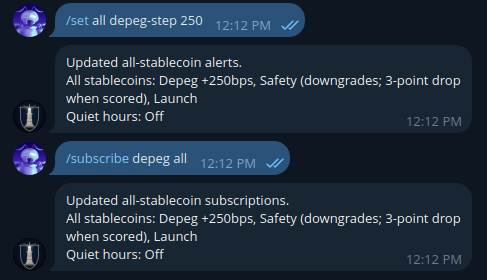
Tired of always being the last notified about stablecoin depegs?
2 commands on @PharosWatch Telegram bot is all it takes:
/set depeg-step XXX: defines XXX, a number in bps at which you want to be notified (2.5% here)
then /subscribe to all, specific, or list (ex: usd-top-25)
fxSAVE TVL just crossed $40M.
Over 3.9% APY. No token emissions. No off-chain wrappers.
Fees from fxUSD issuance. Yield from reserves. Compounded back into more stables.
Yield that comes from somewhere.
I’ve never understood why bridges have to always be fast. I get it for impatient retail or cross-chain arbitrage.
But many tasks aren’t very time sensitive. Which is why I always had a soft spot for the (now-defunct?) @fraxfinance bridge.
They called it Frax Ferry and gave the roles a nautical theme. The captain had admin roles, and a second set of actors called crew members had the power to temporarily pause to enforce a “stop, look, listen” process.
Normally I dislike meme-y themes (like food names), but in this case I think the ferry analogy helped communicate to users how it worked.
The Frax Ferry would have scheduled departure times between specific chains, and would take 24 hours to arrive.
This gave ample time to catch shenanigans. And also meant there was low risk of infinite mint, since any compromise would have to be sustained undetected for the entire journey.
I’m not sure if 24 hours is the right time period, but it’s hard to think that the Frax Ferry would have allowed DPRK to rekt Kelp.
To the extent a need for fast bridging still exists, it does seem appropriate for someone (bridge, issuer, swap-bridge counterparty) to levy a fee to account for the increased risks.
The model converged upon has been the asset issuers doing this for free - you’ll notice even on L2s, the standard bridges aren’t growing their escrows much as fast options proliferate.
I think we can agree there needs to be a rethinking about how this risk is shared. That could be a fee, lower claims priority, or some TBD clever solution.
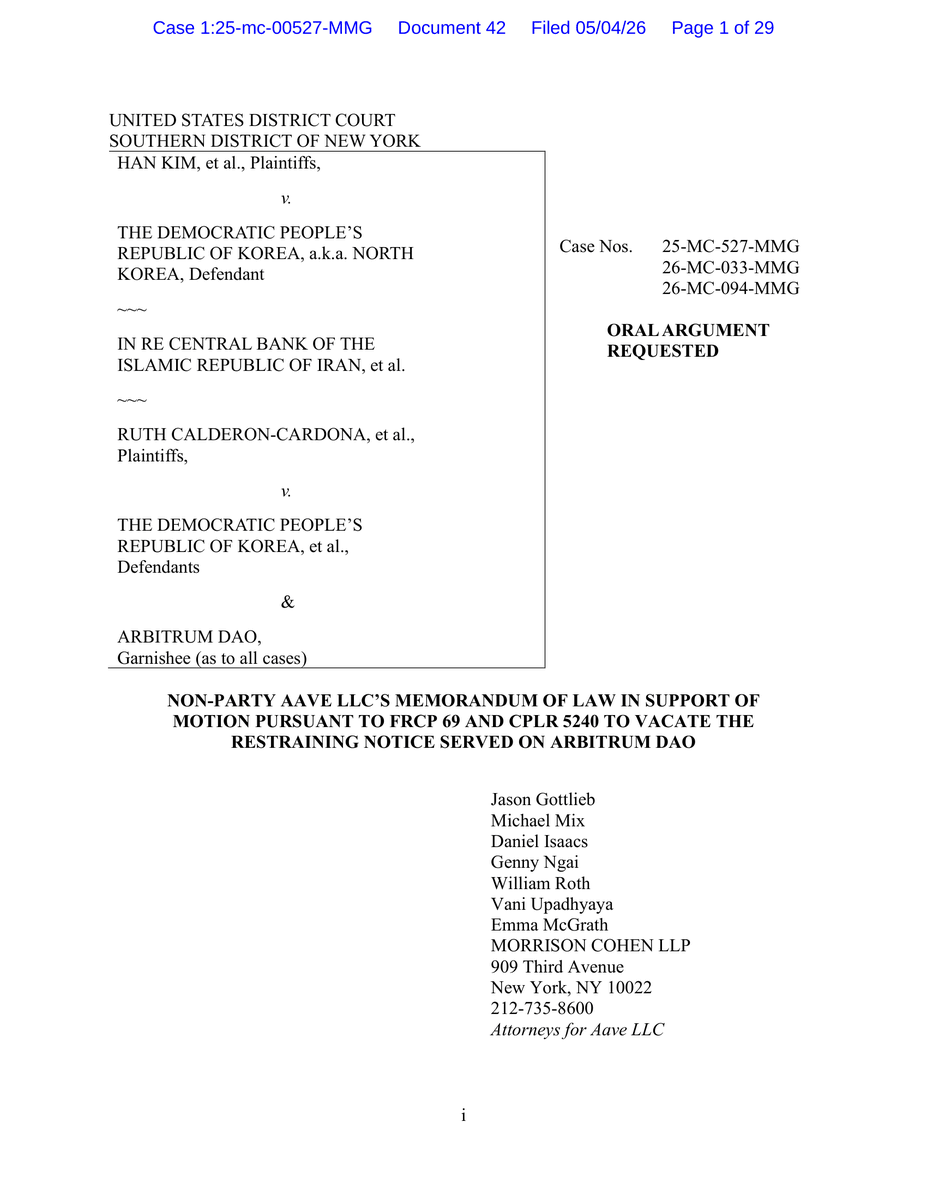
Aave LLC has filed an emergency motion to vacate a restraining notice served on Arbitrum DAO on May 1, 2026 that attempts to seize approximately $71 million in ETH belonging to victims of the April 18 exploit.
A thief does not gain lawful ownership of stolen property simply by taking it, and the law is clear on this. Those assets were recovered to be returned to users victimized in the April 18, 2026 exploit. Freezing them harms the very people this recovery effort is designed to protect.
We’ve asked the court for an expedited hearing and a temporary vacatur, and we are continuing to work alongside the Arbitrum community and DeFi United to make affected users whole.
255 commits. One week. And one feature that changes how you see stablecoin markets entirely. PharosVille is finally live, and you have to see it.
> PharosVille v1
A pixel-art harbor where Pharos data comes to life. Chains are harbors. Stablecoins are ships. DEWS alert tiers are sea zones. It is the most immersive way to experience the stablecoin market ever built.
> Frozen Stablecoin Archive
USR and BUCK become the first stablecoins to enter the Pharos frozen archive. Frozen assets retain their full history and analytics but are clearly marked and excluded from live data pipelines. The market moves on. The record stays.
> Security Audit Complete
A 10-phase audit remediation is now fully closed. Environment contracts, contagion graph, DEX discovery, taxonomy, fallback systems, and KYC blacklist hardening all addressed.
Pharos is running on a significantly hardened codebase.
> New Stablecoins Added
MYRC and KRWQ join Pharos coverage, adding Malaysian Ringgit and Korean Won pegs to our non-USD tracking. pmUSD gets a redemption backstop via sUSDS PSM.
> Cleaner Data Infrastructure
Stablecoin metadata has moved from a single monolithic file to individual per-coin files. Faster, cleaner, and easier to maintain as coverage grows.
> Funding Page Update
12 new donations received this week. The funding page now shows live donor share and prior month coverage. Every contribution is visible and appreciated.
100% agree, spot on. The only remaining Biden-era issue that still needs to be fixed is shutting down the DOJ’s criminal cases (Roman Storm and the others). While those are still hanging, every developer is unprotected and faces real criminal liability risk. SEC side is doing a great job now — finally giving crypto companies the civil clarity and comfort they need.