A major unforced error in crypto is treating technical dashboards as financial dashboards. Nowhere is this as obvious as with TVL of lending protocols. TVL is NOT a substitute for accounting!
Let’s look at TVL defined as “Value of all coins held in smart contracts of the protocol”, and how it would treat a bank with the following balance sheet:
Deposits (a liability): $100m
Loans (an asset): $80m
Reserves (an asset): $20m
Equity: $10m
The TVL of this simplified balance sheet would show up as:
$100m deposits - $80m loans + $10m equity = $30m TVL
Does that feel accurate to you? It should not, because it structurally undercounts economic activity.
In fact, TVL - a technical metric - is treating the bank’s largest asset (its loan book) as a liability and largest liability (its deposits) as an asset!
The problem is one of using the wrong tool for the job. TVL counts how many tokens are in a smart contract or group of affiliated smart contracts. That’s it. In its most simple form, TVL is mostly just counting the reserve ratio of the bank (or lending protocol).
TVL is not a substitute for actual accounting, and people need to understand this.
A deposit on Aave/Morpho/SparkLend/Compound/Euler/Curvance is a liability to that protocol or pool. You could put $1 trillion in deposits onto one of those platforms and TVL would become $1 trillion. But that’s not an indication of economic activity!
Now imagine $999.999 billion of that got lent out. TVL has crashed from $1 trillion to $1 million. Looks bad on a chart, right? But now we’re seeing economic activity!
There is a reason why TVL is not used outside of crypto - it is a technical metric, not a financial one, and any overlap is coincidental and concentrated in very basic protocols like DEXes.
@alfapeachmelba@EvgenyGaevoy@RonwHammond I think issuers want to make sure the costs of operating a structure are low and that tax consequences are not onerous. Basically all the things DATs skipped.
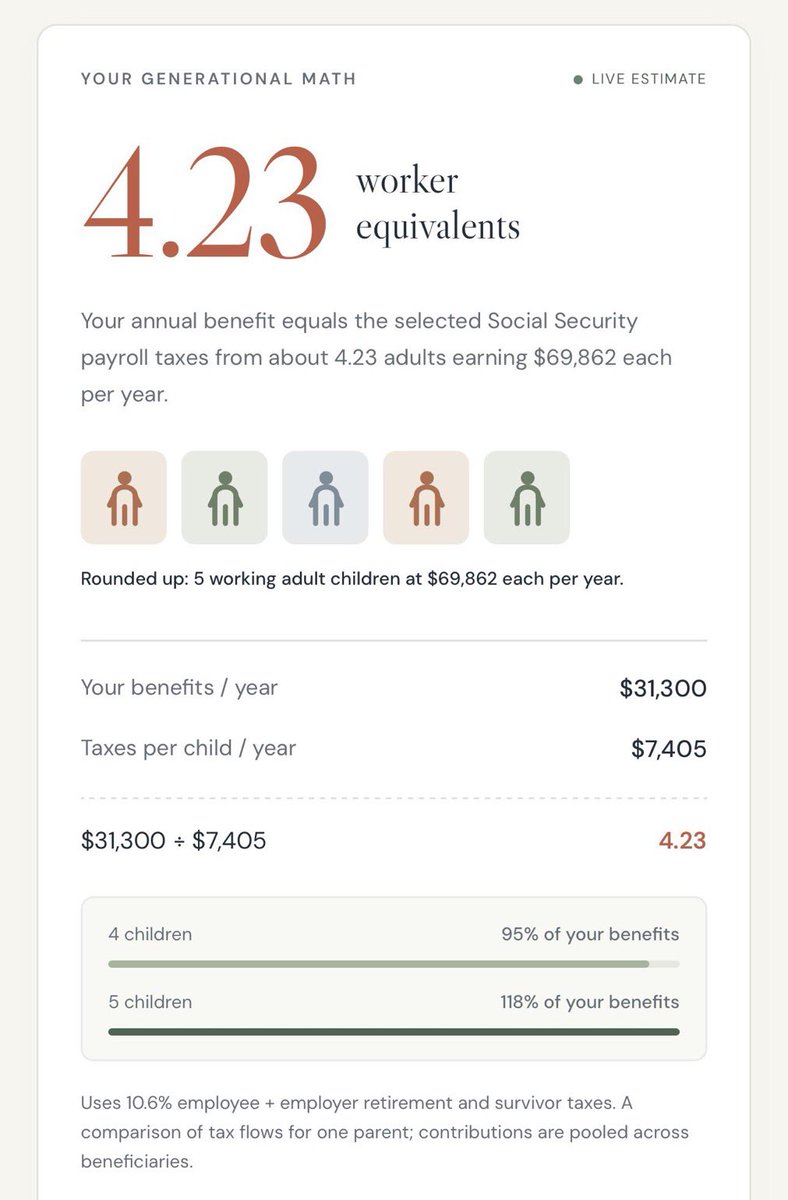
I see a screenshot of my social security benefits calculator out in the wild!
You can set each salary separately so you can see if your adult kids cover your SS (or if you and your siblings cover your parents)
You cannot provide an average income to every retiree when it takes 4 workers to pay for it.
You could provide a basic income for those actually needing it. But that’s not what’s being asked for. What’s being demanded is that generally poorer younger people subsidize generally wealthier older people until a specific generation is done.
I will predict once again that the winner in tokenized equities will be the outfit willing to go work with these companies.
It’s ADRs all over again, so it’s not like we haven’t seen an analogous process play out. Crypto is just speed running financial history (yet again)
@gakonst Some of this is downstream of lax oversight by the largest investors in the space. As projects grow the teams need a board or board-like governance for oversight. This is where liquidity was bad - it was often easier to dump or cut and run. And activists are despised in crypto
For a decade, northern Iraq used money nobody was printing. Old notes stayed in circulation, patched with tape and staples… but gained value as Saddam’s fall approached.
The strange tale of Iraq’s “Swiss” dinar:
https://t.co/lGQSavijC1
Unit production costs need to be competitive if the good or service being produced is available elsewhere!
Increasingly this means identifying weak incumbents susceptible to disruption, rather than going head to head with JP Morgan - or having genuinely new offerings
Uber lets people leverage their personal vehicles. It’s inefficient on a per unit basis but taps idle assets. Airbnb similarly works on those down-market uses of someone’s idle vacation home or hunting lodge
But a hotel can provide per-unit services at a higher level for cheaper
This is a tale as old as time - from the absurd (Mao’s backyard steel furnaces) to the mundane (the demise of local hardware and grocery stores in the face of chain competitors with scale).
This is also a lesson that should be internalized within the crypto industry…
A lot of AirBnB’s problems arise from decentralized production typically cannot compete when economies of scale exist.
Originally they were tapping into idle capacity. The truth is many of these properties don’t make sense as an investment.
Airbnb hosts are so out of touch with how the world works. They fail to understand that Airbnb is making these decisions because its business is struggling, and customers are increasingly avoiding the platform because they don’t want to deal with cleaning responsibilities.
For a decade, northern Iraq used money nobody was printing. Old notes stayed in circulation, patched with tape and staples… but gained value as Saddam’s fall approached.
The strange tale of Iraq’s “Swiss” dinar:
https://t.co/lGQSavijC1
AirBnB is pretty clearly a monopsony, and so vulnerable to anti-trust action. But the hosts are just such an unsympathetic constituency, and pushed back on a pro-consumer change. That makes it hard to see government intervention as a realistic possibility
JUST IN: Airbnb hosts threaten to strike after the company bans them from forcing guests to wash dishes, strip beds, or take out trash before checkout.
Those are completely different sources of demand: deposit a dollar to get a “stable” and encumber collateral to get a “stable”. The latter really takes off as you get into unsecured underwriting.
Stables have to wake up or tokenized deposits will eat their lunch.
People do understand that a bank deposit is essentially a CDP stablecoin, yes?
That’s why vanilla banking is an *ok* business but compliant stablecoins are lukewarm at best. It’s the operating leverage.
Well, we should probably distinguish between two different advantages a bank has: balance sheet leverage and entry demand.
Lending vs land, for example, not only provides the former but also a way for their “stable” to be born that’s not from surrendering a dollar.