Product founder. Married almost 20 years, father of four. Building @TheHusboApp to help men navigate relationships a little better. Learning in public.
I’m building an AI relationship coach for men.
Not because I’m an expert on marriage.
Almost the opposite.
I’ve been with the same woman for nearly 20 years. We have four kids. I’ve spent years in individual therapy and years in couples therapy.
And relationship conflict is still one of the biggest drains on my life.
I can have problems at work and keep working.
I can worry about money and keep functioning.
Even a migraine sometimes takes less from me.
But when my wife and I are really disconnected, it can consume almost all of my mental bandwidth.
I’ve also spent most of my professional life building software products.
So I started wondering:
Can we build something that helps a man in those moments?
Not something that tells him his wife is wrong.
Not a chatbot that endlessly validates him.
Something that helps him understand what’s happening, see his own patterns, communicate better, and gradually build the skills to handle these situations differently.
That’s what I’m trying to build with The Husbo.
I’m using AI agents, relationship research, years of product experience, an unreasonable number of tokens, and a growing laboratory for testing whether the thing actually helps.
I don’t have marriage figured out.
I’m building this precisely because I don’t.
I’ll document what I learn here.
One of the biggest things I learned after 1+ year of working with AI agents:
you should never give away control over what exactly you want to get in the end.
AI can write the spec.
Can suggest architecture.
Can split the task.
Can notice things you forgot.
All good.
But you still need to be the person who knows what a good result actually means.
Because “make it good”, “make it professional”, “do it better” sounds like freedom for the agent.
Usually it just means there are no clear requirements.
And then AI does a funny thing.
It decides what you probably wanted.
Then it builds that.
Then it also kind of decides that the result is good enough.
Very efficient :)
And this is where a lot of AI slop comes from.
The better agents become, the less I care about controlling HOW they do the work.
But I care even more about WHAT exactly should exist in the end.
Agent autonomy should grow inside the spec, not instead of the spec.
I’ve reached the point where The Husbo needs more than my own judgment.
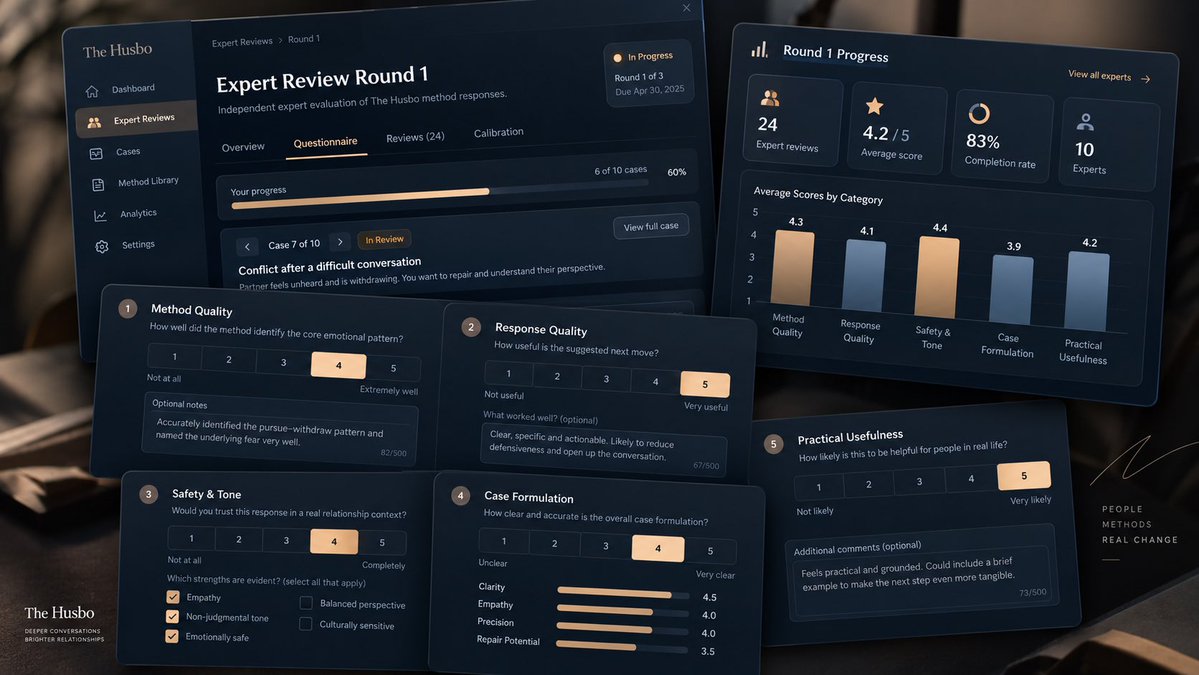
So I’m preparing the first expert review of the method.
Not just “does this look good?” feedback.
A structured evaluation: several key sections, dozens of questions, metrics, edge cases, and real conversations to review.
First round soon.
Time to let other smart people try to break what I’ve built.
There is no magic pill for relationships.
And there is no one big insight that can suddenly change a man who spent decades learning not to feel, not to talk, not to show weakness.
It doesn’t work like that.
And you don’t need to break yourself either.
Change is not about becoming another person.
It is kaizen. Hundreds of small repetitions.
You notice anger — you don’t answer immediately.
You notice hurt — you stay with it for one minute.
You notice the thought “here she goes again…” — you don’t automatically believe it.
One minute.
One small space between what happens and your reaction.
Today.
Tomorrow.
Again.
And again.
At first, almost nothing changes.
And then one day you realize: before, this would become a fight. Now it doesn’t.
This is how people change.
Not through one huge realization.
Through thousands of small moments when you do something just a little differently.
I’m building an AI relationship coach for men.
Not because I’m an expert on marriage.
Almost the opposite.
I’ve been with the same woman for nearly 20 years. We have four kids. I’ve spent years in individual therapy and years in couples therapy.
And relationship conflict is still one of the biggest drains on my life.
I can have problems at work and keep working.
I can worry about money and keep functioning.
Even a migraine sometimes takes less from me.
But when my wife and I are really disconnected, it can consume almost all of my mental bandwidth.
I’ve also spent most of my professional life building software products.
So I started wondering:
Can we build something that helps a man in those moments?
Not something that tells him his wife is wrong.
Not a chatbot that endlessly validates him.
Something that helps him understand what’s happening, see his own patterns, communicate better, and gradually build the skills to handle these situations differently.
That’s what I’m trying to build with The Husbo.
I’m using AI agents, relationship research, years of product experience, an unreasonable number of tokens, and a growing laboratory for testing whether the thing actually helps.
I don’t have marriage figured out.
I’m building this precisely because I don’t.
I’ll document what I learn here.
I don’t measure whether the relationship got better. I check if the method behaves the way it’s supposed to.
First - probes library with hundreds of situations. Each probe is a single message and turn and score must/not must.
Exam - a frozen set of those probes on one method version.
And finally - live session with an llm-judge and 0-2 score for each turn. That’s an observation, not an exam pass.