@mcneiilly This is wild, and I can't tell whether you're being genuine or trolling. I live in a studio that's bigger than that, with a bathroom, constant clean (free) water, and rent's only about $60/mo
My idea of a good life: earn from a first world country, live in a third world country.
@JamesIvings@nico_jeannen Hey. As someone who did a database unit in school, normalisation was hammered right into my DNA. I get how denormalized data would save on read time. But, when you have duplicate data like that, what happens when you want to update it?
Entrepreneurship culture in America is all messed up and it’s a shame.
TechCrunch. Product Hunt. Shark Tank.
It’s all about new ideas. Changing the world. Innovation. 0 to 1. Blue ocean. Venture capital and exits and scalability.
And IT’S ALL A LIE.
If you ask the average American who a real entrepreneur is they’ll say Jobs, Musk or Zuck. We read their books and idolize them and hang on to their every word.
So the brightest among us think they need a moat. A new idea. Something revolutionary. We're setting them up for FAILURE.
I took an entrepreneurship course at Cornell in 2011. 24 kids with new ideas. Big plans. Pitch decks looking for series As.
I was #25 with a regular old-fashioned business. When professors asked me what my differentiator was I didn’t have an answer.
"We're just going to pick up people's stuff and store it when they go home for the summer. I'll answer the phone, do things a little better and I think I can make some decent money."
I saw a company out there doing sweaty, non-scalable work. They weren't very good at it and yet they made really good money.
I started by trading my time for money. Bought a $1500 cargo van. Storage Squad was born. Used the things I had in my life to make some profit.
I wasn’t trying to educate a customer base.
I wasn’t following my passion.
I didn’t need funding or a network.
I wasn’t competing against brilliant folks from Stanford.
I want trying to prove a concept.
I wasn’t emotionally attached to anything except adding value.
My customers and my competitors existed. I could study them interacting with each other. I made decisions with my brain, not my heart. I was competing against folks with fax machines, clipboards and paper ledgers.
And the best part... WE WERE PROFITABLE FROM DAY ONE.
Not a single one of those 24 folks in my class succeeded. They all went and got jobs. Their new ideas didn’t catch on. They all had dreams of millions of users and an exit. Scalable models that could work anywhere from a computer. But 99% failed to make a single dollar.
We made enough money in a few years to build our first self storage facility. That grew into the 60+ property $100m+ portfolio we own and operate today. We sold the service business in January 2021 for $1.75 million. We had no debt and no silent partners. My business partner and I split the cash.
So who are the real entrepreneurs? Who are the wealthiest people you know? I’m not talking about money. I’m talking about the people who do what they want to do when they want to do it. Who are they?
Now here comes the hard truth. I know a lot of wealthy entrepreneurs. None of them had new ideas. Very few of them raised VC money. None of them were on shark tank. They all did common things uncommonly well. Regular old businesses just a little better.
BORING STUFF.
Most of them have a few things in common: They worked really hard doing something not fun for 5+ years. Many times 20+ yrs. They started out trading their time for money. They did things that weren’t scalable. Many of them offered services.
They all had to talk to people. Most of the time face to face. They had to sell themselves and their ideas. They didn’t take a lot of risk. Most of them hired coders but few of them were coders.
The main point:
Stop buying into the hype. The click bait. The sexy stories of overnight success and mega riches. Entrepreneurship isn’t that complicated. Do something with good odds, low risk and moderate rewards. Don’t master your craft, master leading other people.
Think with your head, not your heart. It’s not about you and what YOU love or what YOU want to be doing. And lastly.. Start SMALL.
Biz is about momentum. I started 10 yrs ago carrying boxes up spiral staircases. Now I’m buying millions worth of real estate.
And the best part. When you’re successful, experienced, wealthy and you have a killer network...
It’s time to change the world with something BIG.
A few years ago, I realized I wasn’t unhappy anymore.
The main change: living life noting “good days” and “bad days”.
Then, looking for the things I could control that happened on good days.
Then, deliberately repeating them.
This lead me here:
1) I eat the same stuff. This minimized bad food experiences and kept me in shape. Which always made me feel better than not being in shape.
2) I lift weights with people I like. I noticed I always had good days if I worked out with people I liked.
3) I work on something I could see visible progress on (I write everyday). I noticed when I did that, I felt some larger accomplishment.
3.5) Later I realized if I did that activity with a friend, it made it even more enjoyable. Which is what has given birth to @DrKashey and my daily writing sessions.
4) I unwind with a nice view. I noticed when I had a dedicated place to sit quietly and read or reflect my days went better.
That’s about all I’ve got that actually made me less unhappy.
Simply paying attention to what happened on good days then trying to recreate it might’ve been one of the most valuable things I’ve done for myself.
TLDR: I spend as much time as I can doing things I like with people I like and ignore as much of everything else as I can.
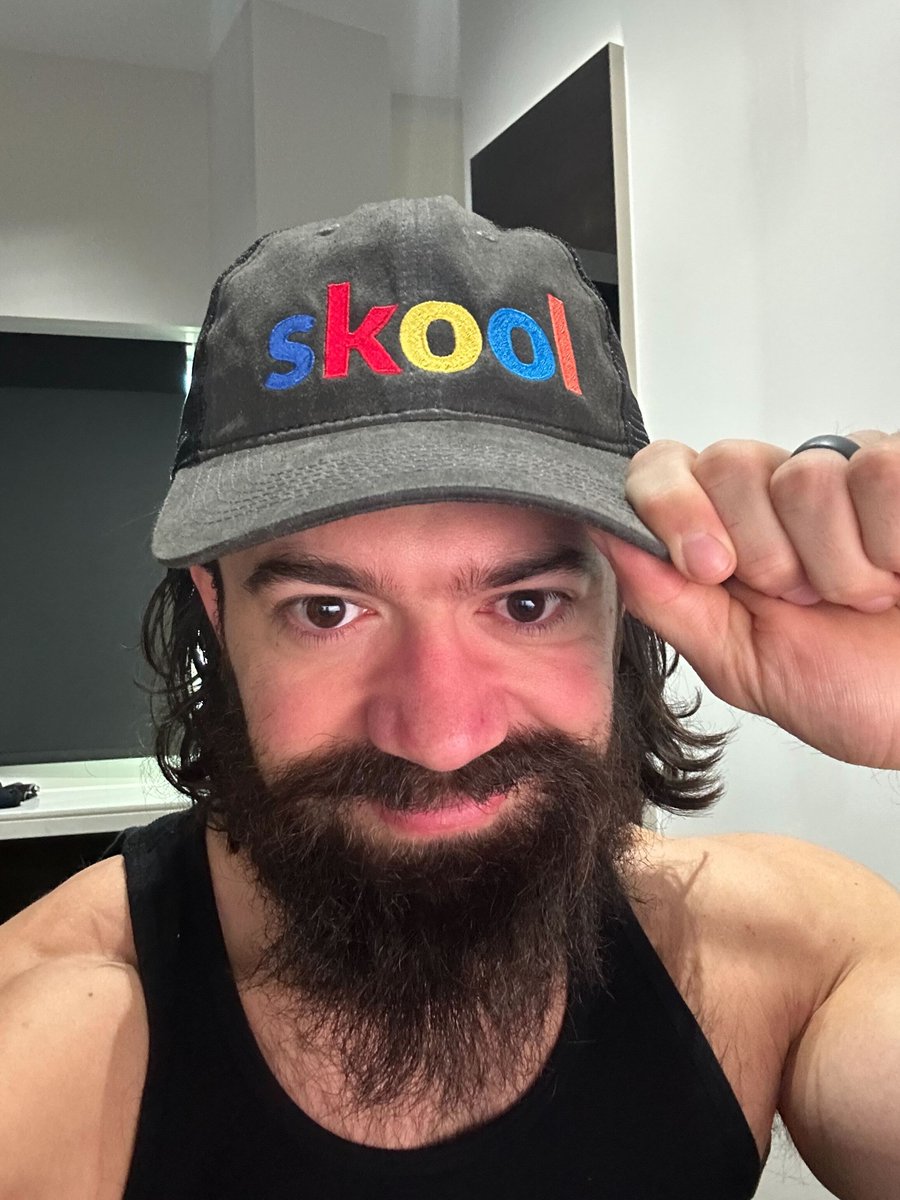
**BIG Announcement** I just made the largest investment of my life into https://t.co/VLS8LzdCDa — a platform with millions of users that makes starting your own online business simple, easy, and fun.
I’ve been looking for an opportunity to make starting a business accessible to EVERYONE. And after four years…I finally found it. Skool is that opportunity.
To give you an idea, users are joining Skool communities so fast that host payouts are growing by 62%...PER. MONTH. (Not a typo).
If that sounds interesting…we’ve got something big coming. It involves business. Competition. Money. Prizes. And most importantly, you. It’s like nothing you’ve ever seen before. You’re gonna love it. More Details to follow…stay tuned.
Skool 🚀🌙
When I was 20, I coded through new years eve because I felt stuck in life. I launched Mixpanel on Jan 1. Nobody noticed but I had a deadline to hit. I salute you hackers tonight 🫡
A lot of very smart people work in strange ways / with a lot of quirks (e.g. contemplating for hours and appearing to do nothing, while then suddenly having 100x output burst).
This usually makes them not a great fit for traditional corporate world, where you often have to fake being busy & work around fixed structures.
The great thing about small teams working in a flexible structure with high autonomy is that you get to witness these quirks manifest into greatness, time and time again.
Many genuinely productive people are misunderstood because their perceived methods many not ‘look’ like hard work from the outside.
Organizations that are able to attract these people at scale & are able to create a culture in which they can flourish, have immense potential for innovation / technological breakthroughs (think OpenAI, SpaceX, ...)
This was my first online appearance in 2020.
• No fancy background
• No aesthetic setup
• Not so confident
I started with a laptop.
Had no idea how useful having an online presence could be.
There was a time when I used to think about quitting everything.
I started self learning.
Joined Twitter and started creating content.
Built over 400K audience in 3 years.
Learned and earned a lot.
You can do it too!
I am not here to gatekeep.
These 10 actionable tips got us a $20,000/mo indie business.
Use them in 2024 🫡
1. Don't start with a product
Customers don't pay you to build the product.
They pay you to solve the problem.
So, your goal is to understand how to solve the problem better than others AND reach as many potential customers as possible.
Before writing a single line of code, make sure you get clear answers to 2 questions:
• What do I understand about this problem that other competitors overlook?
• What 1 channel will get me the first 10 paying customers?
Of course, you can skip this "boring exercise".
But don't be surprised to waste 6 months launching useless products nobody needs.
2. Know when to focus and when to experiment
Launching 12 products in 12 months will do more harm than good.
Focusing on your first product for 12 months is usually a bad idea, too.
Why?
Because there is time to launch new things to see what sticks. And there is time to grow what is working.
This rule applies to both product and marketing.
If your 3rd product is a clear winner, spend at least 3 months growing it.
Don't launch a new product in 2 weeks. Otherwise, you will get a reputation as a "jumper" who isn't reliable enough.
But also, don't burn your savings trying to grow your first product. 99% chances are it's "ungrowable," and you will be better off launching something new.
3. Optimize for simplicity
We are all brainwashed by VC propaganda.
Launching a simple AI wrapper? Looser.
Building over-complicated B2B SaaS? New Steve Jobs.
It's all ego bullshit.
If a 30-minute discussion solves a problem, sell 1-1 consultations.
If a recorded education video solves a problem, launch a course.
The simpler, the better. You will have a shit ton of external problems that will make your life harder.
By the way, the same rule applies to no-code.
If you can do it without writing code (AI wrappers, marketing landing page), do it without writing code.
There are 0 bonus points for coding your products.
4. Don't limit yourself to Twitter
"I just want to tweet about my product like %famous_solopreneur%"
Yeah, this is not how it works.
Every successful Solopreneur is doing marketing beyond Twitter:
• Side-project marketing
• Influencer marketing
• Facebook Ads
• Affiliate marketing
• Email marketing
• Cold outreach
• SEO
The list goes on and on.
Do marketing that works for your product and audience.
It requires stepping from the comfort zone.
But the results are worth it.
5. Be obsessed with the Conversion Rate
You rarely need more website visitors.
You often need a better marketing funnel to convert existing website visitors.
• Product demo
• Social proof
• Pricing
• Reactivation
• Upsells
Focus on nailing these steps.
You will get a better product offer that more people want to buy easier.
Win-win.
6. Leverage one-time payments first
Recurring revenue is nice.
But it's harder to sell it. Even if it only costs $9/mo.
Start with one-time payments: lifetime deals or limited-time passes.
You can charge from $49 to $199 for most products.
Way easier to get $5000/mo this way.
And yes, you need to get customers every month this way.
But if you are not ready to do it, Solopreneurship is not a good fit with you.
7. Forget about marketing shortcuts
Your ChatGPT replies are degenerate.
Your ChatGPT blog posts are useless.
Stop.
There are no easy roads to automate marketing in the beginning.
Do the hard work.
Create good content. Build relationships. Talk to people.
Marketing will be 50% of your work. The more you try to speed it up, the longer it will take.
8. Get so much feedback it starts to hurt
It's easy to think you are the smartest one.
Your idea will revolutionize the market, and Forbes will pay for an interview with you.
Relax, it's not happening.
There is a better way.
You can leverage the wisdom of hundreds of people to grow your business. You just need to ask.
Ask people to roast your landing page. Ask people to play with your product. Ask people to feedback on your pricing.
Ask your audience. Ask seasoned Entrepreneurs.
And you will soon understand that there are tons of smart people. Often smarter than you.
And this is when you will get clarity on how to grow your business.
9. Prioritize revenue over procrastination
You don't need a 10-page privacy policy to launch your first product.
You don't need "forget your password" feature before the profitability.
You don't need a professional product logo ... ever.
It's okay to have a profitable app with not covered edge cases. Don't overthink it.
Focus on growing revenue. Focus on dumb stuff after hitting profitability.
10. Reverse-engineer best Solopreneurs
Here's the deal.
It's perfectly fine to analyze what's working for the top 1% and then implement it in your business.
But, please.
Don't just copycat their products / landing pages / emails and call it a day.
You will not go anywhere with this approach. Personalize everything for your product.
Thank you.
@xdamman@enableflash@Nicolascole77 You must have only seen the first book in the picture and jumped straight to the replies then because the second book has the name "JOAN DIDION" clearly written on it. All caps, huge af font.
- We often confuse 'joy' with 'happiness'. The former is a 'transient emotion', while the latter is more of a 'state of being'. Be sure to understand the difference.
Be well, and happy new year, everyone! 💙