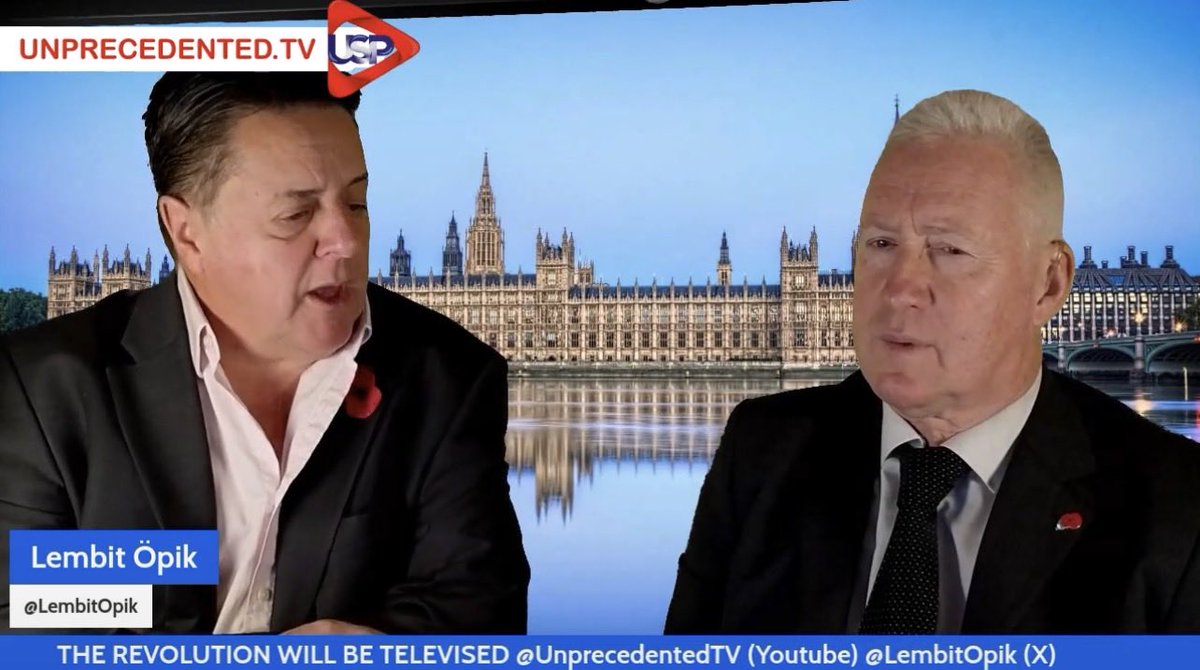
An incredible investigation by @OCCRP and @DelfiEE, led by Martin Laine, has exposed more than 500 ‘useful idiots’ across the West who took part in an extensive Russian fake news campaign.
It includes, for example, Lembit Öpik, the former Liberal Democrat MP turned conspiracy theorist, pictured here hosting neo-Nazi Nick Griffin this week.
It includes Ben Aris, the former Moscow correspondent and “Russia expert” who has both Leonid Ragozin and Mark Galeotti working for him.
They are among the 500 who were supporting “Doppelgänger”, a state-backed Russian disinformation campaign, creating clones of genuine news sites to spread pro-Kremlin narratives aimed at undermining support for Ukraine.
One website contributing to that is ‘Recent Reliable News (RRN)’. It contained more than 500 interviews in its database with pro-Russian useful idiots, which would have been posted across Doppelgänger-linked websites, but have now been made public.
@thenerve_news has attempted to contact those involved, but many have been evasive, such as Lembit Öpik and Ben Aris.
When asked to comment, Öpik claimed not to understand the question, made bizarre remarks about security services, and did not respond to follow-up messages.
Meanwhile, Aris claimed that the Russian propaganda campaign only used his public statements from X. He stopped responding when it was pointed out to him that they’d actually found the videos that he recorded specifically for this campaign.
Full investigation from the OCCRP here. Give it a read and give @Martinlaineolen a follow for this incredible work. https://t.co/LBwTqWfVjL
Not long ago agriculture employed ~70% of the workforce. Now it is ~2%. Undoubtedly there were some painful adjustments, but the result wasn’t a 68% unemployment rate. In another case, the Industrial Revolution increased worker productivity by 50 to 100 times. Again, certain workers were displaced but in this case overall employment in manufacturing increased. Increased productivity is not the enemy.
Dmitrij Miedwiediew, były prezydent Rosji, stwierdził, że w Polsce doszło do zamachu stanu, a “liberałowie Tuska, protegowanego Brukseli, uciskają konserwatystów z PiS”. I wszystko jasne.
Ad agosto sono stato in Lituania. Abbiamo noleggiato una macchina e girato il Paese. È stato bellissimo, ma non è questo che voglio raccontare.
Una sera, a Vilnius, una persona che era con me mi ha detto una frase: «In Italia non ci abbiamo capito niente».
Quel giorno avevamo visitato l’ex sede del KGB. Celle grandi quanto un armadio, stanze di tortura, prigioni per dissidenti e religiosi. Una stanza dove i prigionieri politici venivano giustiziati, uno dopo l’altro, e i corpi fatti sparire. Ci sono ancora i buchi dei proiettili nel muro. Nel museo, oltre ai crimini commessi dall’URSS (milioni di persone deportate, intere famiglie distrutte, oppositori perseguitati…), viene raccontata anche la storia dei partigiani lituani. Uomini e donne che combattevano e morivano per liberare il proprio Paese dall’occupazione sovietica.
E quella voglia di non finire mai più sotto il dominio russo la senti ovunque. Nei musei, nelle testimonianze delle persone, nelle condanne ai crimini che la Russia commette ancora oggi. Senti una continuità storica fortissima, come se quello che succede oggi in Ucraina fosse anche parte della loro storia.
Quella persona era rimasta in silenzio per un po’ prima di dirmi quella frase. Aveva votato comunista per gran parte della sua giovinezza. Come tanti italiani, era cresciuta pensando che il comunismo fosse l’opposto del fascismo e quindi il massimo della libertà e della giustizia. Per lei la bandiera dell’URSS rappresentava la liberazione, la resistenza, la difesa degli oppressi. E invece: «Mentre in Italia votavo comunista, qui c’erano persone che venivano imprigionate, torturate e uccise proprio da chi finanziava il partito che votavo».
Non erano cose che non si potevano sapere. Le repressioni sovietiche erano denunciate già allora. Ma l’URSS finanziava il più grande partito comunista dell’Occidente, quello italiano, ed esercitava un’enorme influenza sulla nostra vita politica e culturale. La propaganda sovietica ha lasciato un’impronta profondissima in Italia. Quella di Putin ha saputo sfruttare anche quell’eredità.
Siamo cresciuti in un Paese dove gli stessi simboli che per milioni di europei rappresentavano occupazione, deportazioni e repressione venivano esibiti come simboli di libertà. E con questa storia non abbiamo mai fatto davvero i conti.
Ancora oggi c’è chi scende in piazza con bandiere sovietiche, convinto di stare dalla parte degli oppressi. E penso a quei ragazzi e a quelle ragazze lituane, e non solo, che mentre noi celebravamo l’URSS morivano per liberarsi proprio dall’URSS. Per essere liberi.
«In Italia non ci abbiamo capito niente». E purtroppo continuiamo a non capire.
IHere's what Pres.Trump has done for Vladimir Putin since 2017:
🇺🇸➡️🇷🇺 First term
1Stood next to Putin in Helsinki and took his word over U.S. intelligence
2Lobbied to bring Russia back into the G7
3Withheld military aid from Ukraine to squeeze Zelensky (impeachment #1)
4Pulled out of Syria, handing Russia a freer hand
5Openly questioned NATO's mutual-defense pledge
6Lifted sanctions on Deripaska-linked companies, including Rusal
7Walked away from the INF nuclear treaty
8Walked away from the Open Skies treaty, leaving our European allies with less visibility
🇺🇸➡️🇷🇺 Second term 9. Called Russia's G7 expulsion a "mistake" 10. Declared Moscow "holds all the cards" 11. Opened talks with Russia with zero preconditions 12. Berated Zelensky in the Oval Office, then paused aid and intel to Ukraine 13. Halted offensive cyber operations against Russia 14. Had the U.S. vote WITH Russia against a UN resolution condemning the invasion 15. Said "Crimea will stay with Russia" 16. Rolled out the red carpet for Putin in Alaska 17. Pressed Ukraine, not Russia, to give up territory
18. Starshield
19. Diesel
20. Revoke Graham sanctions
That's not "America First."
You could never make that list of things a President has done for Zelensky, or for NATO. Ask yourself why.
🥴The United States has proposed unfreezing a portion of frozen Russian state assets (approximately €260 billion, mostly held in the EU) and transferring them under Washington’s control — including through a special financial structure supervised by the US — in order to bring Putin back to negotiations on ending the war. The idea, promoted by Trump’s special envoy Steve Witkoff and Jared Kushner, was discussed last week in Miami with representatives from Ukraine, France, Germany, the United Kingdom, the EU, and NATO; European representatives rejected the plan, opposing any loss of control over the assets and any return of funds to Moscow. A US official confirmed that the issue is being considered as part of a comprehensive peace agreement, although the mechanisms are still under discussion (unfreezing requires the consent of all 27 EU member states).
Source: Financial Times.
Starshield systems are owned and controlled by the US government. Any limits on speed or usage are decided by the US military and ultimately POTUS.
Starlink is a commercial service owned and controlled by SpaceX. Usage of Starlink is limited to civilian or defensive activities and cannot be used for offensive military action, as doing so would be inappropriate for a commercial company.