Westminster may finally be about to have the argument it has spent 40 years avoiding.
If Andy Burnham returns to Parliament, the political class will know how to cover it. A leadership drama. Who is up, who is down, whether Keir Starmer can survive, whether Labour is once again turning inward. The familiar machinery of Westminster psychodrama will whirr into life.
That framing misses the larger point. Burnham’s possible return matters not because of what it says about Labour’s leadership, but because of what it reveals about the British state: what it can still do, what it has forgotten how to do, and what kind of country it must become if it is serious about resilience.
Britain is finally having a more serious conversation about national security. The Strategic Defence Review, the pivot back towards Europe, the recognition that hybrid warfare turns citizens, infrastructure and civic institutions into part of the front line: all of it marks a real shift in how the state thinks about its own survival.
But at the centre of that conversation lies a question that the defence establishment, and most of Westminster, still does not want to answer. What kind of society do you need to be before resilience is possible?
Finland is now the model everyone cites. Comprehensive security. Whole-of-society defence. Civilian preparedness woven into military planning. British strategists admire the Finnish system and ask how it might be copied. But the admiration stops short of the uncomfortable question: why does it work there?
The answer is not geography or history or some mysterious quality of Finnish national character. It is structural. Nearly 80% of Finns say they would defend their country if attacked. In Britain, the figure is closer to 33%. That gap is not an accident. It exists because Finland has spent decades building a society in which people have a genuine stake in what they are being asked to defend. Energy is affordable. Housing is available. Public services function. Institutions command trust. The Nordic welfare state is not a sentimental add-on to Finnish security policy. It is the foundation of it. You cannot ask people to defend a country that does not work for them.
Britain has spent 40 years building the opposite. The privatisation of essentials – energy, water, transport, housing – transferred wealth upwards from households to shareholders while making the basics of everyday life more expensive. The state, stripped of the tools to control costs at source, has been reduced to compensating after the fact.
Out of every pound the Government spends on housing, 88p goes to subsidising private rents. Just 12p goes to building homes. When energy prices spiked in 2022, the Government spent £40bn in a single winter cushioning the blow, not because it had a resilient energy system but because it lacked one. Debt interest now consumes more than £100bn a year. Britain has the highest debt servicing costs in the G7: the compounding price of financing failure rather than eliminating it at source.
This is what bond market dependency actually looks like. It is not an abstract fiscal condition. It is the consequence of a state that has been stripped of the supply-side tools that would let it cure the problems it now pays, indefinitely, to manage. And here is the paradox the Treasury refuses to confront. The countries that borrow most cheaply are often those that have retained the public investment model Britain abandoned. The spread between UK and Dutch borrowing costs has widened sharply not because markets fear public investment, but because they have lost confidence in a model that borrows to subsidise private failure while never addressing its causes.
This is the connection Britain’s defence debate is missing. The familiar framing, that social spending is what must be sacrificed to meet the NATO target, is not merely politically toxic. It is strategically illiterate. Cutting the foundations of social cohesion to fund the hardware of national defence is self-defeating. You end up with planes and no pilots, submarines and no crew, an army that cannot recruit because the society it is meant to protect has stopped believing in itself.
I think Burnham understands this. That is why his programme is more interesting than the leadership gossip suggests. What he has been building in Greater Manchester – public control of transport, expanded social housing, investment in the productive foundations of the city economy – is not a nostalgic rerun of postwar nationalisation. It is a proof of concept for a different kind of state.
The Bee Network is the most visible example, but the argument behind it travels. A state that can shape markets is not condemned to subsidise their failures. A state that produces affordable energy through public generation does not need to spend tens of billions cushioning every price shock. A state with a serious public housebuilding programme does not need housing benefit to rise endlessly in line with private rents. A state that builds institutions people can see, use and trust begins to restore the civic confidence on which resilience depends.
The real constraint on Britain is not money. It is capacity: the workers, institutions, supply chains and public purpose needed to turn national will into national renewal. Britain’s tragedy is not that it has run out of money. It is that after 40 years of hollowing out the state, it has made itself less able to act.
Burnham’s critics will reach for the familiar warning. Borrow more, spend more, spook the gilt markets, repeat the Truss disaster. But this misunderstands both the problem and the opportunity.
Bond markets do not have ideological preferences. They have functional ones. They prefer clarity, credible revenue streams, productive investment, and a state with a plan. What they punish is not public ambition but incoherence. A properly designed productive state programme would not be a leap into fiscal fantasy. It would be an attempt to end the much costlier fantasy that Britain can keep borrowing to compensate for broken markets while refusing to repair them.
The defence conversation and the economic conversation need to become the same conversation. Finland did not build national resilience by choosing between welfare and security. It built resilience by understanding that they are inseparable: that a country in which the basics work, where people trust one another and the institutions around them, is one that can face danger with something more than anxiety.
That is the deeper argument Burnham represents. Westminster will be tempted to treat him as a leadership story. It should resist the temptation. The question is not whether Burnham can return to parliament. It is whether Britain can return to the idea that the state should make life work. Because a country that cannot command the confidence of its people cannot truly defend itself.
@SaulStaniforth@JOwusuNepaul@SaulStaniforth .
Surely you know no one pays for students to go to University? It’s paid for like all govt spending: money creation.
No matter how many Central Banks explain this simple fact, progressives are determined to stick to Thatcher’s lie.
Taxes do NOT fund the govt
This plan will destroy internationally protected saltmarshes and curlew habitats in the Dee Estuary.
It is being pushed through as a project of 'Critical National Priority' so it can connect to carbon capture technology which has failed almost everywhere it has been attempted!
Why should you have to tell firm after firm that you’re vulnerable? Our new @mmhpi campaign is for a ‘tell us once’ service for those with mental (or physical) health conditions, to minimise stress in a crisis.
Do watch and read more here https://t.co/v9nNSonaXx
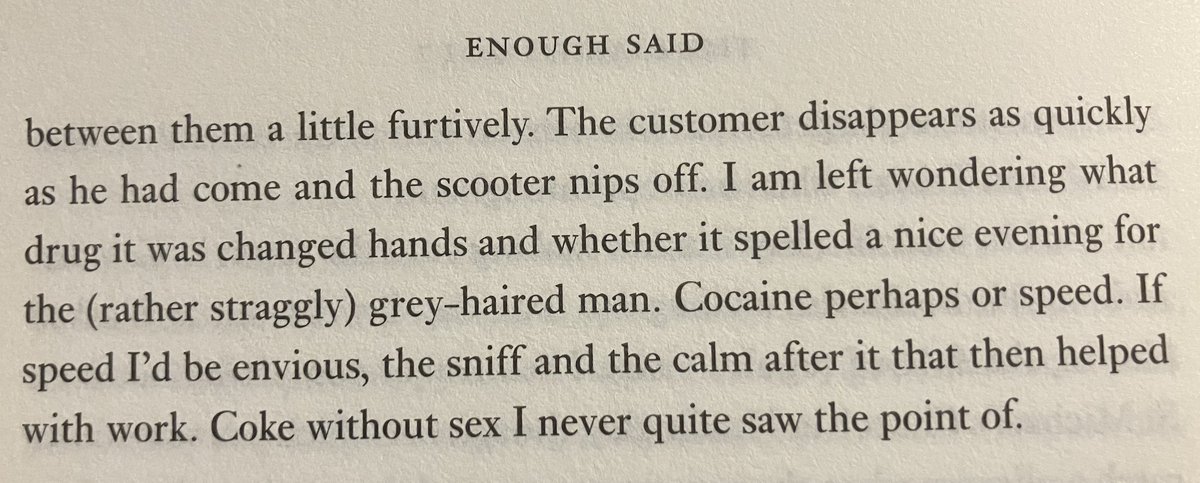
Reading the latest volume of Alan Bennett's Diaries: "Enough Said".
Have to say, wasn't prepared for this entry in March 2017 where AB sees a drug deal taking place on the street outside his window.
this is hard to explain but
middle class people say 'mum' when referring to their mother in external conversation, whereas working class people (correctly) say 'my mum'.
i've noticed this for years but i now have enough data to make the statement. cheers.
Your entire argument rests on one mistake:
You think the presence of formal freedoms in America proves the absence of control.
It does not.
It only proves you confuse permission with power.
Yes, Americans can insult the President.
Yes, they can tweet at Congress.
Yes, they can joke about the FBI.
None of that threatens the system.
None of that changes policy.
None of that stops a war, a sanction, a coup, a bombing campaign, a corporate merger, or a lobbyist-written bill.
In Vietnam, political power is explicit.
In America, political power hides behind the illusion that criticism equals influence.
You mistake noise for freedom.
You cite Article 117 as if it wins the argument.
All it does is show you know Vietnam's laws but not Vietnam's history.
We did not write those laws in a vacuum.
We wrote them in a country where foreign agents, propaganda networks, and psychological operations have been deployed for a century straight.
We wrote them in a nation that survived the French, the Japanese, the Americans, and every attempt to break it from the inside.
We wrote them because sovereignty in Vietnam was earned with blood, not slogans.
America talks about "freedom."
Vietnam talks about survival.
These are not the same conversation.
And since you brought up repression, let us talk about what actually happens in the "land of the free" when someone touches the pillars that matter.
Ask Julian Assange.
Ask Edward Snowden.
Ask Reality Winner.
Ask COINTELPRO.
Ask the Black Panthers murdered in their sleep.
Ask Muslim charities destroyed without trial.
Ask the student protestors beaten for speaking about Gaza.
Ask how many American journalists can challenge AIPAC or the Pentagon and keep their careers.
You brag that America has no midnight knocks.
America doesn't need midnight knocks. It perfected punishment in broad daylight.
Financial blacklisting.
Algorithmic silencing.
Platform bans.
Corporate pressure.
Smear campaigns.
Career destruction.
Legal warfare.
Repression outsourced through institutions looks cleaner, but it functions exactly the same.
Vietnam arrests dissidents openly.
America bankrupts them, erases them, or exiles them.
Vietnam restricts speech because it fears foreign interference.
America restricts speech because it fears the truth.
You want to talk about conditional freedom?
The United States industrialized it.
You may speak freely about everything except the things that matter.
Criticize the President. Yes.
Criticize Israel. No.
Criticize capitalism. Carefully.
Criticize Wall Street. Not if you want a job.
Criticize empire. Enjoy the blacklist.
Criticize the military. Ask the soldiers who were court-martialed for TikTok videos.
Criticize the intelligence community. Ask Assange and Snowden how that story ended.
Freedom is not judged by what a citizen can say.
Freedom is judged by what a citizen can change.
Show me the last time Americans voted to stop a war.
Show me the last time they voted to remove a foreign base.
Show me the last time they voted to end sanctions.
Show me the last time they voted against Wall Street or AIPAC and won.
You cannot.
Because American freedom is theatrical.
You can shout about anything. You just cannot alter anything.
Vietnam does not pretend.
America hides behind its own mythology.
You taunt that people flee countries like Vietnam.
Yet millions flee nations destroyed by U.S. invasions, coups, and sanctions, then arrive in America only to be lectured about freedom by the same empire that turned their homes into rubble.
And here is what you truly do not understand:
Vietnam is not ashamed of being a one-party state.
Vietnam is proud of being a unified nation that defeated three empires in one century while America was still learning where Vietnam was on a map.
We did not fracture.
We did not kneel to foreign interests.
We did not become a client state.
We survived.
And that survival is the freedom Westerners hate most:
The freedom not to live under their approval.
You call it "self-parody" when a Vietnamese person critiques the U.S.
No, the real parody is an American lecturing the one country that beat them so thoroughly their veterans still wake up sweating 50 years later.
Vietnamese freedom does not look like American freedom.
It looks like independence, sovereignty, unity, and resilience, things America talks about but rarely practices.
And if you truly believe America's freedom is judged by the absence of midnight knocks and not by the global violence required to maintain its domestic comfort, then you have already proven my point:
Freedom in America is conditional.
It always has been.
It simply conditions you to believe you are not the one being controlled.
It occurred to Pooh and Piglet that they hadn't heard from Eeyore for several days, so they put on their hats and coats and trotted across the Hundred Acre Wood to Eeyore's house.
Inside the house was Eeyore.
"Hello Eeyore," said Pooh.
"Hello Pooh. Hello Piglet" said Eeyore, in a glum sounding voice.
"We just thought we'd check on you," said Piglet, "because we hadn't heard from you, and so we wanted to know if you were okay."
Eeyore was silent for a moment. "Am I okay?" he asked, eventually. "Well, I don't know, to be honest. Are any of us really okay? That's what I ask myself. All I can tell you, Pooh and Piglet, is that right now I feel really rather sad, and alone, and not much fun to be around at all.
Which is why I haven't bothered you. Because you wouldn't want to waste your time with someone who is sad, and alone, and not much fun to be around at all, would you now."
Pooh looked and Piglet, and Piglet looked at Pooh, and they both sat down, one on either side of Eeyore in his stick house.
Eeyore looked at them in surprise. "What are you doing?"
"We're sitting here with you," said Pooh, "because we are your friends. And true friends don't care if someone is feeling sad, or alone, or not much fun to be around at all. True friends are there for you anyway. And so here we are."
"Oh," said Eeyore. "Oh." And the three of them sat there in silence, and while Pooh and Piglet said nothing at all; somehow, almost imperceptibly, Eeyore started to feel a very tiny little bit better.
Because Pooh and Piglet were there.
No more; no less.
Author - AA Milne | Illustration - EH Shephard
All credit goes to the respective owner
Lockdowns didn’t break society, it was that realization that people would fuck over everyone else to avoid the slightest inconvenience, that the health and lives of other people were worth less than trinkets. That they’d cut years from your life just so they could go eat brunch.
Trial by jury is a cornerstone of our democracy and an essential safeguard against authoritarianism.
It is truly frightening that such a fundamental freedom is now under attack.
Once rights are lost, they are not easy to win back. We must resist this with all we’ve got.
Congratulations, Shabana!
You've unlocked the much coveted Tommy Robinson endorsement!
As he notes, you're shifting the political conversation in the direction of the far right.
You must be so proud!
What an amazing achievement for a Labour politician!
Everything politicians learned in Economics 101 is backwards. And it cost us 40% of our potential prosperity.
I'm Professor Steve Keen, and I've spent four decades studying monetary economics. The data is clear: the economic policies that began with Reagan and Thatcher failed spectacularly.
Before their reforms, per capita economic growth averaged 2.5% in the US and 2.4% in the UK. After? It fell to 1.7% and 1.75% respectively.
That might sound like a small difference, but compound it over 40 years. Our per capita income is now 40% lower than it would have been if we'd maintained pre-neoliberal growth rates.
What went wrong? Bad economic theory led to bad economic policy.
Textbooks teach that banks are intermediaries who lend out deposits. In 2014, the Bank of England published a paper confirming what heretics like me have argued for decades: this is completely false.
Banks don't lend out deposits. Bank lending creates deposits. When you understand this, everything changes.
Textbooks also teach that government deficits crowd out private investment by reducing the money supply. Again, this is backwards.
Government deficits create money for the private sector. Without government deficits, the only way the private sector can be in positive financial equity is by taking on massive private debt. And private debt, not government debt, causes economic crashes.
Look at the data from every major financial crisis. Private debt spikes precede crashes. Government deficits follow crashes and reduce their severity.
I've developed economic models using double-entry bookkeeping instead of supply-demand diagrams. The models that use proper accounting show deficits stabilizing the economy at sustainable debt-to-GDP ratios. The textbook models predict impossible catastrophes that never materialize.
China understood this. While Western nations followed neoclassical economists and imposed austerity, China used strategic deficits for infrastructure and public investment. Their result: 8.5% per capita growth annually for 30 years. Ours: 1.5%.
If current trends continue, by 2070 the average American or Brit will be twice as wealthy as today. The average Chinese person will be 60 times wealthier.
This isn't about socialism versus capitalism. It's about getting the accounting right. The government must be in negative financial equity for banks, households, and firms to all be in positive financial equity simultaneously. That's just mathematics.
We need to throw out the delusional economic theories that gave us decades of stagnation and replace them with realistic approaches that understand how money actually works.
P.S. If you are a visual learner, watch the complete explanation with model demonstrations in the comments.
#Economics #FiscalPolicy #ModernEconomics #GovernmentDebt #EconomicGrowth #MonetaryTheory #FinancialCrisis
"The expensive, bureaucratic apparatus of monitoring and punishing people was effectively useless at getting them into work, but very effective at making them miserable."
Work requirements don't work, and means-testing discourages employment.
UBI is the way to go.