Last time DeepSeek dropped an update, $1 Trillion vanished from US tech stocks in 24 hours.
Yesterday, Tencent and CATL quietly handed them a $15,000,000,000 war chest.
Retail thinks this is just "AI news."
Here is what the institutional dark pool data is actually flashing right now: 👇
1. The "Free" Monopoly (Tencent)
OpenAI needs $20/month from you to survive server burn. Tencent owns WeChat (1.38B users). They are turning frontier AI into free public infrastructure. You cannot compete with a monopoly giving away for free what Silicon Valley spends $100B+ to gatekeep.
2. The Energy Lockout (CATL)
Why did the world’s #1 battery giant co-lead an AI round? Because the next bottleneck isn't code—it’s power grids. While US data centers wait 3 years for electricity permits, DeepSeek just locked in Asia's biggest energy supply chain.
3. The Valuation Trap
• US Hyperscalers: Burning $200B/yr to protect shrinking margins.
• DeepSeek: Doing 95% of the performance at 10% of the cost—now armed with $15B cash ahead of a massive IPO.
Smart money isn't waiting for CNBC. SEC 13F filings and institutional block flows are already rotating out of overpriced US AI hype and hedging into Asian compute.
Don't be the exit liquidity for Wall Street dumping the top.
Like this post and follow @ClarityCapAi for institutional flow data before the next candle drops. 📈
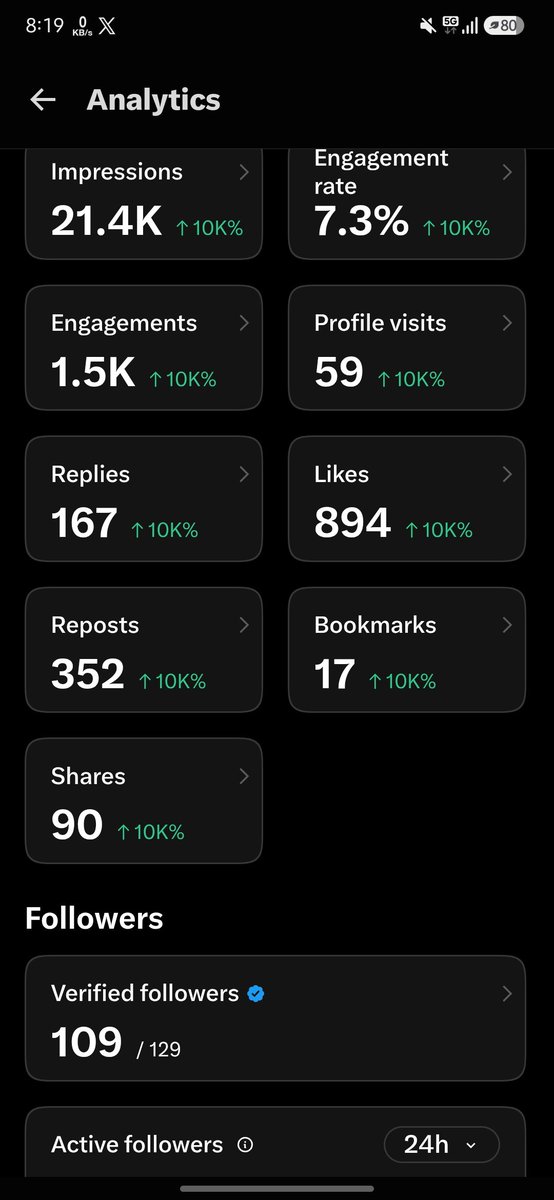
Is Verified impressions still the biggest struggle for X creators?
Millions of views but barely any from Premium users — does that match what you’re seeing?
Anthropic just reported an $80B headline loss in H1 2026 while outputting 6x more AI agent hours than human employee hours.
Inside Anthropic, human reading speed is now the primary company bottleneck.
When autonomous coding agents generate 5,000 lines of refactored code per hour, human code review fails to scale.
This is why top quantitative & engineering stacks are shifting from "more code generation" to automated verification loops:
1️⃣ AST Syntax Validation: Catch schema & typing breaks locally before human review.
2️⃣ Deterministic Unit Test Gates: Auto-reject PRs that breach coverage or execution latency targets.
3️⃣ Asymmetric Agent Auditing: Lightweight critic agents dedicated solely to stripping hallucinated logic.
In 2026, value isn't in how fast your agent writes code.
It’s in how fast your system verifies it. ⚙️⚡
Follow @ClarityCapAi for open-source AI workflows, quant systems, and execution logs.
How is your engineering team handling agent review bottlenecks? Drop your setup below! 👇
Elice IPO flop (single-topic version):
South Korean AI data-center firm Elice just had the worst large IPO debut in Korean history.
It priced at the top of its range, raised ~$151M, and saw its retail tranche oversubscribed 400 times. On day one the stock closed down 32%.
The company is profitable, grew revenue sharply in the first half, and plans to use the money for modular AI data centers. None of that mattered.
This is the cleanest signal yet that the market has stopped paying up for AI infrastructure stories on narrative alone. Demand was there on paper. The open market rejected the valuation immediately.
When even a profitable, high-growth neocloud gets crushed on debut, the bar for the rest of the sector just moved higher.
@ClarityCapAi
Named after economist William Stanley Jevons, Jev isn’t a generative model. It returns ZERO natural language text.
Instead of slow, conversational reasoning ("System 2"), Jev acts as fast, intuitive "System 1" software judgment:
• Inputs: Raw text, state, or JSON objects
• Outputs: Typed values + exact probability distributions
• Latency: 70ms – 500ms (40-200x faster than frontier LLMs)
(2/6) 👇
Generative LLMs are terrible at sub-second workflow routing.
Using a 70B parameter model to return a simple true/false or classify risk burn tokens, adds 1.5s of latency, and introduces structural parsing failures.
TypeSafe AI recently launched Jev—a pure discriminative "System 1" decision model.
Here is how non-generative, probabilistic AI is changing production agent stacks.
Follow @ClarityCapAi for open-source AI workflows, quant systems, and production agent design.
(1/6) 👇
The biggest mistake developers make when building autonomous AI agents?
Passing uncompressed execution logs directly back into the LLM context loop.
It inflates token burn, increases API latency, and accelerates prompt drift.
High-signal agent runtimes enforce 3 strict architectural rules:
1️⃣ Dynamic Pruning: Strip raw HTML/JSON responses immediately post-parsing.
2️⃣ State Snapshots: Force agents to emit a key-value JSON state summary every N turns.
3️⃣ Asymmetric Context: Give memory only to decision nodes—keep worker nodes stateless.
Keep the runtime lean, keep execution deterministic. ⚙️⚡
Follow @ClarityCapAi for open-source AI workflows, quant tools, and live execution logs.
What’s your default framework for managing agent memory right now? Drop your stack below! 👇
Hey @grok someone is trying to spam us with fake followers and i started blocking them can X automatically delete them because know it is showing error that failed to block user please help us resolve this isssue .
BLACK MONDAY 😱📉
It would be a complete dishonour for a market technician not to share this technical setup.
Monday marks the 39th anniversary of Black Monday October 19, 1987 when markets crashed an astonishing 22% in a single day.
While modern circuit breakers protect us from a total free-fall, the structural overlay between 1987 and today’s 2026 setup is eerie.
It would be something if Monday marks the beginning of something so beautiful, yet so consequential.
For one's private perusal.
Enjoy .