When people hear “diet,” they often think of wellness influencers. When they hear "cure," they're even more skeptical.
Ketogenic therapies are not a wellness trend. They are medical interventions that alter core biology, including mitochondrial function, neurotransmitter activity, insulin signaling, inflammation, the gut microbiome, and brain energy metabolism.
The ketogenic diet has long been established as an effective treatment for epilepsy, capable of stopping seizures even when medications fail.
A growing body of research suggests that ketogenic therapies may also benefit some individuals with serious mental illnesses, including depression, bipolar disorder, and schizophrenia—sometimes resulting in sustained remission of symptoms.
I personally do not describe this as a “cure”; the word "remission" is fine with me.
For those who achieve remission after years of suffering, it can feel like nothing short of a miracle—regardless of the underlying mechanism.
Let's work together to reduce the suffering and improve the lives of people living with mental illness.
If you knew what your cells do to defective mitochondria the moment you move, you’d never sit still again. Your body doesn’t delete broken mitochondria because you’re healthy. It deletes them because you move.
Mitocytosis (the ancient protocol that exposes defective engines) only unlocks when the organism is in motion, because a cell does not patiently wait for a damaged mitochondrion to repair itself… it drags the defective engine to the furthest edge of its geometry, concentrates it into a migrasome, and ejects it into the extracellular field where immune cells can dismantle it.
Stay still long enough and those damaged mitochondria don’t just accumulate: they go dark, slipping beneath immune detection and leaking noise that bends your biology away from continuity.
This is the principle I name The Locomotive Deletion Law:
• Movement is not fitness.
• Movement is the cell’s original delete key.
• A system in motion can prune its mistakes, and a system at rest is forced to store every error it makes.
You don’t move to burn calories.
You move to stay eligible for repair.
“Acute exercise-induced mitophagy is dependent on Parkin and attenuated with age.” — PMID: 31644316
A leading gastroenterologist who has sequenced over 4,000 human microbiomes just revealed the three most powerful things she tells patients to do every single day to restore microbial health.
Dr. Sabine Hazan’s answer is surprisingly simple — and backed by hard data:
1. Lower stress and release hatred.
Her exact words: “The person you think is your enemy is probably lacking microbes — and you likely need some of theirs.”
A hug is literally a transfer of resilience-building bacteria.
2. Eat only real, fresh food from sources you trust.
Farmers’ markets, local producers, food that hasn’t traveled for weeks. Ultra-processed products are the fastest way to wipe out microbial diversity.
3. Get outside daily — sun, soil, nature, human contact.
“Stop being afraid of microbes. Touch the earth, touch people. That’s where life is.”
After 4,000+ samples, her lab found detectable Bifidobacterium in fewer than 5% of adults.
She calls it a crisis.
Her closing line: “Save the Bif.”
Watch Dr. Hazan explain it herself — calm, evidence-based, and urgent.
Which of these three will you start today?
When you see highly educated scientists and physicians (people with master’s degrees in public health and PhDs in their fields) completely disagreeing on a health topic (whether it’s diet, cholesterol, or vaccines), it should raise a red flag.
Why? Because when experts who are supposedly looking at the same body of evidence land on opposite conclusions, it usually means one or more of the following is happening:
• Someone is cherry-picking data.
• Someone is overly biased or dogmatic.
• Someone is ignoring inconvenient evidence.
• Someone has financial or professional incentives to defend their position.
Bad intentions are rarely the root cause. Most experts genuinely believe their viewpoint. But we can’t ignore the reality that careers, reputations, and salaries often depend on defending certain narratives. As Upton Sinclair put it: “It is difficult to get a man to understand something when his salary depends on his not understanding it.”
Example 1: Nutrition
Some PhDs will swear red meat is dangerous because of saturated fat, while others will argue it’s one of the most nutrient-dense, health-promoting foods. Both cite “the science.” The difference usually lies in what evidence they prioritize: weak food-frequency questionnaires vs. rigorous clinical outcomes, or epidemiology vs. biochemistry.
Example 2: Cholesterol and Statins
Decades of dogma have framed LDL cholesterol as the “cause” of heart disease, leading to the widespread prescription of statins. Yet, other equally credentialed experts argue the story is far more nuanced: LDL may be a marker rather than the cause, and metabolic health (insulin resistance, inflammation) drives cardiovascular risk far more than cholesterol alone. Patients are put on lifelong statins, despite the fact that for many groups (especially primary prevention in low-risk individuals), the absolute benefit is tiny, while side effects are real. Both camps have MDs, PhDs, and clinical trials to back them. So which one is “science,” and which one is “misinformation”?
Example 3: Vaccines
Some public health experts say every single vaccine on the schedule is safe and necessary, while others raise legitimate concerns about certain ingredients or the aggressive dosing schedule. Again, same credentials but opposite conclusions because interpretation and bias are involved.
Here’s the broader lesson: when smart people with the same level of training land on opposite sides of the fence, it doesn’t mean both sides are equally valid. It means you, as a critical thinker, need to look closer at the assumptions, incentives, and blind spots driving their conclusions. Science isn’t about consensus—it’s about evidence that can withstand scrutiny. Consensus is often just a snapshot of what the majority believes, not necessarily what’s true.
And history proves this over and over again. What was once “settled science” is often overturned later:
• Galileo was condemned for rejecting the Earth-centered consensus.
• Semmelweis was ridiculed for handwashing. Germ theory was once “quackery.”
• For years, smoking was considered safe, and even endorsed by doctors.
Each time, there was consensus. Each time, the consensus was wrong.
So the presence of disagreement among equally credentialed experts should not be dismissed as “misinformation.” It should be seen as an invitation to think more critically, to examine incentives, and to remember that truth doesn’t depend on a vote.
How to Start a Mediterranean Ketogenic Diet: A Step-by-Step Guide (Link to more🔗 in 5/5)
1/6) I started a ketogenic diet on June 1, 2019, and it saved me from debilitating inflammatory bowel disease.
But here’s a hard fact: despite its many benefits—including for obesity, diabetes, mental health, autoimmune and inflammatory conditions—ketogenic diets are still grossly misunderstood. Many people assume keto is all about bacon, butter, and steak, low in fiber, and at odds with what most have been taught, and internalized over their life courses, is “healthy.”
🚨That’s a huge misconception!🚨
Ketosis isn’t about specific foods—it’s about a metabolic state, where you’re producing ketone bodies. You can be keto while eating anything from a fully #vegan diet to a fully #carnivore one.
There is not one ketogenic diet. There are infinite.
And a Mediterranean ketogenic diet is an excellent entry point for many people because it balances the perceived health benefits of Mediterranean eating with the metabolic advantages of keto
Simply put, Medi-Keto is a low-friction dietary entry point to low-carb diets for many people.
Today’s Newsletter breaks down the how-to of Medi-Keto, including:
👉 4 ‘musts’ for preparing to start on your ketogenic lifestyle.
👉 My 9 favorite Medi-Keto foods and help flesh out your shopping list.
👉Common Q&A
In this thread, I’ll tease you with a few highlights…
Children who were not at risk of any serious injury from Covid are now suffering from IgG4-RD which can cause irreversible organ damage due to the mRNA Covid injections still being pushed —This madness needs to end. Does this settle your quandary @MartyMakary ?
It's published!
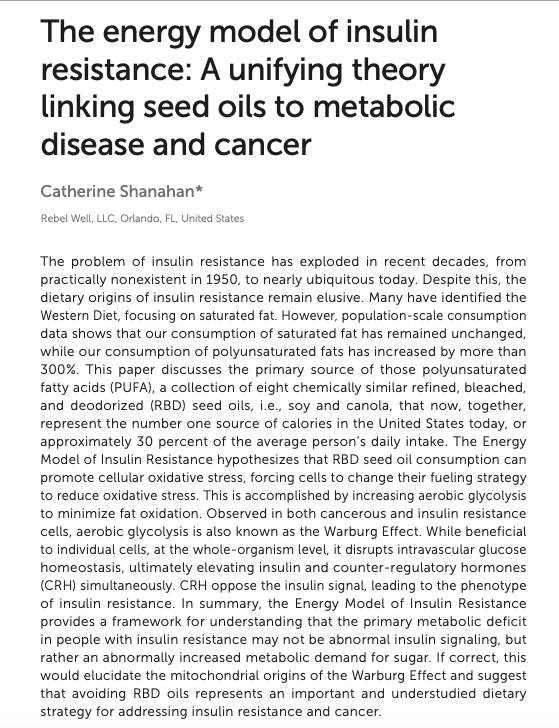
The energy model of insulin resistance: A unifying theory linking seed oils to metabolic disease and cancer
Here’s the link to the full text.
Let’s make this the most downloaded paper on their website!!
Here’s my summary:
The paper proposes that seed oils, by causing oxidative stress, force cells to change their fueling strategy. The result of that is metabolic disease and cancer.
It works like this:
Oxidative stress suffocates cells. It puts them into a kind of survival mode, and activates genes for bringing sugar into the cell. That's called aerobic glycolysis, which is now understood to be the main mechanism driving cancer!
At the whole-person level, many cells stealing sugar from the bloodstream all at once lower our blood sugar. That causes hypoglycemia, and then you get a flood of stress hormones.
This is immediately practical.
Wonder why you feel hangry? That's why. And yes it means you have insulin resistance. Cancer and insulin resistance share the same root cause. So if you get hangry, you are at higher risk of cancer.
This paper explains why insulin resistance and cancer are rampant among youth. They were tragically born and raised on more processed foods than any previous generation. Seed oils are the worst ingredient in processed foods.
I tried to make the theory airtight. But I appreciate anyone who wants to poke holes.
Writing this paper consumed many hours over the past few months. Keeping me away from terribly important things, like posting on X.
Read the full text here:
https://t.co/LS3dEjdGLN
Someday people will look back in disbelief that the medical field separated mental health from physical health, as though the brain was somehow an isolated organ, or that trauma and stress don’t impact physical health in the same ways they impact mental health.
When a student asks, “How could they have been so naïve?”, what do you think the professors will say?
Diabetes kills 1,700,000/year
That’s an average of 4,658 deaths/day
Hypertension kills 7,500,000/year
or 20,548/day
Obesity kills 2,800,000/year
or 7,671/day
⚰️30,000+ deaths/day⚰️
People still scared about measles and flu when we have a pandemic hiding in plain sight 👁️
First ever peer-reviewed low-carb/keto food pyramid!!
🔥New paper addresses all the myths vs. FACTs on these diets. i.e, they are not nutritionally deficient, not a "fad" diet, do not have harmful side effects, do not cause heart disease, and more. Link below.
The American Beverage Association is saying if States ban dyes, 60% of their store shelves would be empty. Admitting that 60% of grocery store food has petroleum and coal tar based ingredients in them - this in itself is a travesty and why we desperately need this legislation to pass. When Europe regulations took place in 2010, it was less than a year for the top food companies to reformulate their products without dyes. They don’t need to reinvent the wheel, they already have the formulations and are using scare tactics to keep poisoning Americans with ingredients they don’t use in other countries.
I'm launching a NEW PODCAST. We need to change the conversation.
I'm talking directly with people I disagree with, people I look up to, and you -- the listeners.
Egg prices? Tariffs? DOGE? We're tackling all your big questions.
This is Gavin Newsom. Subscribe now ➡️
https://t.co/LasCKa9GhN
🚨 7-step weight loss plan 🚨
1. Get fat-adapted🥩
2. U no longer rely on food for fuel🤯
3. Eat less frequently🕢
4. Understand what is driving ur hunger🤔
5. Figure out how to get full off w/ less junk🤐
6. Start gentle exercise🏃
7. Increase exercise intensity🏋🏼♂️
BREAKING NEWS!
The most rigorous study to date of the ketogenic diet for bipolar disorder demonstrates:
✅ High levels of adherence (patients CAN do the diet)
✅ Significant improvement in metabolic health AND mental health!
✅Changes in brain glutamate and myo-inositol