✨Introducing SpinGTP: Complete & Asymptotically Fast Tensor Products via Spin-Weighted Spherical Harmonics
E(3)-equivariant neural networks are the gold standard for data efficiency in AI for physical sciences. However, a major computational roadblock remains: the standard Clebsch-Gordan Tensor Product (CGTP) scales at an expensive O(L⁶) complexity.
While recent Fast Fourier-based alternatives like the Gaunt Tensor Product (GTP) drop this to O(L³), they do so by sacrificing mathematical completeness. Specifically, GTP omits all antisymmetric paths (where ℓ₁ + ℓ₂ + ℓ₃ is odd), creating an "antisymmetric gap" that leaves models blind to chiral geometries and parity-odd interactions (like vector cross-products).
To resolve this trade-off, we introduce the Spin-Weighted Gaunt Tensor Product (SpinGTP).
🔬 Core Methodology
Rather than lifting scalar signals to complex vector-valued fields, SpinGTP operates directly on Spin-Weighted Spherical Harmonics (SWSHs). By utilizing a signed spin selection rule within a generalized Gaunt integral, our formulation natively recovers all missing parity-odd interactions.
🚀 Key Advantages
• Mathematical Completeness: Restores the full spectrum of symmetric and antisymmetric interactions necessary for universal E(3) equivariance. 🎯
• Asymptotically Fast Scaling: Retains the highly scalable, Fourier-based asymptotic efficiency advantages over standard O(L⁶) architectures. 📈
• Chiral Awareness: Demonstrates targeted performance improvements on parity-sensitive tasks and chiral molecular structures. 🌀
• Empirical Validation: Matches the accuracy of full CGTP models across diverse benchmarks, including Tetris, 3BPA, SPICE-MACE-OFF, and OC20. 📊
📄 arXiv: https://t.co/h1rKzqpQb9
💻 GitHub: https://t.co/beJkzRY4rI
(The attached video illustrates the difference in representation capability: Standard Scalar Spherical Harmonics on the top 🔼 versus Spin-Weighted Spherical Harmonics on the bottom 🔽.)
🚀MIT Flow Matching and Diffusion Lecture 2026 Released (https://t.co/bKgs2wghvY)!
We just released our new MIT 2026 course on flow matching and diffusion models! We teach the full stack of modern AI image, video, protein generators - theory and practice. We include:
📺 Videos: Step-by-step derivations.
📝 Notes: Mathematically self-contained lecture notes
💻 Coding: Hands-on exercises for every component
We fully improved last years’ iteration and added new topics: latent spaces, diffusion transformers, building language models with discrete diffusion models.
Everything is available here: https://t.co/bKgs2wghvY
A huge thanks to Tommi Jaakkola for his support in making this class possible and Ashay Athalye (MIT SOUL) for the incredible production! Was fun to do this with @RShprints!
#MachineLearning #GenerativeAI #MIT #DiffusionModels #AI
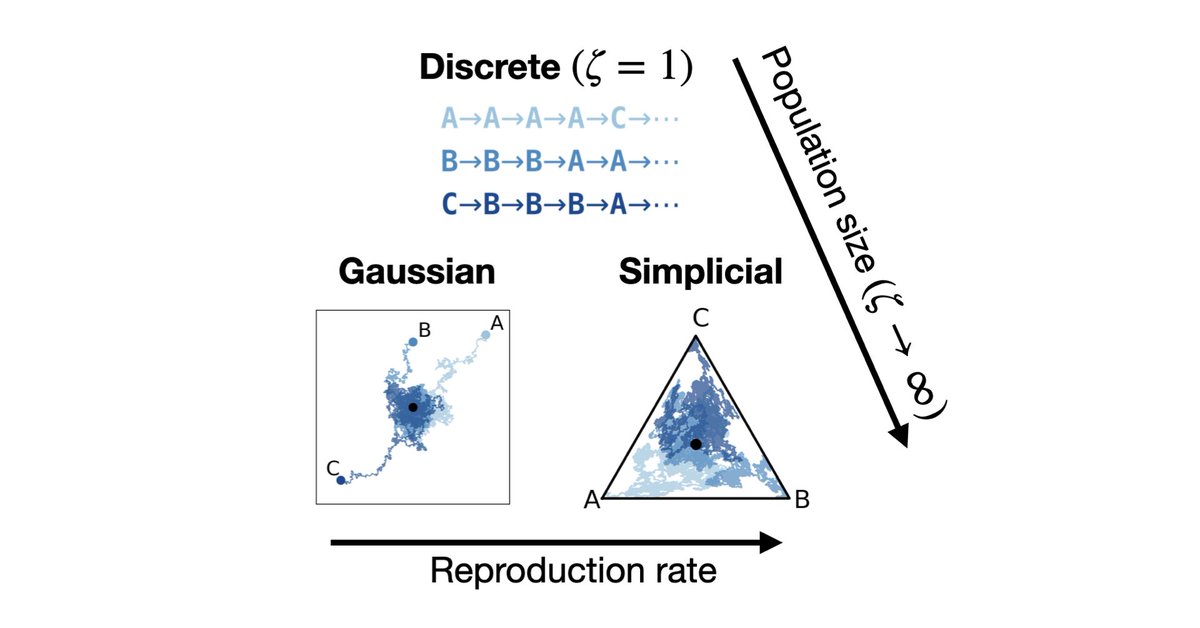
If you want to do diffusion on discrete data, you have three choices: discrete, Gaussian, or simplicial. How are they related? Which should you use? We theoretically unify all three and train one model to do them all! @AlinaChandra@yucenlily@alex4ali@andrewgwils 1/7
My "Complete Guide to Spherical Equivariant Graph Transformers" now has a permanent home on arXiv! 📖
📃 arXiv: https://t.co/iJHL3jPl0L
Over a year ago, I published this article on my blog, Alchemy Bio 🔮 (https://t.co/LE6ofXpqzB). Even now, I’m always surprised by how often people tell me it has meaningfully supported their learning and research, which inspired me to publish this guide with a permanent DOI 🌟 Revisiting this article truly reminded me how much I’ve grown over this past year (and how much my research interests have evolved!).
With the rapid advancements in ML-based interatomic potentials, materials and biomolecular design, and atomic simulation, the topics covered in the guide remain extremely relevant for understanding the theoretical foundations of equivariant architectures. 🧬
The arXiv version (99 pages, 46 figures) contains updated figures and refined content highlighting:
🌟 The mathematical foundations of how features transform under spherical equivariance, including group theory, spherical tensors, spherical harmonics, tensor products, and Clebsch-Gordan coefficients.
🌟 A step-by-step derivation of the SO(3)-equivariant kernel, which forms the core of rotation-equivariant message-passing layers.
🌟 Construction of Tensor Field Networks and their extension to attention mechanisms through the SE(3)-Transformer (+ annotated code excerpts).
I am extremely grateful for all the positive feedback I’ve received on this article, and I hope it continues to support researchers and learners interested in geometric deep learning! 🧩💫
Flow matching produces smooth, deterministic trajectories.
In contrast, the sampling process of a diffusion model is chaotic, resembling the random motion of gas particles.
Flow Matching aims to learn a "flow" that transforms a simple source distribution (e.g. Gaussian) to an arbitrarily complex target distribution.
This video shows the evolution of the marginal probability path as a source distribution is transformed to a target distribution.
If you are interested in Generative #AI, or statistical physics, you will know that you can use latent diffusion models to make synthetic images (or videos), but these methods are a bit slow (I explain here how the Fokker-Planck formulation and Langevin diffusion are related):
https://t.co/x4lsJZDdhq
About an hour ago some Russian scientists from Skoltech posted a quite considerable leap forward in this field, computing these maps much faster + in one step:
https://t.co/92AluHBU03
Excited and proud mentor moment 💫! A new materials foundation model with two of my undergraduate mentees Montgomery Bohde and Andrii Kryvenko as core authors.
For Materials Foundation Models, Invariance V.S. Equivariance? Invariance + Equivariance!
The slides of my NeurIPS lecture "From Diffusion Models to Schrödinger Bridges - Generative Modeling meets Optimal Transport" can be found here: https://t.co/RrgPIrmkdx
A common question nowadays: Which is better, diffusion or flow matching? 🤔
Our answer: They’re two sides of the same coin. We wrote a blog post to show how diffusion models and Gaussian flow matching are equivalent. That’s great: It means you can use them interchangeably.
There’s a single formula that makes all of your diffusion models possible: Tweedie's
Say 𝐱 is a noisy version of 𝐮 with 𝐞 ∼ 𝒩(𝟎, σ² 𝐈)
𝐱 = 𝐮 + 𝐞
MMSE estimate of 𝐮 is 𝔼[𝐮 | 𝐱] and would seem to require P(𝐮|𝐱). Yet Tweedie says P(𝐱) is all you need
1/3
"This is just a stock image of a cat. Physicists are not allowed to own cats, for various reasons." (from a great lecture [1] on generative AI [2] by Jordan Cotler)
[1] https://t.co/kvzsar9qde
[2] This is a very clear explanation of denoising diffusion probabilistic models (DDPMs [3]), and how they arise in statistical physics (diffusion of smoke in air or ink in a fluid, drifts of sand dunes in the wind).
[3] DDPMs and their compressed extension, LDMs, are used in text-based image generation (MidJourney, SORA, Kling). A trickier but very clear lecture is the one by the inventor of DDPMs, Jascha Sohl-Dickstein, also featuring his dog (!)
https://t.co/V4bWG3hqib
[4] for an even deeper version, someone has posted an entire book on Twitter tonight, which is pretty amazing "Statistical Optimal Transport": https://t.co/xZszU8B3ug #AI #DDPM
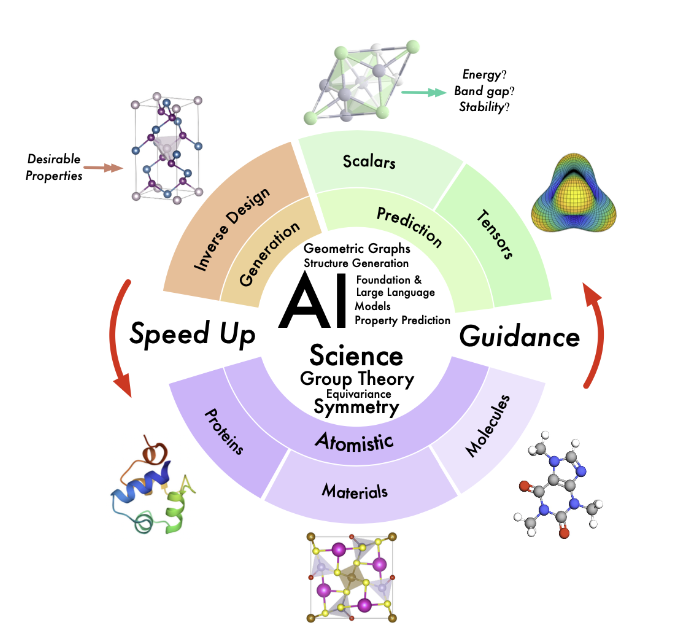
I am on the faculty job market for Fall 2025.
My research focuses on scientific ML and AI for science.
I use science to guide AI/ML/LLMs and develop AI/ML to accelerate scientific discovery.
Homepage: https://t.co/deFwYhi6i2
Opportunities are greatly appreciated!
I agree with this statement from https://t.co/RgEOMwIPVg "... the application of transformers to single-cell data is currently based on an analogy of genes as words and cells as sentences; yet, such theoretical arguments are not sufficient.."
arXiv -> alphaXiv
Students at Stanford have built alphaXiv, an open discussion forum for arXiv papers. @askalphaxiv
You can post questions and comments directly on top of any arXiv paper by changing arXiv to alphaXiv in any URL!
I am leading the new RAISE Initiative (https://t.co/LIVgrmqkKA). The aim of RAISE is to take a first step in building a coordination network within TAMU to promote collaborations among AI, science, and engineering. Very grateful to my colleagues and friends for support.






![docmilanfar's tweet photo. There’s a single formula that makes all of your diffusion models possible: Tweedie's
Say 𝐱 is a noisy version of 𝐮 with 𝐞 ∼ 𝒩(𝟎, σ² 𝐈)
𝐱 = 𝐮 + 𝐞
MMSE estimate of 𝐮 is 𝔼[𝐮 | 𝐱] and would seem to require P(𝐮|𝐱). Yet Tweedie says P(𝐱) is all you need
1/3 https://t.co/4prFCx4jWi](https://pbs.twimg.com/media/Gc9mpoObYAA0gMh.jpg)
![PTenigma's tweet photo. "This is just a stock image of a cat. Physicists are not allowed to own cats, for various reasons." (from a great lecture [1] on generative AI [2] by Jordan Cotler)
[1] https://t.co/kvzsar9qde
[2] This is a very clear explanation of denoising diffusion probabilistic models (DDPMs [3]), and how they arise in statistical physics (diffusion of smoke in air or ink in a fluid, drifts of sand dunes in the wind).
[3] DDPMs and their compressed extension, LDMs, are used in text-based image generation (MidJourney, SORA, Kling). A trickier but very clear lecture is the one by the inventor of DDPMs, Jascha Sohl-Dickstein, also featuring his dog (!)
https://t.co/V4bWG3hqib
[4] for an even deeper version, someone has posted an entire book on Twitter tonight, which is pretty amazing "Statistical Optimal Transport": https://t.co/xZszU8B3ug #AI #DDPM](https://pbs.twimg.com/media/GTZBp3wagAAyW4f.jpg)