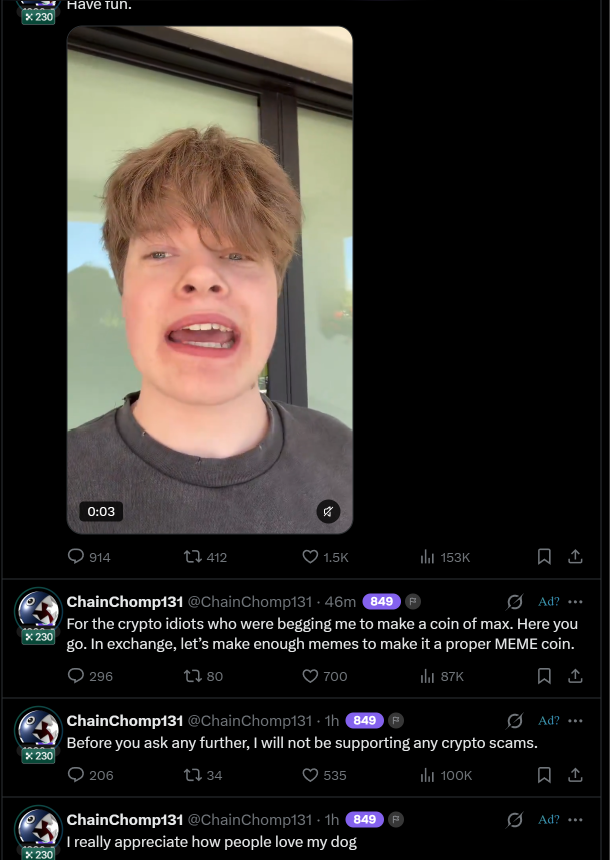
am i getting this right, elon musk’s son’s account @ChainChomp131 got hacked, they launched a memecoin $MAX + posted an ai video with him?
if so, why hasnt he called his dad yet and gotten all of it wiped, its been an hour
meanwhile MAX is at 7m
https://t.co/t5mXZvu8hu
@RealAlexBob It's funny to read this, considering the chain has only been around for a few months and just went through its first real test.
And it passed with flying colors.
No major L2 has delivered comparable results in recent years. Only Hyperliquid has shown anything close.
Most of the volume comes from bots, so I wouldn't read too much into such a dramatic drop.
Bot activity has simply been dialed down to a minimum. Nobody wants to burn liquidity for no reason.
At some point, a hot narrative will emerge, money will flow in, and the bots will be running at full speed again.
It's literally like flipping a switch.
We've seen much worse on Solana. So for now, we just wait.
There is no next Robinhood.
So just be patient. It'll all come.
I'm not a big fan of large-cap alts, but sentiment around the-open-network:native is extremely negative.
Hate rally time?
Maybe, but only after another shakeout. Definitely not on a green candle.
When a market maker starts working with a project, the team simply gives them a portion of the token supply to work with. They pay the market-making fees separately.
Same with exchange listings. The team allocates a certain percentage of the supply and pays the listing fee on top.
And it works the same way with major KOLs. They get 1%, 2%, or 3% of the supply to work with, while their services are paid for separately, either at their standard rates or through a negotiated deal.
So yeah, it's easy to hold bags you never paid for, or bags you've already been paid to hold.
We had a great meme season this summer. The whole market came back to life.
And that was just with bitcoin:native moving from $60K to $80K.
Now imagine what happens when bitcoin:native hits $100K or gets close to its ATH.
Cashcat looks stronger overall.
Compared to the main coins from the summer pump — Marscoin, AI, and Ansem — it's holding up better than all of them.
And of course, compared to major assets like ETH, I see much more upside potential in Cashcat.
It's still a new asset with very little retail participation.
Liquidity comes and goes. It's mostly a matter of seasonality and market conditions.
The real question is where that liquidity flows.
When it comes to Robinhood, I'm confident liquidity will return. It's only a matter of time.
Robinhood has a unique combination of massive infrastructure, a multibillion-dollar operating business, strong leadership, deep connections, and resilience.
That puts it in a completely different league from the countless L2s and smaller projects that tried to extract maximum value with minimal investment and effort.
Most of those projects ended up leaving their participants with nothing but losses.
@WhiteWhaleLabs The issue with STRC was mostly driven by all the noise around it.
Once attention shifted elsewhere, the problem pretty much disappeared on its own.
This is what happens when the goal from day one is to extract as much profit as possible while spending as little as possible, rather than building a real, working ecosystem.
Some might argue they launched into a bad market.
But Robinhood Chain launched in mid-summer, right in the middle of vacation season, with the market completely dead and sentiment bearish.
So that excuse looks pretty weak.
Elysium = Arc. Fake meta.
@Natan_benish Stocks are becoming more like crypto, but the real opportunity is making crypto behave more like stocks: deeper liquidity, real economic value, and communities that actually hold.
When a market maker starts working with a project, the team simply gives them a portion of the token supply to work with. They pay the market-making fees separately.
Same with exchange listings. The team allocates a certain percentage of the supply and pays the listing fee on top.
And it works the same way with major KOLs. They get 1%, 2%, or 3% of the supply to work with, while their services are paid for separately, either at their standard rates or through a negotiated deal.
So yeah, it's easy to hold bags you never paid for, or bags you've already been paid to hold.
Bubblemaps teased an investigation claiming that one of the biggest KOLs allegedly made millions of dollars at the expense of his followers.
And that person turned out to be... Cupsey.
Well, nothing shocking here.
Judging by the comments, people were expecting something else.
The Cupsey exposé seems to be getting a collective shrug. Almost everyone saw it coming.
@ProMint_X Notice how these guys are just extracting liquidity from their users as fast as possible while spending next to nothing on marketing and promotion.
So yeah, the tech is just a cover.
Elysium can't become a major player simply because it lacks scale.
A large user base. A major figure behind the chain. Serious marketing budgets, PR, ideas, and tools.
Solana has that scale. Robinhood Chain has it too. Even BNB has it, to some extent.
That's why Robinhood Chain succeeded from day one, while dozens of similar chains failed. And I don't think Elysium will be any different.
That's also why we're seeing what we're seeing there: extracting liquidity from users while spending as little as possible on marketing and promotion.