@BullTheoryio Never understand how can anyone call a 5 % pullback from all time high a “crash” after such an insane steep multi months rally? Look at a weekly chart. It is nothing. A crash will be when this sht goes to 15000-20000 range.
@BullTheoryio This means one thing for sure. This is a systemic cheat and a ponzi, which means the texh sectors valuation generally is probably 30-50 % higher then it should be realistically.
@BullTheoryio I think it’s impossible to manipulate the world’s largest financial instruments’ market. It was rather liquid in Asian and European hours, and traders managed to push prices lower ahead of 30 year auction.
🚨 Michael Burry says AI companies are on track to outspend even the dot-com bubble.
He says overspending like this has marked the top of every major bubble over the past 40 years.
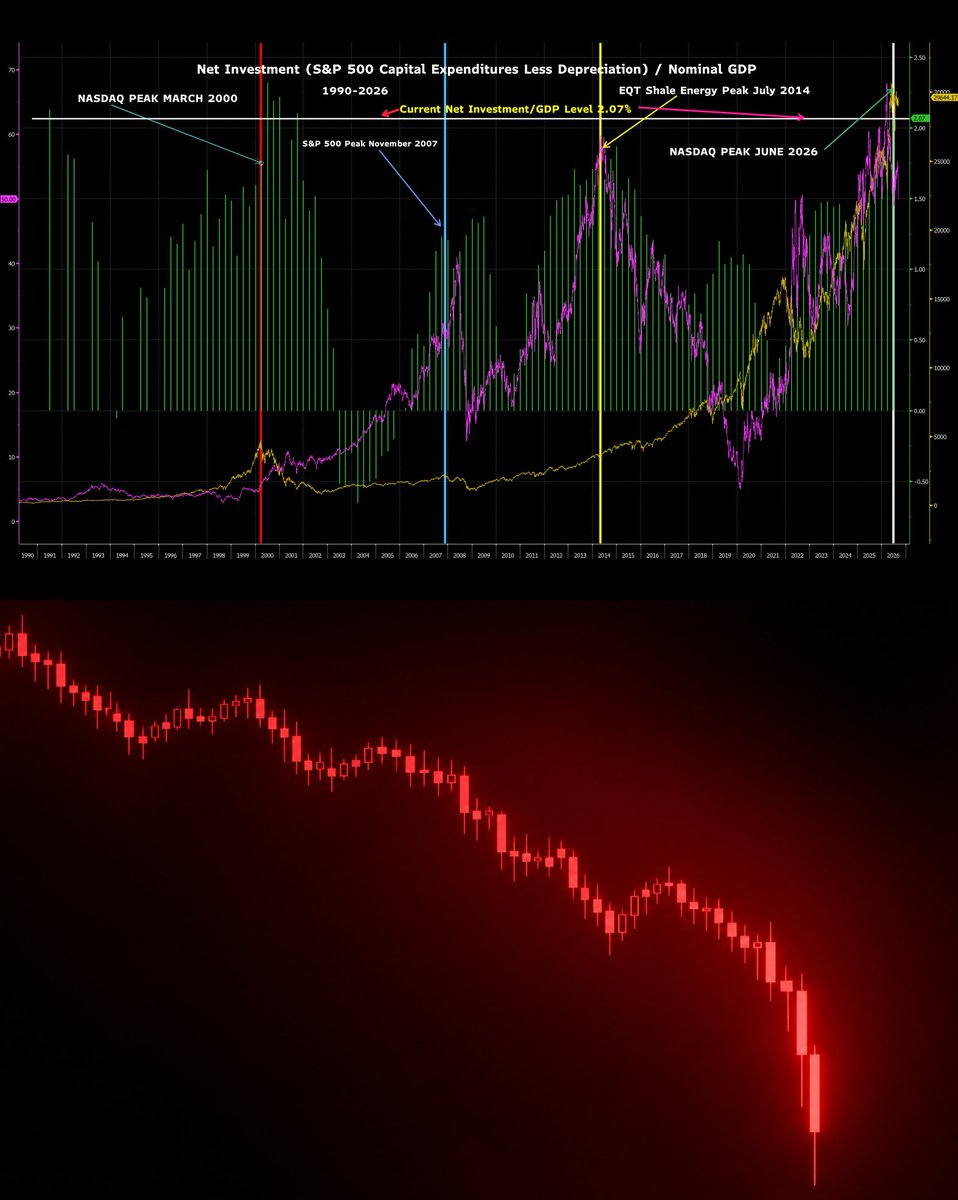
S&P 500 net investment hit 2.07% of GDP in Q2, the highest level in almost 40 years except the 2000 peak itself.
He expects that number to keep climbing, possibly passing the dot-com level entirely in the next few quarters.
In 2000, capital spending kept rising even after the Nasdaq topped out, and it took 15 years to fully recover.
In 2007, net investment peaked months before the S&P 500 itself topped out, right before the housing crash.
In the 2010s shale boom, energy stocks peaked in the middle of the drilling spending cycle, then collapsed.
Burry says the crash after 2000 left depreciation so large it dragged net investment negative for 12 straight quarters between 2003 and 2006.
That hangover helped wipe out Lehman Brothers, Bear Stearns, Washington Mutual, Countrywide, and AIG.
The top 5 hyperscalers now carry $3 trillion in combined purchase commitments, leases, and debt guarantees tied to AI data centers.
Their free cash flow is turning negative as borrowing accelerates to fund the buildout.
Every time investment has run this hot relative to the economy, it has ended in a crash.