On the night of October 18, 1974, Al Green was relaxing in his bathtub in Memphis when his girlfriend, Mary
Woodson, walked in and poured a pot of scalding grits all over his back and shoulders. Second- and third-degree burns covered his body. Then she took his handgun and ended her own life right there in his home.
He was twenty-eight years old, at the absolute peak of his powers, and one of the most seductive, successful soul singers on Earth.
Between 1971 and 1974, Al Green had done something rare: he made intimacy feel effortless and inevitable.
"Let's Stay Together" went to No. 1 on the Billboard Hot
100. "Tired of Being Alone," "I'm Still in Love with You,"
"Call Me" — one after another, the hits poured out. His voice was liquid honey and raw ache at the same time. It didn't beg. It didn't perform. It simply arrived, and you surrendered. More than twenty million records sold.
Radio couldn't stop playing him. Women screamed his name at shows. He was living the dream most artists only pray for.
And then he walked away.
Not because the voice failed. Not because the hits stopped coming. He stopped because the man the world saw on stage and the man he saw in the mirror were becoming two different people — and the distance between them was starting to scare him.
In 1976, Al Green was ordained as a Baptist minister. He founded the Full Gospel Tabernacle Church in Memphis, just a few miles from Graceland. Record executives called it career suicide. Many fans felt abandoned.
Industry people whispered that he had lost his mind.
Green believed he had finally found it. He was convinced that God had spared his life that October night for a reason, and he refused to waste his second chance chasing applause and hit records.
The cost was immediate and steep. Sales plummeted.
Radio stations moved on. For years he refused to sing his old secular love songs in public, treating them like a chapter of his life he no longer had the right to open. He preached. He raised a family. He poured his voice into gospel albums that sold modestly but healed people deeply. He built a church where real community happened on Sunday mornings instead of sold-out arenas on Saturday nights.
Then, slowly and only when he was ready, he came back.
The voice was still there — older, wiser, steadier. In 2008, the album Lay It Down earned him two Grammy Awards and reminded the world what they had been missing. Today he holds eight Grammys, has sold more than twenty million albums, and was inducted into the Rock & Roll Hall of Fame in 1995. But the numbers were never really the point.
The point is that Al Green had the courage to walk away from the very top.
Most artists, most people, would have kept going. The money was too good. The adoration was too loud. The identity was too comfortable to surrender. Al Green heard something louder than the crowd. He listened.
And because he listened, the man singing those songs today feels completely aligned with the voice coming out of him. There is no daylight between the artist and the human being. That honesty is why his music still hits different — even decades later.
When you hear "Let's Stay Together" playing in a store or on a playlist, you're hearing more than a classic love song. You're hearing a man who once had the world at his feet, looked at the gap growing inside himself, and chose truth over fame. You're hearing someone who survived betrayal, burns, and a very public breakdown, then rebuilt his life on his own terms instead of the world's.
Al Green could have kept being the silky, untouchable sex symbol the industry wanted. Instead, he became a whole man. A minister. A father. A pastor who still sings with every ounce of that old fire — but now sings from a place that is fully his.
In a culture that rewards staying on top at all costs, Al Green reminds us that sometimes the most powerful move is stepping down on purpose. Sometimes the greatest comeback isn't louder or bigger. 🤯🤐😭
It’s been a challenging year for us, but our hearts are filled with gratitude. Thanksgiving is a wonderful time to pause and reflect on God’s unconditional love for us all, the gift of life, and the infinite blessings that surround us in spite of any hardship we may be experiencing. Abraham and I send you all our thanks and aloha for your prayers and well wishes, and wish you a wonderful happy Thanksgiving!
There are HEROES among us.
The Pilot Who Refused to Leave Him Behind
The security guard at Arlington National Cemetery wasn't budging. "Ma'am, you're not on the list. Please step back."
Samantha Morgan stood at the gate in a simple black dress, watching officers escort VIPs past the barricade to General William Hawthorne's funeral. For ten years, she'd avoided the spotlight, working quietly at a VA clinic. But today was different.
She reached into her worn leather bag and pulled out a bronze challenge coin—tarnished, heavy with memory. On it was engraved a Blackhawk helicopter with Valkyrie feathers.
"I pulled him out of a burning crash site in Kandahar, 2014," she said quietly. "I'm not leaving him behind now."
The young specialist shook his head. "Everyone claims they knew him, Ma'am. I can't make exceptions."
A staff sergeant joined in, eyeing her civilian clothes with disdain. "The public viewing area is 200 yards back. That's where you belong."
Samantha's hands trembled slightly, gripping the coin tighter. She'd disobeyed direct orders that day when her radio crackled: "Angel-Zero-Six, abort! LZ is too hot!" But Hawthorne was pinned under twisted metal, bleeding out. She landed anyway.
Just as the sergeant reached for his radio to have her removed, gravel crunched behind them.
A black limousine pulled up. Four stars gleamed on the shoulders of the man who emerged—General Elias Thorne, Chairman of the Joint Chiefs of Staff.
He walked straight toward them. The sergeant's salute was so sharp his heels cracked together.
But Thorne only had eyes for Samantha. He stopped, looking at the coin in her white-knuckled grip.
"Captain Morgan," he said softly.
Samantha saluted, muscle memory overriding emotion.
Thorne pulled a yellowed, blood-stained flight manifest from his breast pocket, preserved in plastic. "Sergeant, she's not on the guest list because General Hawthorne left only one directive that mattered: 'If the pilot who flew Angel-Zero-Six shows up, she walks in front of me.'"
His voice cracked slightly. "I was the Colonel in the TOC that day. We ordered you to abort. You turned off your radio."
"He was dying," Samantha whispered.
"I know," Thorne said, his eyes wet. "He told that story every Thanksgiving for a decade. Called you the Stubborn Angel. Said you gave him ten more years with his grandchildren."
Thorne stepped aside, extending his arm. "Escort Captain Morgan to the front row. Next to Mrs. Hawthorne."
At the grave site, an elegant elderly woman stood immediately when she saw them approaching. Mrs. Hawthorne walked past senators and dignitaries, straight to Samantha.
She took Samantha's calloused hands and pressed something into her palm—another challenge coin, its edges worn smooth from years of being held.
"He kept this on his nightstand," Mrs. Hawthorne said through tears. "Whenever he felt afraid, he'd hold it. He said it reminded him that when the world was burning, someone came for him."
As Taps began to play, Samantha stood at attention—the General on her right, the widow on her left.
She'd carried him out of the fire once. Now she was here to see him safely home.
When asked later why she'd risked her life that day, Samantha simply said: "You don't leave people behind. That's not protocol—that's a promise."
The coin Mrs. Hawthorne gave her now sits in Samantha's VA clinic office, where veterans see it daily—a reminder that someone will always come when they need help most
He claimed he was faster than Bruce Lee.
A martial arts instructor who had gained attention in Hollywood through his flashy, revolutionary demonstrations.
“Bruce Lee is nothing more than a showman,” he said.
“I’ve faced the best fighters in the country, and none of them lasted more than two minutes against me.”
—
Bruce Lee waited for him in the center of the gym, barefoot, wearing simple black pants.
“Thank you for coming,” Bruce said, extending his hand with genuine respect.
Lewis shook it firmly—perhaps too firmly, as if trying to assert dominance from the very start.
“No problem,” Lewis replied. “I was curious to see what you could teach me.”
“Let’s start with something simple,” Bruce suggested.
“I’d like you to try to punch me. A straight punch, with full speed and power. I won’t counterattack. I’ll only step aside to evade it.”
“You’re sure about that?”
The karate champion settled into a perfect fighting stance. Lewis took a deep breath and focused.
His fist sliced through the air at impressive speed, aimed straight at Bruce Lee’s face.
But when the punch should have landed—Bruce was no longer there.
In the same fluid motion, while Lewis’s fist continued its empty trajectory, Bruce’s open hand stopped just two centimeters from the karate champion’s throat.
“If I wanted to,” Bruce said calmly,
“I could have ended this encounter right there.”
Lewis’s wounded pride turned into fierce determination.
He launched a combination—jab, cross, hook.
Three strikes in rapid succession, each powerful enough to finish an ordinary opponent.
Each punch met nothing but air.
And after every failed combination, Bruce’s hand appeared at a vital point—
the throat,
the solar plexus,
the jaw.
“Do you want to know why you can’t touch me?” Bruce asked, without a trace of mockery in his voice.
“Your punches are powerful. Yes—and fast.
But you announce every strike before you throw it.
You tense your shoulder here.”
He lightly touched Lewis’s shoulder.
“You shift your weight here.”
He pointed to his hips.
“And your eyes give it away here.”
He gestured toward Lewis’s gaze.
“By the time your fist moves, I already know exactly where it’s going.”
—
“Now,” Bruce said, still wearing the same calm smile,
“let me show you something.”
Bruce stood in front of a heavy bag weighing about 70 kilograms.
He positioned himself just two centimeters from it.
Then—without any visible wind-up, without pulling back his arm or clearly rotating his hips—he struck.
The sound was like thunder in an enclosed space.
The bag bent inward at the center, absorbing an impact that seemed impossible given the lack of distance.
But the most astonishing part was the speed.
Lewis—considered one of the fastest strikers in karate—barely saw the movement at all.
It was like a flash. A burst of motion that defied perception.
“This is called the one-inch punch,” Bruce explained.
—
For the next two hours, Bruce worked with Joe Lewis.
To Lewis’s credit, he absorbed every lesson with the humility of a beginner.
At the end of the session, as Lewis prepared to leave, Bruce placed a hand on his shoulder.
“You have extraordinary talent,” Bruce said sincerely.
“Your speed and power are real. But now you know there are levels beyond what you imagined.”
“The question is—what will you do with this knowledge?”
Joe Lewis looked Bruce Lee in the eyes and, for the first time in many years, smiled with genuine humility.
“I’m going to learn,” he said.
“If you’ll accept me as a student, I want to train with you.”
“That was the day I understood the difference between being good and being great,” he later said.
“I was good. But Bruce Lee was something else entirely.”
For more You should see this
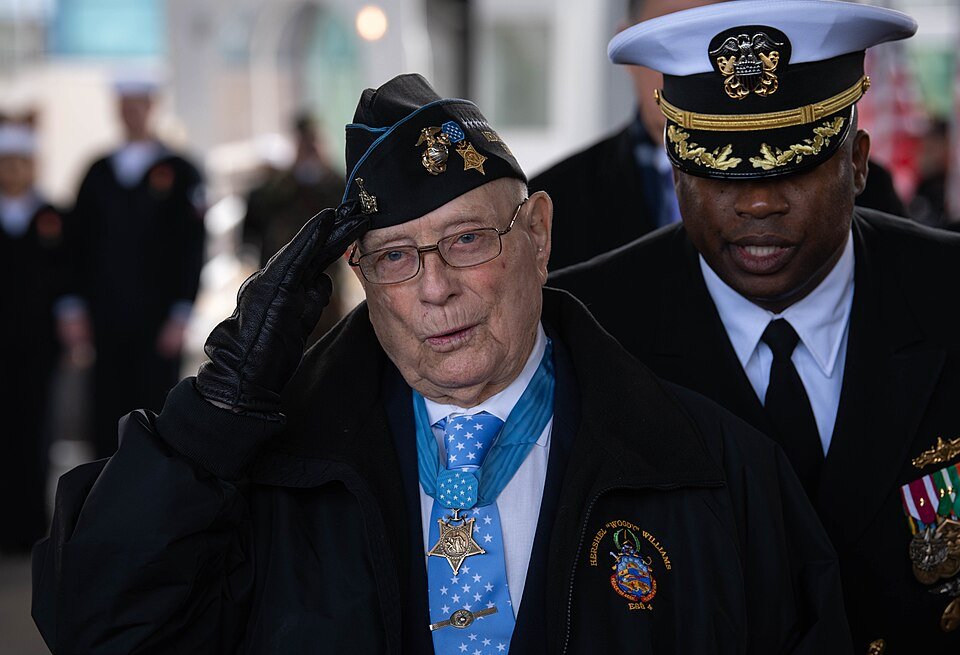
The Marine Corps turned him away the first time he tried to enlist in 1942 because five feet six inches was deemed too short for a Marine.
Three years later on Iwo Jima, that rejected West Virginia farm kid strapped a 70-pound flamethrower onto his back and did what American tanks could not do.
Hershel Williams, known to everyone as Woody, grew up milking cows on a struggling dairy farm in Quiet Dell during the Great Depression.
Before joining the Marines after height rules changed in 1943, his wartime job was delivering Western Union telegrams to families whose sons had been killed in action.
Watching mothers collapse on their front porches burned a promise into his heart that he carried for the rest of his life.
On February 23, 1945, the exact same day the flag went up on Mount Suribachi, American tanks trying to clear Airfield Number One ran into a maze of reinforced concrete pillboxes buried in black volcanic rock.
Artillery shells bounced off the concrete walls.
American infantrymen fell in rows across the open ground.
When his company commander asked if anything could be done, the 21-year-old corporal picked up a flamethrower and walked forward with only four riflemen covering his flanks.
For four straight hours under heavy small-arms fire, Woody crawled through ash and shrapnel.
He climbed directly onto the roof of a concrete pillbox and shoved his flamethrower nozzle down the air vent to silence the machine gun inside.
When enemy soldiers rushed out with fixed bayonets to kill him at point-blank range, he stopped them himself.
Five times his fuel tanks ran dry.
Five times he walked all the way back through bullets to haul another serviced 70-pound rig and satchel charges to the front until seven strongpoints were quiet.
Woody lived to age 98, becoming the very last surviving World War II Medal of Honor recipient in America.
Remembering those grieving mothers on West Virginia porches, he spent his nineties building over 100 Gold Star Families Memorial Monuments across all 50 states.
When Woody died on June 29, 2022, Congress laid the five-foot-six farm boy in honor inside the United States Capitol Rotunda.
He fixed bayonets at Ia Drang in 1965. On September 11, 2001, he helped evacuate approximately 2,700 people from the South Tower of the World Trade Center—and then went back inside to save anyone who might still be trapped.
You may recognize this photograph from the cover of We Were Soldiers Once… and Young. The man pictured is Rick Rescorla, a true American hero.
Born in Cornwall, England, Rescorla served as a British paratrooper before immigrating to America and joining the U.S. Army. In November 1965, he served as a platoon leader with the 2nd Battalion, 7th Cavalry, during the Battle of Ia Drang in Vietnam. Associated Press photographer Peter Arnett captured this iconic photograph during a patrol when Rescorla ordered his men to fix bayonets.
His men nicknamed him "Hard Core," while Lt. Col. Hal Moore described him as "the best platoon leader I ever saw." Even under intense enemy fire, Rescorla sang to keep his men calm and steady. His bravery and leadership earned him both the Silver Star and the Bronze Star.
Years later, Rescorla became head of security for Morgan Stanley at the World Trade Center. Following the 1993 bombing, he warned that the towers remained a potential terrorist target. He insisted on regular evacuation drills every three months, even though some considered his precautions excessive.
On September 11, 2001, he watched the North Tower burn from his office on the 44th floor of the South Tower. Despite an announcement instructing occupants to remain at their desks, Rescorla ignored the order and immediately began evacuating employees.
He called his wife and reassured her: "Stop crying. I have to get these people out safely."
He successfully helped approximately 2,700 people escape the building. But after learning that a few employees were still missing, he made the decision to go back inside. When a co-worker urged him to leave, Rescorla replied, "As soon as I make sure everyone else is out."
He was last seen on the 10th floor, heading upward to continue searching for survivors. At 9:59 a.m., the South Tower collapsed. Rick Rescorla was never seen again, and his remains were never recovered.
He was just 62 years old.
He once said about the book and movie recounting the Battle of Ia Drang: "The real heroes are dead."
Rick Rescorla was a warrior, a leader, and a man who refused to leave others behind. He survived the battlefield in Vietnam, only to sacrifice his life saving thousands on September 11.
Rick Rescorla. 7th Cavalry. A hero who never stopped serving. Never forget.
Look at this woman - Let us never forget!
The world hasn't just become wicked...it's always been wicked.
The prize doesn't always go to the most deserving.
Her name is Irena Sendler
She Died 12 May 2008 (aged 98) in Warsaw, Poland
During WWII, Irena, got permission to work in the Warsaw ghetto, as a plumbing/sewer specialist.
She had an 'ulterior motive'.
She KNEW what the Nazi's plans were for the Jews (being German).
Irena smuggled infants out in the bottom of the tool box she carried and she carried in the back of her truck a burlap sack, (for larger children).
She also had a dog in the back that she trained to bark when the Nazi soldiers let her in and out of the ghetto.
The soldiers of course wanted nothing to do with the dog and the barking covered the infants' noises.
During her time of doing this, she managed to smuggle out and save 2500 children/infants.
She was caught, and the Nazi's broke both her legs, arms and beat her severely.
Irena kept a record of the names of all the kids she smuggled out and kept them in a glass jar, buried under a tree in her back yard.
After the war, she tried to locate any parents that may have survived it and reunited the family.
Most had been gassed. Those children she helped got placed into foster family homes or adopted.
Last year Irena was up for the Nobel Peace Prize.
She was not selected.
President Obama won one year before becoming President for his work as a community organizer for ACORN
Al Gore won also --- for a slide show on Global Warming.
In MEMORIAM - 63 YEARS LATER
We're doing our small part by posting this message.
I hope you'll consider doing the same...
It is now more than 60 years after the Second World War in Europe ended.
This posting stands as a memorial chain, in memory of the six million Jews, 20 million Russians, 10 million Christians and 1,900 Catholic priests who were murdered, massacred, raped, burned, starved and humiliated!
Now, more than ever, with Iran, and others, claiming the HOLOCAUST to be 'a myth'.
It's imperative to make sure the world never forgets, because there are others who would like to do it again.
THE CEO OF NVIDIA WAS ASKED WHICH COLLEGE DEGREE IS AI PROOF. HIS ANSWER: "IT WON'T MATTER."
He didn't sugarcoat it.
Parents everywhere are pushing their kids toward the "safe" major.
Jensen Huang says there isn't one.
What matters is how well you use AI inside whatever you choose.
He's said it before, even more bluntly:
"If you're not using AI, you're going to lose your job to somebody who uses AI."
Not a robot.
Not a chatbot.
A PERSON who learned AI before you did.
So pick the field you love.
Then learn how AI makes you dangerous in it.
Here are 14 free places to start, sorted by field:
ANYONE
1. Anthropic AI Fluency, the basics of working with AI
https://t.co/VAC50EMdCs
2. Elements of AI, the free course 1M+ people have taken
https://t.co/vqKLwmzIMC
3. Generative AI for Everyone by Andrew Ng
https://t.co/EpEoEcpUiN
4. OpenAI Academy, free lessons and live workshops
https://t.co/ECOpVl9rLW
STUDENTS AND TEACHERS
5. Anthropic AI Fluency for Students and for Educators
https://t.co/VAC50EMdCs
6. Harvard CS50 AI, the full course, free
https://t.co/an7bCuWdY7
LAW
7. Generative AI for Legal Services
https://t.co/W6jq4ykx94
8. Open University courses on AI in legal advice
https://t.co/e8usO9O4tA
MEDICINE
9. Stanford's AI in Healthcare
https://t.co/9fwPfE2oyN
BUSINESS AND FINANCE
10. Wharton's AI for Business
https://t.co/9L0pRZ5qR2
MARKETING
11. HubSpot Academy AI for Marketers
https://t.co/DGSOSM2FT1
DESIGN AND CREATIVE
12. Anthropic AI Fluency for Creative Work
https://t.co/PtBOZz1mIg
ENGINEERING AND DATA
13. Google's Machine Learning Crash Course
https://t.co/Wd1xgdfdUE
14. Kaggle Learn, hands on in your browser
https://t.co/GWTzb7d1dF
Total cost: $0.
Here's my take.
The "AI proof degree" is a myth sold to scared parents.
A nurse who uses AI beats a nurse who doesn't.
A lawyer who uses AI beats a lawyer who doesn't.
An engineer who uses AI beats an engineer who doesn't.
The degree was never the protection.
The skill is.
Send this to a parent stressing about their kid's major.
@_ChristinaR_ You are NOT NERDY - you are INTELLIGENT AND STUDIED. You are NOT STRANGE - you are UNIQUE. You have your Knowledge and LOVE you want to share - you are a BLESSING to CREATION and you will impel Humanity forward. 🥰🤗
🚨BREAKING: Country music legend Darius Rucker just unloaded, revealing the racism he faces comes mainly from other Black people.
“Some woman comes on and says, 'You know you're black, right?' I just went off and I was like, 'I've been doing this for 60 years. I F*CKING know I'm black...'”
“I was told what I wanted to do was impossible. Instead of embracing us and saying 'Look what these 2 brothers did,' they just ignore us.”
On The BobbyCast, Rucker explained that the sharpest attacks over his country success have come from Black critics questioning why he is even in the genre. He pointed to Charley Pride’s own experience of being shut out by Black media despite dominating country music, and said the dismissal from his own community cuts deeper than anything he expected from outsiders.
The man who turned Hootie & the Blowfish into one of the biggest bands of the ’90s and then stacked No. 1 country hits is done pretending this double standard does not exist.
This is f*cking insane. Elon Musk (Founder & CEO of SpaceXSI and Tesla) cautions that the time left is short:
“You have 3 years at most to keep earning from selling your work. After that, AI takes over most tasks, and paying people for their time stops making sense.
The 200-year-old model, ‘I give you your salary in exchange for your time’, will soon be over.
This will set off the largest wealth transfer in modern history. People already making the shift get it. People waiting for the headlines will show up too late.
In the end, what you own counts for more than how much you work.
The smartest asset to build right now ranks above Bitcoin and land: an income stream powered by AI that compounds while you sleep.”
99% people are still selling hours
A Grok Bot team lets you own the output instead
You set the direction. The bots do the work. The income compounds while you sleep
Save this before it disappears from your feed
Every guide below is free from SpaceXAI and shows exactly how to set this up:
Getting started with Grok Bot
https://t.co/P17RHmtfo4
Engineering: run a fleet of engineer bots
https://t.co/qLmXw8NL97
Six bots, one mobile game studio
https://t.co/7jEFMhtQ5Z
Design with always-on bots
https://t.co/nnarKjtNRz
PMs: a team that reports to you
https://t.co/4spDmNxJGR
Marketing bots that research and draft
https://t.co/Ji5s5bFZSA
Founder-led sales with bots
https://t.co/1NT016PpNO
Recruiting: sourcing, scorecards, prep
https://t.co/EEFi0aIPvs
Legal ops with bots
https://t.co/nwsg2aFYO3
Support: clear the whole queue
https://t.co/tQCI2NOciz
Share bots as templates
https://t.co/zfYpACsyzz
All of this costs $0
Bookmark it and start with the first link right now
Then read how to set up your own Grok Bot income system in the guide below ↓
“Do you believe that men can get pregnant?”
“No, I don’t think men can get pregnant.”
“So you are denying that trans people exist. Thank you.”
Professor Khiara Bridges and Senator Josh Hawley CLASH over pregnancy, women’s rights, and transgender identity in a tense Senate exchange.
Hawley wasn’t done asking questions.
Sen. Josh Hawley: You’ve referred several times to “people with a capacity for pregnancy.” Would that be women?
Prof. Khiara Bridges: Many women—cis women—have the capacity for pregnancy. Many cis women do not. There are also trans men who are capable of pregnancy, as well as non-binary people.
Hawley: So this isn’t really a women’s rights issue?
Bridges: We can recognize that this impacts women while also recognizing that it impacts other groups. Those things are not mutually exclusive.
Hawley: Your view is that the core of this right is about what?
Bridges: Your line of questioning is transphobic, and it opens up trans people to violence by not recognizing them.
Hawley: You’re saying I’m opening up people to violence by asking whether women are the ones who can get pregnant?
Bridges: One out of five transgender persons have attempted suicide. I think it’s important—
Hawley: Because of my line of questioning? So we can’t talk about it?
Bridges: Because denying that trans people exist and pretending not to know that they exist—
Hawley: I’m denying that trans people exist by asking if you’re talking about women having pregnancies?
Bridges: Do you believe that men can get pregnant?
Hawley: No, I don’t think men can get pregnant.
Bridges: So you are denying that trans people exist. Thank you.
Hawley: Is this how you run your classroom? Are students allowed to question you, or are they also told they’re opening up people to violence?
Bridges: Absolutely. They’re allowed to. We have a good time in my class. You should join. You might learn a lot.
Hawley: Wow, I would learn a lot. I’ve learned a lot just in this exchange. Extraordinary.
⸻
Hawley: Ms. Matzke, you provide healthcare to women free of charge, correct? You have licensed medical professionals at your pregnancy care centers?
Heidi Matzke: That is correct.
Hawley: What resources do you provide?
Matzke: We have three OB-GYN doctors, five registered nurses, nurse practitioners, physician assistants, phlebotomists and medical assistants. We provide prenatal care, OB-GYN care, pregnancy tests, ultrasounds, well-woman visits and breast exams.
Hawley: Do you run a fake clinic? You don’t provide actual medical care to actual women?
Matzke: We absolutely do not run a fake clinic. We have a full medical staff. Our medical professionals are there for women, whether they choose abortion and walk out the door or choose life for their baby. We support them for years after that.
Hawley: Should there be an ideological test to get medical care in this country? Should women have to agree with the Democrats’ position on abortion before they can receive care? Or should medical professionals have to agree with that position before they can provide care?
Matzke: Absolutely not.
Przepiękną historię napisało nam życie, przeczytajcie bo warto
się z tą historią zapoznać
👇🤔👇
30 kwietnia 1994 roku, około drugiej w nocy, Joe Campbell wyszedł z domu we wschodnim Londynie, żeby skorzystać z publicznej budki telefonicznej. Chciał zadzwonić do swojej rodziny mieszkającej w Gujanie. Było to dla niego coś zupełnie zwyczajnego, ponieważ w tamtych czasach rozmowy międzynarodowe często wymagały korzystania z publicznych telefonów. Kiedy zbliżał się do budki przy skrzyżowaniu Dames Road i Clinton Road w dzielnicy Forest Gate, zauważył coś leżącego na podłodze. Początkowo pomyślał, że ktoś zostawił tam papierowe opakowanie po jedzeniu. Dopiero gdy podszedł bliżej, zorientował się, że patrzy na maleńkie dziecko. Dziewczynka była noworodkiem, miała zaledwie dwie godziny i wciąż nie odpadła jej pępowina. Została pozostawiona samotnie w środku nocy, bez żadnych informacji pozwalających ustalić, kim jest i skąd się tam wzięła.
Joe natychmiast wezwał policję i pogotowie ratunkowe. Dziewczynkę przewieziono do szpitala, gdzie stwierdzono u niej objawy wychłodzenia organizmu. Gdyby mężczyzna nie zdecydował się tamtej nocy ponownie wyjść z domu, jej historia mogłaby zakończyć się tragicznie. Tymczasem Joe nie potrafił po prostu zapomnieć o dziecku, które odnalazł. Nadał jej imię April, ponieważ przyszła na świat ostatniego dnia kwietnia. Przez kolejne dni kontaktował się ze służbami społecznymi, pytając o jej stan zdrowia i dalsze losy. Z czasem zaczął odwiedzać dziewczynkę, a później wysyłał jej kartki urodzinowe, prezenty i drobne upominki. W pewnym momencie chciał nawet ją adoptować, ale dowiedział się, że jako nieżonaty mężczyzna nie będzie mógł zostać jej opiekunem.
Przez kilka następnych lat Joe starał się utrzymywać kontakt z dzieckiem, chociaż nie łączyło ich żadne biologiczne pokrewieństwo. Nie był członkiem jej rodziny, nie znał jej matki i przed tamtą nocą nie miał pojęcia o jej istnieniu. A jednak nie chciał, żeby dziewczynka została całkowicie pozbawiona kontaktu z człowiekiem, który znalazł ją w najtrudniejszym momencie jej życia. Kiedy April została adoptowana, służby społeczne poinformowały go jednak, że dalsze kontakty nie będą możliwe. Musiał przestać wysyłać prezenty i kartki. Dziewczynka miała dorastać w nowej rodzinie, a on nie otrzymywał już informacji na temat jej życia. Joe podporządkował się tej decyzji, ale nigdy o niej nie zapomniał.
Tymczasem April dorastała, nie rozumiejąc w pełni okoliczności swojego przyjścia na świat. Jej dzieciństwo nie należało do łatwych, a świadomość porzucenia przez biologiczną matkę pozostawała jednym z najtrudniejszych doświadczeń. Dopiero kiedy zaczęła poznawać dokumenty dotyczące swojej adopcji, dowiedziała się więcej o mężczyźnie, który uratował jej życie. Odkryła, że przez lata próbował się z nią kontaktować, wysyłał prezenty i pamiętał o jej urodzinach. W dokumentacji znajdowały się informacje o człowieku, który nie miał żadnego obowiązku interesować się jej losem, a mimo to robił wszystko, żeby wiedzieć, czy dziewczynka jest bezpieczna. April postanowiła, że pewnego dnia go odnajdzie. Nie wiedziała jednak, gdzie mieszka, czy nadal przebywa w Wielkiej Brytanii, ani nawet czy jeszcze żyje.
W 2016 roku, mając 22 lata, zdecydowała się publicznie opowiedzieć swoją historię i poprosić o pomoc w odnalezieniu Joe. Jej apel pojawił się w brytyjskich mediach. Mężczyzna dowiedział się, że dziewczynka, o której myślał przez ponad dwie dekady, próbuje go odnaleźć. Wkrótce później doszło do ich pierwszego spotkania od czasów jej dzieciństwa. April wspominała, że kiedy go zobaczyła, natychmiast poczuła niezwykłą bliskość. Przytulili się, a rozmowa bardzo szybko przerodziła się w coś więcej niż zwyczajne podziękowanie za wydarzenie sprzed lat. Joe przedstawił jej swoją rodzinę i powiedział, że jego dzieci mogą być również jej rodzeństwem, nawet jeśli nie łączą ich więzy krwi. Dla April było to doświadczenie, którego wcześniej nie potrafiła sobie wyobrazić. Po latach poszukiwania odpowiedzi na pytanie, dlaczego została porzucona, znalazła człowieka, który od początku chciał być obecny w jej życiu.
Ich relacja nie zakończyła się na jednym wzruszającym spotkaniu przed kamerami. Z czasem zaczęli regularnie się odwiedzać, poznawać nawzajem swoje rodziny i spędzać razem coraz więcej czasu. W 2026 roku April opowiadała, że widują się niemal każdego tygodnia, a Joe stał się dla niej kimś w rodzaju ojca. Jego dzieci traktuje jak własne rodzeństwo. Mężczyzna nadal przynosi jej zakupy, pomaga w codziennych sprawach i interesuje się tym, jak sobie radzi. April przyznaje, że czasami trudno jej uwierzyć, iż człowiek, który przypadkowo odnalazł ją w budce telefonicznej, po tylu latach stał się tak ważną częścią jej życia.
Historia ma jednak również bolesną stronę. April próbowała odnaleźć biologiczną matkę i zrozumieć, dlaczego została pozostawiona w budce zaledwie kilka godzin po narodzinach. Udało jej się ustalić, że kobieta przez wiele lat mieszkała zaskakująco blisko miejsca, w którym sama dorastała. W końcu doszło do krótkiego spotkania, ale matka nie chciała nawiązać bliższej relacji ani wyjaśnić okoliczności porzucenia. April dowiedziała się również, że ma biologiczne rodzeństwo, o którego istnieniu wcześniej nie wiedziała. Dziś, sama będąc matką, przyznaje, że nadal chciałaby usłyszeć odpowiedź na pytanie, które towarzyszy jej od dzieciństwa. Dlaczego została pozostawiona właśnie tamtej nocy? Jednocześnie coraz bardziej godzi się z myślą, że być może nigdy nie pozna całej prawdy.
W 2026 roku postanowiła zrobić coś wyjątkowego dla człowieka, któremu zawdzięcza życie. Joe Campbell ma obecnie 62 lata i przez większość dorosłego życia ciężko pracował, utrzymując rodzinę. Przeszedł operacje obu kolan, a problemy zdrowotne coraz bardziej utrudniają mu wykonywanie obowiązków zawodowych. April rozpoczęła internetową zbiórkę, której celem jest zebranie pieniędzy pozwalających mu przejść na emeryturę i odpocząć po latach pracy. Jak tłumaczyła w rozmowie z dziennikarzami, Joe przez całe życie pomagał innym, rzadko prosząc o cokolwiek dla siebie. Teraz ona chciałaby zrobić dla niego coś równie ważnego. Na początku października zbiórka przekroczyła już 18 tysięcy funtów.
W tej historii najbardziej poruszające jest jednak to, jak niewiele brakowało, żeby życie April potoczyło się zupełnie inaczej. Joe nie planował ratować dziecka, nie szukał nikogo potrzebującego pomocy i nie spodziewał się, że zwykła nocna rozmowa telefoniczna zmieni jego życie. Gdyby jego rodzina odebrała telefon podczas wcześniejszej próby połączenia, być może nie wróciłby do budki kilka godzin później. Gdyby minął leżący na podłodze pakunek, uznając go za zwyczajne śmieci, dziewczynka mogłaby nie przeżyć do rana. Zamiast tego zatrzymał się, sprawdził, co znajduje się w środku, i podjął decyzję, dzięki której noworodek otrzymał szansę na życie.
Dziś April ma 32 lata, własną rodzinę i człowieka, którego nazywa swoim aniołem stróżem. Joe nigdy nie został jej formalnym ojcem, ale przez lata pokazał, że rodzina nie zawsze musi oznaczać wspólne nazwisko czy więzy krwi.
32 lata temu uratował życie dziewczynce, której nawet nie znał. Dziś ona chce pomóc człowiekowi, który wtedy nie przeszedł obojętnie.