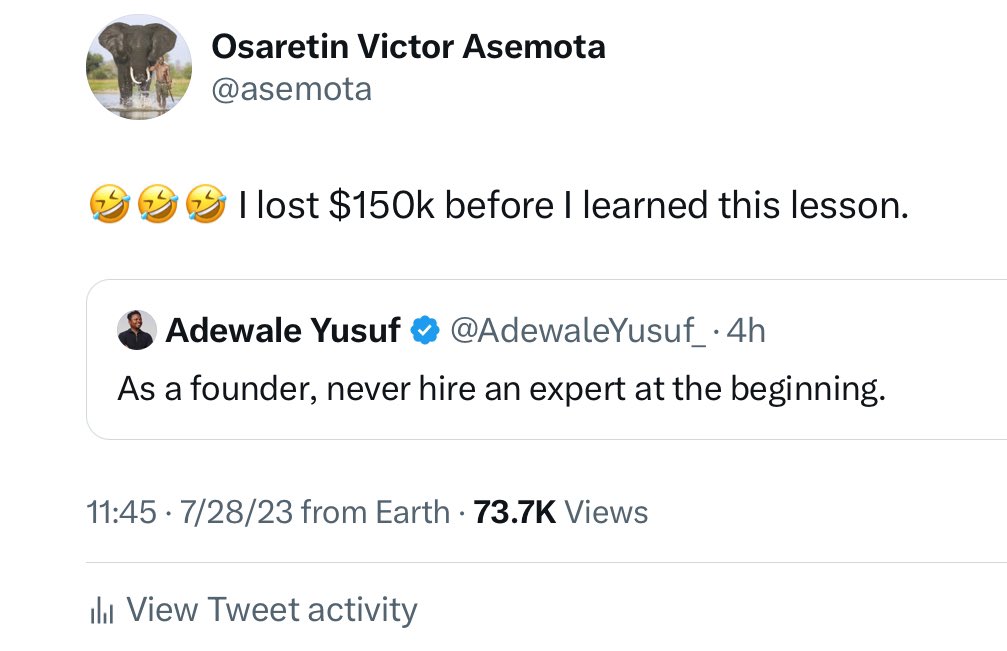
20 years after university, I found a classmate working as a security guard in a bank. I took his number, and we discussed what happened to him. He had traveled to Germany for work, and all the money he was sending home was squandered by a relative until he got deported.
If I have to do a startup accelerator today, I will select more failed or struggling founders to be the mentors. This is why Village Capital does so well because founders mentor each other. This is the best message I have heard from an African preacher.
If only someone told me this before my 1st startup:
1. Validate idea first.
I wasted at least 5 years building stuff nobody needed.
2. Kill your EGO.
It's not about me, but the user. I must want what the user wants, not what I want.
3. Don't chaise investors, chase users, and then investors will be chasing you.
4. Never hire managers.
Only hire doers until PMF.
5. Landing page is the least important thing in a startup.
Pick an average template, edit texts and that's it.
90% of the users will end up on your site coming from a blog article, social media post, a recommendation. Which means they have the intent. No need to "convert" them again.
6. Hire only fullstack devs.
There is nothing less productive in this world than a team of developers.
One full stack dev building the whole product. That's it.
7. Chase global market from day 1.
If the product and marketing are good, it will work on the global market too, if it's bad, it won't work on the local market too. So better go global from day 1, so that if it works, the upside is 100x bigger.
8. Do SEO from day 2.
As early as you can. I ignored this for 14 years. It's my biggest regret.
9. Sell features, before building them.
Ask existing users if they want this feature. I run DMs with 10-20 users every day, where I chat about all my ideas and features I wanna add. I clearly see what resonates with me most and only go build those.
10. Hire only people you would wanna hug.
My mentor said this to me in 2015. And it was a big shift. I realized that if I don't wanna hug the person, it means I dislike them. Even if I can't say why, but that's the fact. Sooner or later, we would have a conflict and eventually break up.
11. Invest all money into your startups and friends.
Not crypt0, not stockmarket, not properties.
I did some math, if I kept investing all my money into all my friends’ startups, that would be about 70 investments.
3 of them turned into unicorns eventually. Even 1 would have made the bank. Since 2022, I have invested all my money into my products, friends, and network.
12. Post on Twitter daily.
I started posting here in March this year. It's my primary source of new connections and traffic.
13. Don't work/partner with corporates.
Corporations always seem like an amazing opportunity. They're big and rich, they promise huge stuff, millions of users, etc. But every single time none of this happens. Because you talk to a regular employees there. They waste your time, destroy focus, shift priorities, and eventually bring in no users/money.
14. Don't get ever distracted by hype, e.g. crypt0.
I lost 1.5 years of my life this way.
I met the worst people along the way. Fricks, scammers, thieves. Some of my close friends turned into thieves along the way, just because it was so common in that space. I wish this didn't happen to me.
15. Don't build consumer apps. Only b2b.
Consumer apps are so hard, like a lottery. It's just 0.00001% who make it big. The rest don't.
Even if I got many users, then there is a monetization challenge. I've spent 4 years in consumer apps and regret it.
16. Don't hold on bad project for too long, max 1 year.
Some projects just don't work. In most cases, it's either the idea that's so wrong that you can't even pivot it or it's a team that is good one by one but can't make it as a team. Don't drag this out for years.
17. Tech conferences are a waste of time.
They cost money, take energy, and time and you never really meet anyone there. Most people there are the "good" employees of corporations who were sent there as a perk for being loyal to the corporation. Very few fellow makers.
18. Scrum is a Scam.
If I had a team that had to be nagged every morning with questions as if they were children in kindergarten, then things would eventually fail.
The only good stuff I managed to do happened with people who were grownups and could manage their stuff. We would just do everything over chat as a sync on goals and plans.
19. Outsource nothing at all until PMF.
In a startup, almost everything needs to be done in a slightly different way, more creative, and more integrated into the vision. When outsourcing, the external members get no love and no case for the product. It's just yet another assignment in their boring job.
20. Bootstrap.
I spent way too much time raising money. I raised more than 10 times, preseed, seed, and series A. But each time it was a 3-9 month project, meetings every week, and lots of destruction. I could afford to bootstrap, but I still went the VC-funded way, I don't know why. To be honest, I didn't know bootstrapping was a thing I could do or anyone does.
That's it.
All my projects → https://t.co/Fpjq9yZPMZ
Tesla's FSD v12 is a REALLY big deal.
Last night @elonmusk livestreamed a ~45-minute video of a Model S driving itself around using Tesla's latest self-driving software, FSD v12.
Self-driving is something the company has been trying to solve since Tesla Autopilot was released in 2015. Since then, Tesla has made steady progress improving the code to handle all kinds of road situations, has added cameras around the car, and removed sensors, all the while rewriting the code multiple times to solve for things the car couldn’t handle.
And even though Tesla cars can drive themselves in many situations, the biggest challenge with self-driving cars is the thousands (or millions) of situations drivers face on a daily basis that are completely unexpected or difficult to solve for, like other drivers acting irrationally, inclement weather, debris on the road, weird (or lack of) lane markings, etc.
Up to this point, Tesla and other companies have to spend a large amount of time running through simulated scenarios to generate code that would teach the system how to handle these situations. This code is oftentimes written by a human and needs to account for every variation of something happening on the road. And even then, there are thousands (or millions) of situations that a simulation won’t come with, since real life is so damn complicated and complex.
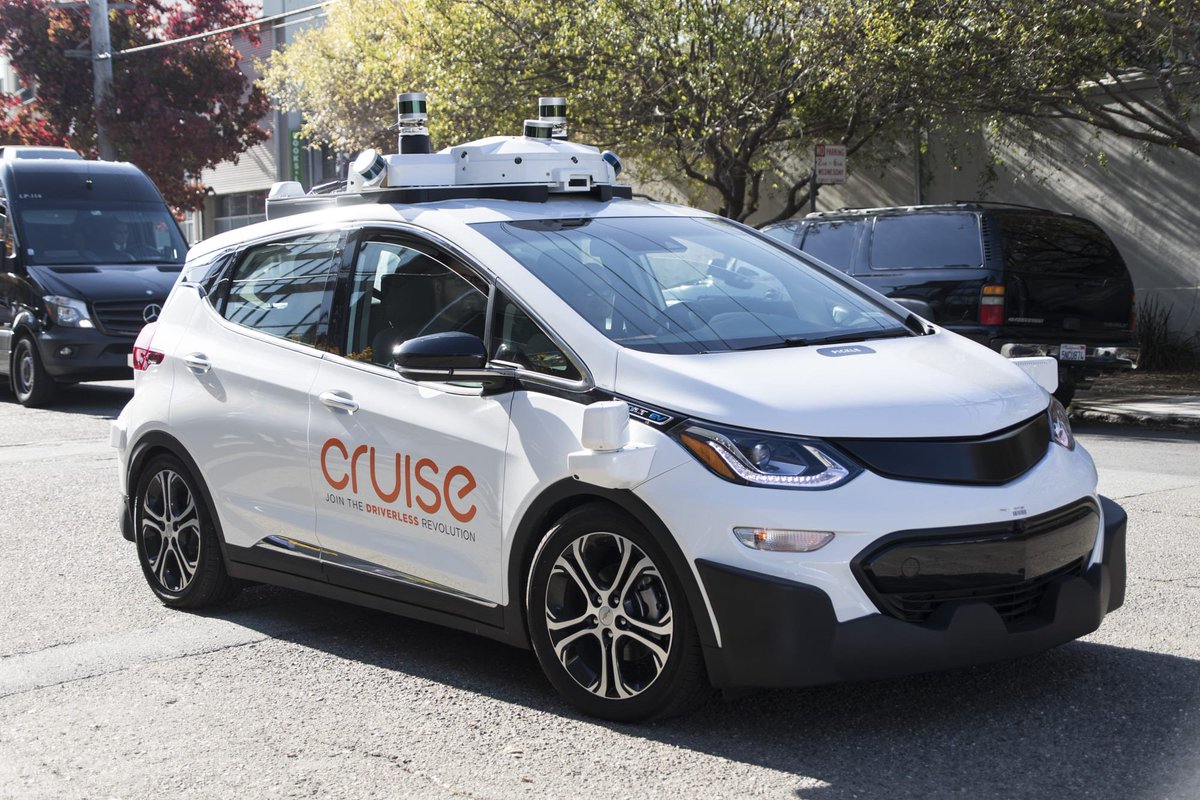
The approach many have taken to try and solve this problem is by overfitting their self-driving cars with a ton of different sensors like LIDAR, radar, ultrasonics, cameras, and other sensors in addition to generating High-Definition maps of the areas where the cars are meant to be driven in. They’ve done this in hopes that there’s a combination of sensors and map data that would allow them to solve for the most unexpected situations. Here’s a picture of a GM Cruise vehicle that uses this approach.
However, yesterday’s video has demonstrated a breakthrough in how self-driving cars can operate.
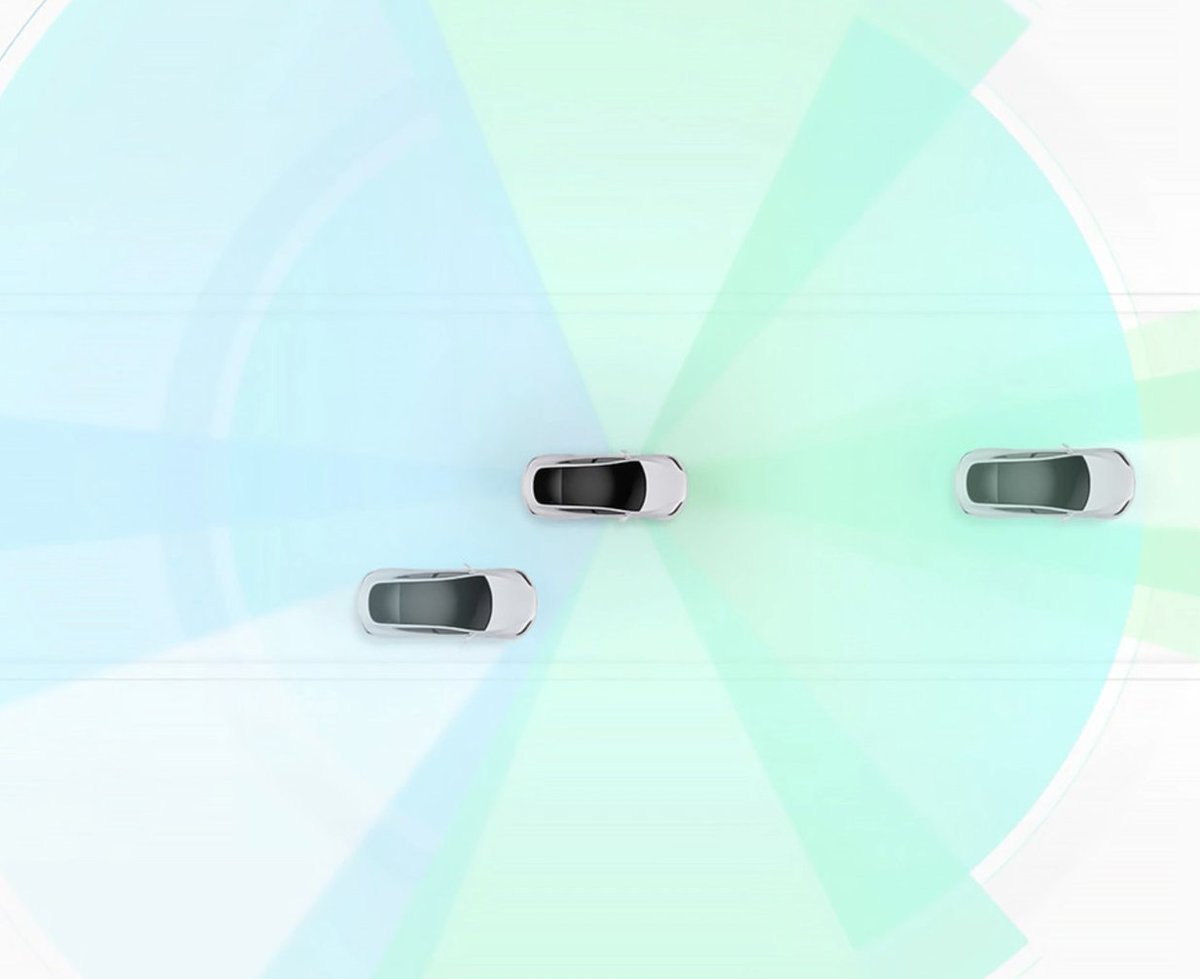
Instead of using many sensors and hardware on their cars to process the world, Tesla is using 8 cameras and a computer that’s specifically built to process video data. That’s 9 total parts vs everyone else’s 30, 40, 50+ parts to process the world.
Using only vision to process the world and not needing things like LIDAR, radar, and other sensors to interpret the physical objects around the car is impressive enough, but HOW the car learns to do this is what the real breakthrough is.
With FSD v12, Tesla takes the video data that is collected by its fleet of ~4 million cars and runs it through an AI that is built using Neural-Nets (like ChatGPT but for the real world), and then the AI figures out what the car should do based on what it sees.
What’s important to highlight here is that Tesla has done 0 work in telling the car how it should interpret the world. That means that the AI doesn’t explicitly know what a lane is, what a traffic light is, what a stop sign is, what a cone is, what a pothole is, what rain is, etc.
What Tesla does is it shows the AI a metric-ton of video of a car driving around using the 8 cameras that are outfitted around the car, and the AI learns how to do the same. The more video Tesla feeds it, the better the system gets. The more unique situations that are collected from the fleet of Teslas, the better the system gets at accounting for those situations.
This “AI code” will then be beamed to every Tesla in the world, and the on-board computer will be able to process its surroundings without the need to connect to Tesla’s AI server. It’s no different than you or I getting into a car and driving it. Instead of our 2 eyes collecting video around us and using our brain to process the info, the 8 camera system will collect the video and Tesla’s on-board computer will process it using the “AI code”.
In other words, Tesla has moved away from humans figuring out how to write code that tells the car what to do, and instead feeds video to an AI, and the AI figures out the best way to account for every situation.
The only thing Tesla needs moving forward is more video and more compute power (chips) to process videos.
That’s it.
This is profound. Everything that is captured on video with the 8 camera system is something the AI will be able to figure out how to navigate through. Snow. Potholes. Deer. Cyclists. Aliens. You name it. And this “code” that is generated by the AI will get better and better as Tesla’s compute capabilities grow with their purchases of NVIDIA’s H100 chips and the build-out of their in-house DOJO compute system. Not to mention the growing fleet of Teslas that will capture more and more video data around the world. Every Model S, 3, X, and Y that is sold today is a video-capturing robot that feeds the AI. And every Cybertruck and Compact Car will be the same.
And believe it or not, it gets even crazier.
Now that Tesla has come up with a real-world data collection and processing system with its cameras and on-board computer, this same system can be used on other physical products that can learn how to move around its surroundings.
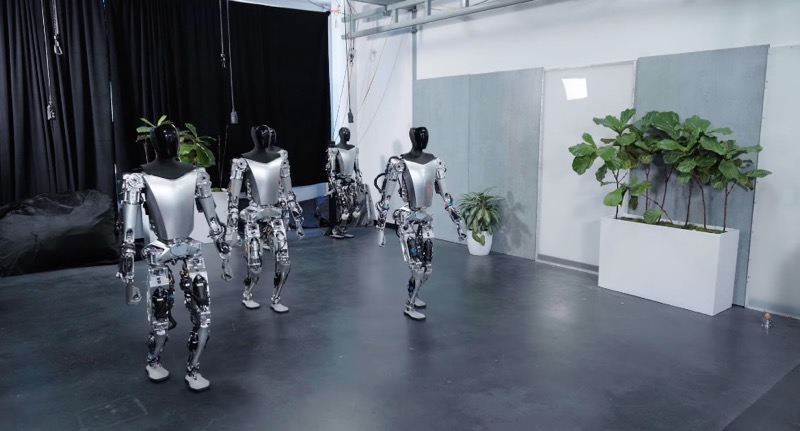
This is where Tesla’s Optimus Bot comes into play. Tesla will be able to use its 8 camera system on the Tesla Bot to collect video of its surroundings, beam it back to the AI, the AI figures out how to best do that thing that it’s collecting video for, and then beam back the “AI code” for the Bot to process with its on-board compute.
We are not far away from a world where a humanoid robot watches you do the dishes, sends back the data to the mothership to process it, and then the next morning the Bot has learned how to do the dishes - not only using the video it gathered from you doing it, but from every other person in the world washing dishes.
Do this process with literally anything.
ChatGPT showed the masses what the potential of AI can be. NVIDIA showed the masses just how much demand there is for hardware that is used by AI systems.
And now, Tesla just showed the masses what AI means for real-world physical applications.
The world has changed - again.
A MasterClass on Storytelling
4 year Storytelling Degree in just 5 minutes
You def need this. Kurt Vonnegut is a total legend.
Bookmark and comeback to this again and again.
No, if it's a great product, you should get some market validation for it without risking your life savings.
First, try and see if someone will prepay (to receive it at cost). Second, see if investors will back the idea.
Also, remember that your startup/product has one unique idea that nobody in the market currently has. There is something you believe that they don't. To prove that the product will work, you don't need to build and sell the product; you need to validate that unique idea.
Example: Uber didn't need to build out their entire company to test the idea. They believed people would prefer to order a car on their phones instead of calling in. The first version of Uber cab was just an app, and you'd order, and their team would call you a cab. This was 1/100th of the work but validated the idea enough to raise investment.
Future of AI assistants
A “jailbroken” Google Nest Mini running custom LLM’s & voice models by Justin Alvey
This demo is insane, a matter of time before these are shipped like this as standard.
Link in next tweet
A sobering thought on the speed of AI:
Something that took 50 eng, 4 PMs, and 1.5 designers 6-12mo to build in 2018/2019 can now be (mostly) done by two people in a few days.
And I know this because I led the team in 2018.
And a 2-person team just pitched me on it.
Gulp.
Paystack co-founder Ezra Olubi shared an important piece of his life yesterday: he is a sill tenant in Lagos even though he is unbelievably liquid after Paystack was acquired by Stripe for $200 million.
That information he shared, as expected, generated a lot of conversation and buzz, as a lot of people wondered why he chose to be a tenant when he drives a Tesla.
But the young man is right, and this is why
A friend recently visited me.
I live in a rented duplex in a secluded neighborhood in Lagos.
My guest was shocked that I live in a rented 4 bedroom duplex when I could have saved and built mine.
I laughed and then told him that at this stage of my growth,
I don’t think I need to build my own house yet.
It is cheaper for me to rent, which is why
Building on my estate will cost me 200 million naira.
A plot of land alone is worth 90–100 million, depending on who Is selling it.
Instead of burying 200 million in a dead asset. it is more economically wise for me to plough the money into setting up a daily 5,000-modular refinery someplace in Akwa Ibom or a tissue conversion business in Lagos,
When the modular refinery business takes shape and breaks even, the business can fulfill my vanity by building a palatial Manson of my choice anywhere in the world, and the business will continue to be operational.
When my oga and the MD of Tiger Foods, Don Ebubeogu, were building up Tiger Foods with his older brother, they were tenants in GRA Onitsha for the longest time.
They were liquid, but they chose to plough the money the business was generating back into the business.
Even though their senior staff were busy buying and building their house.
A lot of people who knew that they were renting thought they were stupid but they ignored the distraction and noise but rather focused on the grind.
They finally built their houses eight years ago in Onitsha.
Their house is unarguably one of the finest properties you can see in Onitsha.
A palatial mansion befitting of kings, built in the old Roman Empire style, and it must have cost them billions of naira to do that.
Tiger Foods funded the project for them without stress.
So the money they would have used to build their first properties was plugged back into the business.
The money grew and funded their vanities.
They have Tiger Foods as their business, and their residence is by the side.
This is the standard, and this is how it is supposed to be.
Our parents made that mistake, investing in illiquid assets that did not generate enough cash flow on the properties where they would live.
You know, I want to be a landlord.
That is why. So many of us grew up seeing our parents with illiquid assets all over the place but no cash flow and a decent 50 million in the bank that could cover any life emergencies.
And our generation is making that same mistake again, which is fine because Nigerians have an emotional attachment to their homes, which is good.
If there is one lesson I learned from my mentor, Peace Mass Transit Chairman, Dr. Samuel Maduka Onyishi, MON, it is to think long-term even when short-term is alluring.
That 200 million you want to use to build your first house can start a business that can generate the money you need to build that house, and the business will still continue operating.
I think that is what Ezra has done, and I think he is an example and poster boy of this long-term mindset, just like my mentor taught me.
Sir Paschal Dozie once posed a riddle to us during the christening of his first grandson Chidi. He asked us who is more important to hire when starting a business? The loyal person or the effective person?
We all stupidly chose effectiveness. We later learned the hard way.