THIS IS INSANE
Anthropic just dropped a goldmine of 20 Claude Code plugins. $29,077 worth of tools, FREE on GitHub
paid marketplaces sell a skill for $19 and an agent for $39. these repos ship 970 skills and 273 agents for $0
1.8M stars combined, picked from 68,900 repos tagged claude-code
most people still run Claude Code bare: no memory, no team, no taste, burning tokens on raw logs
20 GitHub projects you should open first:
1. Everything Claude Code → 71 agents, 311 skills and 97 commands in one harness. the closest thing to an agent OS
https://t.co/9rVZrWAndi
2. agent-skills → 25 production skills by Addy Osmani: spec, plan, build, verify, review, ship
https://t.co/t2ygivKgH7
3. Ruflo → runs agent swarms across Claude Code and Codex with shared memory between them
https://t.co/26QeNpJ8gC
4. agents → 202 agents, 185 skills and 105 commands packed into 94 installable plugins
https://t.co/otsYWvZkhj
5. claude-mem → records what your agent did, summarizes it and feeds it back next session
https://t.co/WccJ8te0TD
6. planning-with-files → keeps the plan in markdown on disk, so it survives /clear, compaction and crashes
https://t.co/5pENbLceT5
7. Graphify → turns code, docs and SQL schemas into a knowledge graph. parsed locally, nothing leaves your machine
https://t.co/IpUK6nWsRt
8. Understand-Anything → an interactive map of your codebase with search, guided tours and diff impact analysis
https://t.co/m5ot7lrl5g
9. ponytail → makes Claude code like the laziest senior dev. 53% less code and 45% fewer tokens in its own Opus 5.5 benchmark
https://t.co/W3h34gBkiK
10. rtk → a Rust CLI proxy that cuts 60-90% of the tokens from common dev command output
https://t.co/uFvslUWFb5
11. headroom → compresses logs, tool outputs and JSON before they reach the model
https://t.co/1Qluj9lMY5
12. context-mode → sandboxes tool output. 315 KB in, 5.4 KB to the model
https://t.co/usOJ1EnMAO
13. UI UX Pro Max → 79 styles, 192 palettes and 74 font pairings, so your UI stops looking AI-made
https://t.co/eLGaTdG1NV
14. taste-skill → gives Claude art direction, real reference photos and a browser check at several screen widths
https://t.co/x0KitmaEOL
15. video-shotcraft → turns your real pages into a cinematic product video in Remotion, synced to the beat
https://t.co/yspobXd0ye
16. Agent-Reach → lets your agent read YouTube, GitHub, Reddit and the web from one CLI, zero API fees
https://t.co/zZuAchQkUW
17. cc-switch → a desktop app to switch providers in one click and manage MCP, skills and prompts in one place
https://t.co/kgbzMzAbjs
18. pm-skills → 69 product skills and 42 chained workflows, from discovery to launch
https://t.co/RNc1RzrnaT
19. claude-skills → 380+ skills across engineering, marketing, finance, compliance and C-level advice
https://t.co/wGpjj88gE0
20. career-ops → scans job boards, scores every role against your CV and drafts the application. you still press Submit
https://t.co/2HXY1LWPqj
start with 3, not 20: one for memory, one for tokens, one for your actual job
run the same task before and after. keep only what makes the result better or cheaper
every plugin you add loads into context, so more isn't free
save this before you spend another weekend building something that already exists
and repost it for the friend who's still paying $19 a skill ↓
You're still using Claude without plugins.
Here are the top 30 on GitHub (by job):
Each one comes with its install line (plus a check it worked). Free guide
→ https://t.co/hjNrbfrCKM
1. Code like a senior
- Karpathy Skills (222k): one CLAUDE.md for better code
- Matt Pocock Skills (301k): questions your plan first
- ECC (287k): skills, memory and security in one
- Agent Skills (109k): senior engineering habits
- Superpowers (304k): plans, tests, checks
- Ponytail (174k): less code
2. Research and understanding
- Career Ops (77k): matches jobs to your CV
- REA (371k): shows how any app really works
- Graphify (133k): turns docs and code into a map
- Understand Anything (87k): maps any codebase
- Last 30 Days (65k): researches any topic for you
- Agent Reach (101k): reads X, Reddit and YouTube
3. Big projects, fewer tokens
- Headroom (77k): shrinks files before Claude reads
- BMAD Method (54k): an agile team of AI agents
- Claude-Mem (102k): remembers past sessions
- gstack (137k): a CEO, designer and QA team
- Caveman (114k): fewer tokens
- GSD (64k): big builds, no drift
4. Design and visuals
- Taste (101k): art direction
- Archify (88k): turns any idea into a diagram
- Diagram Design (60k): clean editorial diagrams
- Impeccable (85k): a design language for Claude
- UI UX Pro Max (139k): a designer's eye for apps
- PPT Master (67k): real, editable PowerPoint decks
5. Writing and video
- Marketing Skills (56k): copywriting, SEO and CRO
- Skills by Anthropic (183k): Word, Excel and PDF
- OpenMontage (71k): a whole video studio
- Humanizer (59k): removes AI writing tells
- HyperFrames (70k): HTML to video
- I Have ADHD (58k): answer first
But don't install all 30. Pick the row that matches your week, and add one plugin from it.
Repost ♻️ to help someone in your network.
Anthropic engineer:
“Anthropic hired me at $350K–$950K because I know how to build harnesses.
99% of people still hand-roll multi-agent systems and wonder why they break.
I build systems that run loops + sandbox tools + turn yesterday’s logs into new skills — same model, 10x more reliable agents that keep improving overnight.”
Opus 5.5 → Agents → Harness → Loops → Graphs
In a short workshop, he shows exactly how to build one from scratch.
step 1 → harness handles loops, context, and sandboxing
step 2 → brain and hands separated — 60% faster to first token
step 3 → runs server-side, resumes from the log after crashes
step 4 → failure is cheap — retry and replay instead of starting over
step 5 → yesterday’s logs become new memory — the system wakes up smarter
Anthropic calls this “dreaming”.
Most people spend weeks building this by hand.
You don’t have to.
Bookmark and watch it.
Then read the full Opus 5.5 harness engineering guide below ↓
During my system design round at Amazon, the interviewer took down my cache.
During my system design round at Walmart, the interviewer killed my primary database.
During my system design round at Atlassian, the interviewer made one downstream service take 10 seconds to respond.
In every round, someone broke my design on purpose.
Because any design works when nothing fails.
Interviewers want to see what yours does when something does.
After sitting through 100s of interviews in the last 13 years, one thing is clear to me:
If you're starting system design prep, focus hard on Failure & Reliability Fundamentals.
Here's a list to help you get started:
[1] Timeouts & Deadlines
- Connection vs request timeouts
- Deadlines that travel across service calls
- What happens when a call has no timeout at all
[2] Retries
- Exponential backoff with jitter
- Retry budgets
- Retry storms and how they stretch outages
[3] Idempotency
- Idempotency keys for write APIs
- At-least-once delivery and duplicate handling
- Safe vs unsafe retries
[4] Isolation
- Circuit breakers
- Bulkheads and separate thread pools
- Blast radius per tenant, region and feature
[5] Overload Protection
- Rate limiting
- Backpressure
- Load shedding and priority queues
[6] Replication & Failover
- Leader election and split brain
- Sync vs async replication
- Failover vs failback
[7] Graceful Degradation
- Serving stale data on purpose
- Fallbacks and feature switches
- Read-only mode
[8] Data Safety
- Write-ahead logs
- Backups and point-in-time recovery
- Restores you've actually tested
[9] Observability
- p50 vs p99 latency
- SLIs, SLOs and error budgets
- Alerts that map to a runbook step
[10] Recovery & Operations
- Rollbacks and feature flags
- Zero-downtime migrations
- Postmortems that change the system
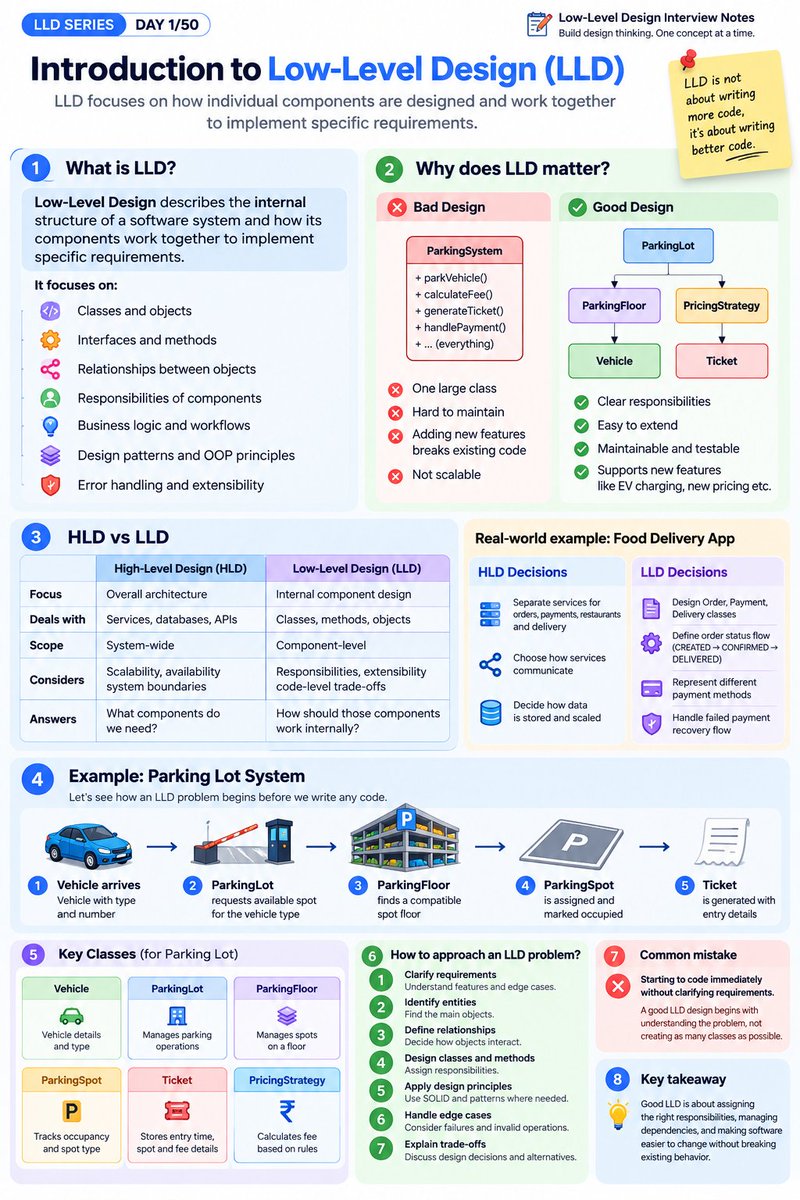
LLD Interview Notes: Day 1/50
What is Low-Level Design?
Low-Level Design (LLD) defines how individual components of a software system are structured and interact with each other.
It focuses on classes, objects, interfaces, methods, relationships, and the logic that connects them.
Example: Parking Lot System
Before writing code, we need to decide:
What classes do we need?
How will parking spots and vehicles be represented?
How will a vehicle get assigned a spot?
How will parking fees be calculated?
How can the system support different vehicle types?
These decisions are part of LLD.
HLD vs LLD
High-Level Design (HLD) focuses on the overall architecture.
Example: services, databases, load balancers, APIs, and communication between components.
Low-Level Design (LLD) focuses on the internal implementation.
Example: classes, interfaces, methods, object relationships, and design patterns.
Think of it this way:
HLD decides which components your system needs.
LLD decides how those components are designed and work together internally.
What do interviewers evaluate?
Object-oriented programming fundamentals
Clean class and interface design
SOLID principles
Appropriate use of design patterns
Extensibility and maintainability
Handling edge cases and requirements
Ability to explain trade-offs
How to approach an LLD interview
Step 1: Clarify requirements
Identify the core features, constraints, and edge cases.
Step 2: Identify entities
Find the main objects in the problem.
For a parking lot: Vehicle, ParkingSpot, Ticket, ParkingFloor, and ParkingLot.
Step 3: Define relationships
Decide how these objects interact and which object owns which responsibility.
Step 4: Design interfaces and classes
Assign responsibilities and define methods.
Step 5: Apply design principles
Use SOLID and design patterns where they solve an actual problem. Don't force patterns into every design.
Step 6: Handle edge cases
Consider unavailable resources, invalid operations, failures, and concurrent requests.
Step 7: Explain trade-offs
Discuss why you chose a particular design and how it could evolve.
Common mistake
Starting to code immediately without clarifying requirements.
A good LLD solution begins with understanding the problem, not creating as many classes as possible.
Key takeaway: Good LLD is about assigning the right responsibilities, managing dependencies, and making software easier to change without breaking existing behavior.
Next: Day 2/50, OOP fundamentals: classes, objects, and relationships.
حاس إنك متأخر لأنك بدأت بالنسخة العادية بـ FC27؟ 🤔
لا تشيل هم جمعت لك كل شي تحتاجه بثريد واحد:
✅ افضل لاعبين البدايات
✅ إعدادات مهمة قبل تلعب
✅ إعدادات اليد
✅أفضل كاميرا وتكتيك
✅ كيف تجمع كوينز و XP بسرعة
✅ لاعبين وباكات مجانية بالمهام
لايك وفضّل الثريد عشان ترجع له بأي وقت 📌
Look for these exact phrases in your interview problem statement to identify the pattern instantly:
"Sorted array" + "Find a pair/triplet" ➔ 🔵 Two Pointers
"Longest/shortest continuous subarray/substring" ➔ 🔵 Sliding Window
"Linked list loop or midpoint" ➔ 🔵 Fast & Slow Pointers
"Overlapping time ranges / meeting rooms" ➔ 🔵 Merge Intervals
"Sorted search space" or "Minimize the maximum" ➔ 🔵 Binary Search
"Shortest path in unweighted grid" ➔ 🔵 BFS
"Connected components / explore all branches" ➔ 🔵 DFS
"Find total number of ways / Maximize profit with choices" ➔ 🔵 Dynamic Programming
"Generate all valid permutations / combinations" ➔ 🔵 Backtracking
"Find the Kth largest / Top K frequent elements" ➔ 🔵 Heap / Priority Queue
"Check for duplicates / Frequency count" ➔ 🔵 Hashing
@unknownaham@amarreddy_s Unless they have a lot of free wealth lying around.
BTW both me and my wife have built our careers from 0 , starting from tier 3 colleges. If anyone’s wondering we must have had a lot of generational wealth. Answer is NO.
@unknownaham@amarreddy_s Not that i would do it, but ofcourse i can afford a 6CR house.
1. Sell my 4CR portfolio and invest everything into the house, under section 54F i pay 0 taxes on the capital gains.
2. Rent both my existing apartments that will generate 1.5Lakh per month (1/2).
@unknownaham@amarreddy_s I got into trading only 5 years back and i know at least 100 ex - colleagues who’ve been into trading for more than 15 years with 2x my portfolio can also do it.
So there are many ways in which people can afford a 6CR house.
But a smart man would never do it.
@unknownaham@amarreddy_s Take out a loan of 2 CR with my apartments as collateral with ~ 7% interest, my rental income pays for the house loan interest.
I wouldn’t do it though. But anyone who has an apartment in Hyderabad with 0 loans and a portfolio of upwards of 4 CR can do it.
Chelsea is unarguably the greatest the club of all time when it comes to business. They bought Jackson for €35m and have now sold him for €75m. They bought Delap for £30m and he flopped they sold him for £45m. They bought Andrey Santos for £12.5m and sold him for £50m. There are a million more examples. These are the greatest men/women I’ve seen in my entire life.