Almost everyone knows about Muslim rule in Spain but very less is discussed about Muslim rule in certain areas in France, Northern Italy and Switzerland... A book on topic
MUSLIM COLONIES IN FRANCE, NORTHERN ITALY AND SWITZERLAND
By HAROON KHAN SHERWANI
https://t.co/WqGDjIfgmP
Malatya ve Elazığ’ın gerçek kimliği olan Kürdlüğe geri dönmeleri lazım. Ulus bilinci olmayan toplumlarda asimilasyon kaçınılmazdır… #malatya#elazığ#canbeg
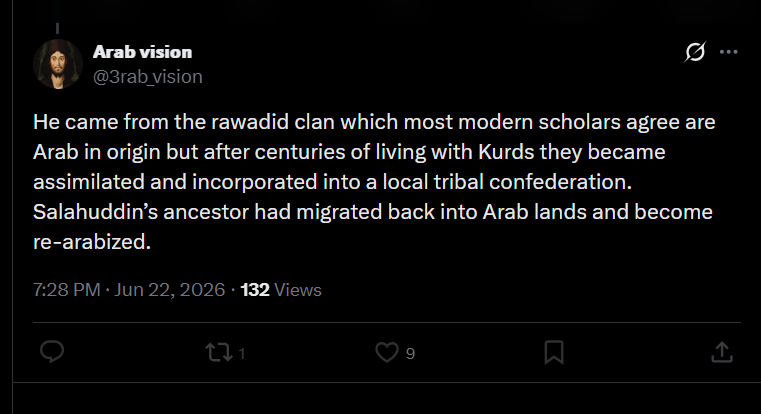
Even Ibn Wasil and al-Safadi, who are sometimes cited in Arab nationalist arguments to challenge the Ayyubids' Kurdish origin, actually confirm in their own writings that the dynasty was of Kurdish origin.
Another source mentioning the rawadids but implicitly is ibn al Qalanisi mentioning ahmadil al kurdi ruler of azerbaijan back then under rawadid rule against the crusaders in the year 1111 AD two explicit arabic contemporary sources who were famous in their age
This shameless imbecile has been replied to thousands of times but I'll reply again ibn asakir specifically mentioned the scribe of the rawadid ruler muhammad bin malman as al azdi but referred to the rawadid ruler muhammad bin malman explicitly as Al Kurdi one of the earliest
In December 2024, the head of Google's quantum computing lab said the company's new chip was so fast it must have borrowed computing power from parallel universes. The chip, called Willow, finished a test in under five minutes that would take the world's fastest supercomputer 10 septillion years, a number with 25 zeros, far longer than the universe has existed.
So the multiverse is not fringe. It shows up in serious science journals and major labs. The tweet just wrapped a movie plot around it.
The "many worlds" idea goes back to a Princeton physics student, Hugh Everett, in 1957. Every time a particle could go two ways, the universe splits, and both versions happen. In a 2025 survey of more than 1,000 physicists marking a century of quantum mechanics, about 15 percent picked it as their favorite explanation of reality. The older Copenhagen view won with 36 percent. Still, 15 percent is a lot of physicists, not a few cranks.
Now for the theory the tweet is probably mangling. In 2014, three physicists at Griffith University in Australia published a paper in Physical Review X saying parallel worlds are real and physically push against each other. Worlds that are almost identical push apart, like people elbowing for space in a packed room. That shoving creates every strange quantum effect, from particles slipping through solid walls to acting like a wave and a particle at the same time. One world gives you ordinary, predictable physics. A huge number of worlds gives you the weird rules of quantum mechanics.
In all of these pictures, your other copies cannot touch your life. The moment a quantum system bumps into its surroundings, the branches split and stop talking to each other. For an object about as heavy as a paperclip, the split happens faster than light can cross the center of a single atom. Even in the Griffith theory, the worlds interact through a blind force, not through choices. No version of you is sitting in another universe steering your life.
Google's bold claim got pushback too. Astrophysicist Ethan Siegel said you can explain everything Willow did without a single parallel universe. Physicist Sabine Hossenfelder pointed out that the test it passed just spits out a list of random numbers with no real-world use.
The image on the tweet is from the movie that swept the 2023 Oscars, where a woman's parallel selves bleed into one messy life. The true physics is stranger and lonelier than the movie. Those copies, if they exist, can never reach you and never change a thing.
Some of the last Ayyubid emirs including Nasir al din Muhammad Al kamil son of al Salih Ismail talking with al Dawadari and Abul feda the last major Ayyubid ruler everywhere confirming their Kurdish origin unlike the Baathist twitter larpers claim
The most honest thing you can say about Islamic jurisprudence is that it solved problems Western legal theory is still struggling with.
The question of how to derive binding rules from foundational texts without either rigid literalism or unconstrained judicial invention, this is the central problem of every legal system.
Originalism versus living constitutionalism in American law is essentially the same argument that Islamic jurists were having in the 9th century, with considerably more sophistication.
Usul al-fiqh; the science of legal methodology developed tools that are genuinely impressive: the distinction between qat’i and zanni evidence, the hierarchy of legal objectives through maqasid al-shari’a, the role of maslaha in adjudicating novel cases, the epistemological honesty of acknowledging ikhtilaf, legitimate scholarly disagreement, as a feature rather than a bug. The four madhabs were different but equally valid methodological schools, and the civilization was capacious enough to hold all of them simultaneously.
What happened to this tradition is the real tragedy. Colonialism redrew the borders and systematically dismantled the institutional infrastructure that sustained Islamic legal reasoning. The waqf system that funded independent scholarship was seized. The madrasa curriculum was narrowed and ossified. The mujtahid; the scholar qualified to exercise independent legal reasoning became increasingly rare, and the tradition increasingly relied on taqlid, deference to past authority because the human capital to do otherwise had been depleted.
The result is a legal tradition that often presents its medieval outputs as timeless divine mandates, rather than what they actually are: brilliant but historically situated human reasoning applied to divine sources.
Recovering the distinction between the two is probably the most important intellectual task in contemporary Islamic thought. And almost nobody with institutional credibility is doing it seriously.
Who is the Ummah today?
In The Liberal and Socialist Ummahs, Yaaser Al-Zaiat (@al_ashajj) explores how liberalism and socialism became the two 'ummahs' of the modern world.
In the fallout of Islamic civilisation's collapse in the 20th century, Islam was relegated from the status of 'ummah' (a community of universal faith) to a mere 'millah' (approximating the secular definition of 'religion').
In turn, two 'madhabs' (intellectual schools of thought and practice) tried to offer an answer: the Manarists and the Qutbists. Both claimed an ‘ummatic’ cause, yet were largely ensconced within the two greater ummahs of liberalism and socialism.
There is one ummah today: the liberal, Anglophone world order that grew out of industrial capitalism. Socialism itself could not make it to the 21st century. Everything since has operated within the liberal ummah, including Islamic movements like the Manarists and Qutbists.
The process of secularisation that came with the liberal and socialist ummahs did not take Islam away in the absolute, but rather imposed a hard limit to its scale. Muslims have been reduced from an ummah to a millah, from a civilisation able to address the whole world in a competent, authoritative language to a sect that broadcasts its politics as dreams.
This is a shift modern Muslims across the political spectrum have failed to make, imagining Islam as an alternative bloc rather than a living force in a one-world reality.
All flaws in worldviews, political methodologies, legal distinctions, and even social movements stem from the failure to recognise this most basic reality: that there is no alternative ideological existence.
The fish do not know the water they swim in.
Read more on Kasurian. Link below:
Türkmenler kendilerini Türk olarak görmüyorlar şah İsmail Kürt oğlu Kürt’tür
Safavi Kürt devletidir.
Daha çok Yalnışınız var tıpkı 100 yıllık tarihimiz gibi yazdıklarınızın %98’ doğru değil, ama daha fazla sizi utandırmayayım.
Another interesting fact is that Zazas used the endonym „Kurd” before the Kurmanjis did.
People who try to divide the Kurds restrict Kurdish identity to Kurmanji- and Sorani-speaking Kurds, yet they draw the line at the Yezidis who are the most archaic form of Kurmanji Kurds. Yezidis are Kurmanjis par excellence. Alevi Kurmanjis who make up the majority of Kurdish Alevis are frequently misclassified as Zazas (some people don‘t even know that we exist).
Southern Kurds (Kalhors, Laks, Feylis etc) on the other hand, are often completely overlooked or mistakenly classified as Lurs.
It‘s a mess. Many MENA groups have absolutely no idea about Kurdish demographics and the linguistic & religious diversity of Kurdish people, yet they can‘t stop yapping about us.
Japanese actor Hiroyuki Sanada spoke about the contradictions of human nature:
“Some people dream of having a swimming pool at home, while those who have one hardly ever use it. Those who have lost a loved one feel a profound sense of loss, while others often complain about their living relatives. Those without a partner long for one, while those who have one often don't appreciate it. The hungry would give anything for a meal, while the satiated complain about the taste of their food. Those without a car dream of owning one, while those who have a car are always looking for a better one.”
The key to happiness is gratitude: truly seeing and appreciating what we already have, and understanding that somewhere, someone would give anything for what we take for granted.
📌 Kürtlerin İslam Medeniyetine Katkıları;
İslam medeniyetinin "Altın Çağı" olarak adlandırılan dönem, farklı coğrafyalardan ve etnik kökenlerden olan dâhilerin insanlığın ortak mirasına katkı sunduğu muazzam bir aydınlanma çağıydı. Bu çağın en parlak şahsiyetlerinden biri, sibernetik ve robotik biliminin babası olarak kabul edilen, Kürt kökenli büyük bilim insanı El-Cezerî’dir.
Tam adı Bedîüzzamân Ebû’l-Izz İsmâîl b. er-Rezzâz el-Cezerî olan bu dâhi, Mezopotamya’nın kadim topraklarında filizlenen Kürt ilim geleneğinin ve İslam bilim tarihinin en evrensel figürlerinden biri olarak tarihe adını altın harflerle yazdırmıştır.
El-Cezerî, 1136 yılında Cizre’de (Tor bölgesinde) doğmuştur. Lakabı olan "El-Cezerî", doğup büyüdüğü ve Mezopotamya’da Dicle ile Fırat nehirleri arasında kalan "Cezire" (ada/yarımada) bölgesinden, yani bugünkü Cizre’den gelmektedir.
Hayatının büyük bir bölümünü, o dönem bölgede hüküm süren ve Kürt/Türkmen kültür dairesinde önemli bir yer tutan, ilme ve sanata verdikleri değerle bilinen Artukluların sarayında başmühendis olarak geçirmiştir. Diyarbakır (Amid) İçkale’deki Artuklu Sarayı’nda yaklaşık 25 yıl boyunca kesintisiz olarak çalışmış, hükümdarların saray mühendisliğini üstlenmiş ve en ünlü icatlarını bu dönemde hayata geçirmiştir.
El-Cezerî’yi dünya bilim tarihinde eşsiz kılan en önemli özellik, günümüz bilgisayarlarının, otomasyon sistemlerinin ve robotların temelini oluşturan sibernetik (kontrol ve denge mekanizması) biliminin kurucusu olmasıdır. Kendisinden yüzyıllar sonra yaşayacak olan Leonardo da Vinci gibi dâhilere ilham kaynağı olmuştur.
O, sadece teorik teoriler üreten bir filozof değil; tasarladığı her mekanizmayı bizzat inşa eden, çalıştıran ve test eden bir pratik dehaydı. Onun bilim felsefesini özetleyen şu sözü, bilime bakışını çok net ortaya koyar:
"Uygulamaya dönüştürülmeyen her teknik ilim, doğru ile yanlış arasında bir yerde kalır."
El-Cezerî, Artuklu Sultanı Nasreddin Mahmud’un isteği üzerine tüm icatlarını, tasarımlarını ve mühendislik sırlarını "El-Câmi‘ beyne’l-ilm ve’l-ameli’n-nâfi‘ fî sınâ‘ati’l-hiyel" (Bilim ve Faydalı Amelin Birleşimiyle Mekanik Cihazların Yapımı) adlı eserinde toplamıştır.
Bu kitap, orta çağ mühendisliğinin zirvesidir. Kitapta 50'den fazla cihazın çizimi, çalışma prensipleri ve montaj talimatları renkli minyatürlerle en ince ayrıntısına kadar anlatılmıştır. Kitap şu ana kategorilerden oluşur:
• Su Saatleri ve Mum Saatleri: Zamanı ölçmek için şamandıralı ve ağırlıklı sistemler.
• Ziyafet ve Meclis Otomatları: Kendi kendine içki veya su dolduran hizmetçi robotlar, şarkı söyleyen mekanik kuşlar.
• Abdest Almak İçin Otomatlar: Sultanların eline su döken, havlu uzatan havuzlu ve leğenli düzenekler.
• Fıskiyeler ve Kan Toplama Kapları: Tıbbi amaçlı kan ölçüm kapları ve suyu farklı şekillerde fışkırtan otomatlar.
• Kuyulardan Su Kaldırma Araçları: Tarımı kolaylaştıran dişli sistemleri.
El-Cezerî'nin insanlığa bıraktığı en önemli mekanik yenilikler şunlardır:
• Krank Mili ve Piston Sistemi: Dönme hareketini doğrusal harekete çeviren krank milini mekanik tarihte ilk kez kullanan kişidir. Bu sistem bugün modern arabaların motorlarından fabrikalardaki makinelere kadar endüstrinin temel taşıdır.
• İlk Programlanabilir Robotlar: Saray eğlenceleri için tasarladığı "Müzisyen Robot Grubu", suyun akış gücüne göre sırayla ritim tutan, flüt ve tef çalan bir otomattı. Suyun akış hızı değiştirilerek robotların çalma ritmi ayarlanabiliyordu; bu da dünyadaki ilk "programlama" örneklerinden biridir.
• Şifreli Kilitler ve Kasalar: Bugün kullandığımız şifreli çelik kasaların ilk örneklerini, dörtlü veya beşli dönen kadranlar kullanarak El-Cezerî tasarlamıştır.
• Segment Dişliler: Sadece tam yuvarlak dişlileri değil, mekanik hareketin yönünü değiştirmek için yarım (segment) dişlileri de dünya mühendislik literatürüne kazandırmıştır.
Les Kurdes du Liban et du Rojava Kurdistan envoyant des fonds, des caisses d'armes lourdes et des munitions aux Kurdes de Dersim en 1938.
Document turc declassifié.
Were the Kurds really just semi-nomadic by overwhelming majority before modern times?
A 17th-century Italian traveler who crossed Kurdistan left behind an account that suggests a different picture.
New translation and commentary:
https://t.co/62iIBdXA3J