Asst Prof at Sungkyunkwan Univ & Samsung Medical Center | predictive modeling, brain imaging, medical data science, AI, etc | previously @YalePsychology & KAIST
Welcome to Seoul & #OHBM2024! LOC has worked hard and helped staffs and the program committee organize it (busy busy…) Hope you enjoy the conference a lot! Plz make sure to check out this @OHBM blog (beginner’s guide to Korea) https://t.co/cGJkGODUp9
Welcome to @CNIR_IBS ! We are extremely happy to recruit you and Ka to Korea! 😍 We will make a great program together, and are looking forward to working with you.
This is out now in JNeuro!
Thanks to everyone who provided feedback throughout the process. I am really looking forward to seeing what information edges can give us about ongoing cognitive processes.
https://t.co/946CqMWo0U
1/ Associative thinking---connecting concepts to form ideas, inventions, and artworks---is at the heart of creativity.
In our new @TrendsCognSci review, @yoed_kenett and I explore how associative thinking works in the creative mind 🧵
My lab at Johns Hopkins has openings for new postdoctoral fellows (and graduate students) to study the functions of PFC, BG, and hippocampus related to planning and mental simulation in non-human primates.
https://t.co/UhraqALtgd
New (and first!) preprint from the Braga Lab!
https://t.co/9xuQNewBXb
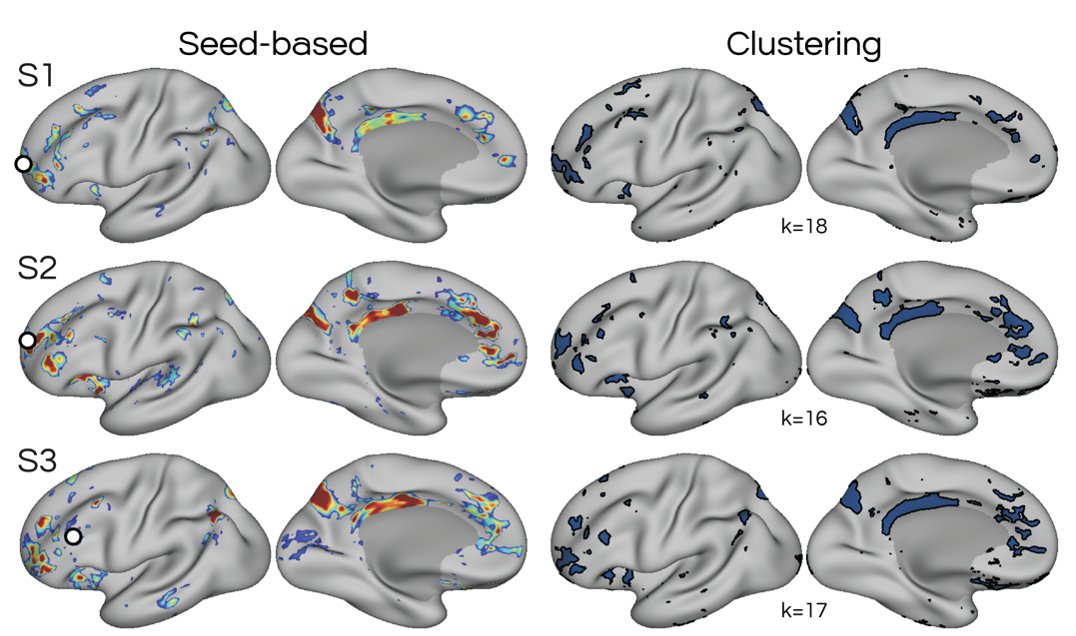
@judy_yhkwon investigated the parietal memory network (PMN) in densely sampled participants using high-res 7T fMRI.
We saw smaller regions of the PMN that are inconsistently reported, esp. in group maps.
Situating the parietal memory network in the context of multiple parallel distributed networks using high-resolution functional connectivity https://t.co/NX8BICXZZU #bioRxiv
Situating the parietal memory network in the context of multiple parallel distributed networks using high-resolution functional ... https://t.co/m2D1sZU0MB #biorxiv_neursci
If you're attending #OHBM2023, plz visit the LOC committee booth of @OHBM 2024, set to take place in Seoul, Korea! We're giving out traditional Korean souvenirs for free, available on a first-come, first-served basis each day. Find us @ Booth #414. Please RT and spread the word!
If you want to learn more, please read the paper AND/OR find my poster at OHBM (# 2513)!
Enormous thanks to @KwangsunRayYoo, Marvin Chun, and especially @monicarosenb for being incredible collaborators and mentors who supported and improved this project at every stage.
end/6
🥳Preprint alert! 🥳 https://t.co/0u4R0Uf71T
In my first, first-author paper (😭), we asked: How do edges relate to fluctuations in cognition and behavior?
We developed a new method (edge-based GLM) to examine this relationship and tested it in 2 sustained attention datasets.
1/6
When two people act similarly we call them “in-sync” — could this figure of speech be literally true? Do more similar individuals show greater neural synchrony?
Check out our answer: https://t.co/0jEzMCqwiB
@monicarosenb @AnnaCorriveau @HayoungSong5@judy_yhkwon@KwangsunRayYoo
Curious about how frailty may be an indicator of other health outcomes? We present new work that suggests a link between frailty and >300 health-related outcomes, especially those relating to mental health, which may be mediated by brain structure. Now out in @LancetDigitalH
Thankful to coauthors—esp 1st author Omid Kardan—for massive efforts! This is one of my favorite papers because it doesn't just ask wether we can predict behavior from functional connectivity, but also asks what we learn from patterns of predictive model success & failure.
Here's our take on the BWAS paper & individual differences analyses in human neuroscience more generally @esfinn. Props to the original authors for such discussion-generating work
https://t.co/nmCbTPIUGX
Great pleasure to organize the Korean session at
@OHBM 2022! Continuing our success in 2021, this year we feature @HayoungSong5 to present her work on attentional engagement. We are now ready to meet children full of curiosity! w/ co-moderator Kwangsun Yoo