Postdoc with Daniela Schiller and Jennifer Foss-Feig. PhD mentored by Jonathan D. Victor and Nicholas Schiff. Interested in understanding cognition in humans.
Just moved to bsky. Does anyone know how to transfer the accounts I follow? If not, can people pin their move so others (including me) know who to look up there? I am going to pin this too.
New in @AmJPsychiatry — personally I think this is my best paper so far. Highest statistical rigor, strongest causal inference (via a series of natural experiments), and multiple clinical applications.
Thanks @KJBinSTL and team tagged below.
https://t.co/l5gyWQ7XSt
New paper!
Electric fields generated by groups of neurons also feed back onto those neurons, creating a two-way interaction that may help organize activity patterns involved in memory.
https://t.co/dnT7KgU4LQ
Work by @dimitrispp#neuroscience
News alert: New paper!
Electric fields help guide neural activity, even from moment to moment
“The brain is a rollicking sea of electrical influences”
https://t.co/LPjoEOTVEs
work by @dimitrispp#neuroscience
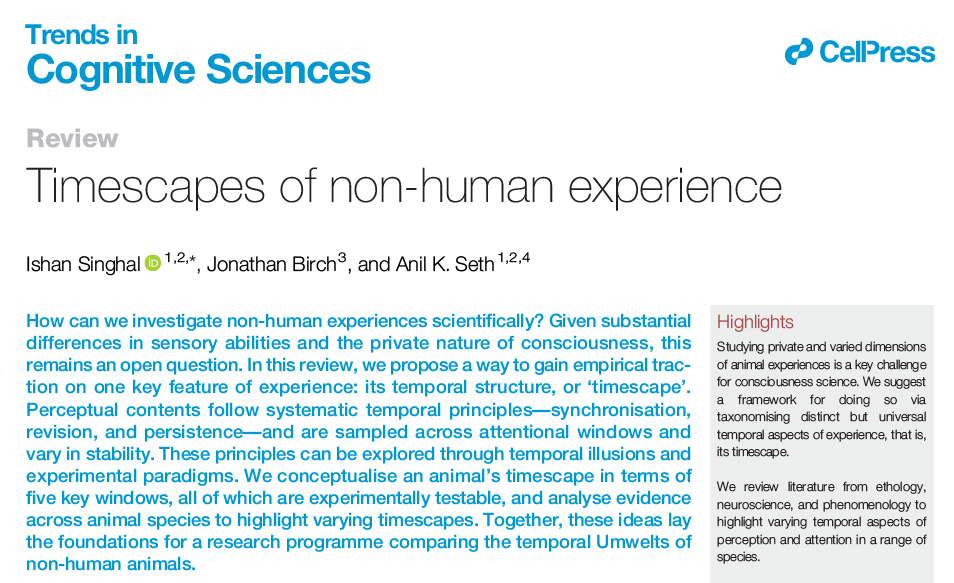
Timescapes of non-human experience
Review by Ishan Singhal (@ishan276), Jonathan Birch (@birchlse), & Anil K. Seth (@anilkseth)
Free access before August 6: https://t.co/OJwD1HnxZk
What if much of human thought is navigation? 🧠
New open-access review: I argue that the DMN + hippocampal–entorhinal system form a domain-general engine for "mental navigation" across physical and abstract spaces (e.g. social, conceptual, and value).
https://t.co/745L2VRCa7
Article: "Human hippocampal ripples tune cortical responses based on predicted uncertainty"
Coauthors: @FrankDarya S. Moratti @RHellerstedt@SarntheinJ Ningfei Li @andreashorn_@lukasimbach L. Stieglitz, A. Gil-Nagel, R. Toledano, B. A. Strange
https://t.co/dsggRYpb07
New publication alert! Reviewing neuroimaging studies, we find that certain representations are only accessible when social relationships are observed overtime as opposed to at the moment.
🚨 New paper @Nature ! We asked why two hippocampal areas with very different anatomy, CA3 and CA1, often seem to code space so similarly.
By recording bats flying up to 200 m, we found the difference was hidden by scale!
https://t.co/m6aVLZknOV
🧵
1/10
Many of us were taught that experiments are for testing hypotheses. In Ch 1 of Experimentology, our open methods textbook, my coauthors and I argue for something different: experiments are for estimating the magnitude of causal effects.
I think this reframe matters. 🧵
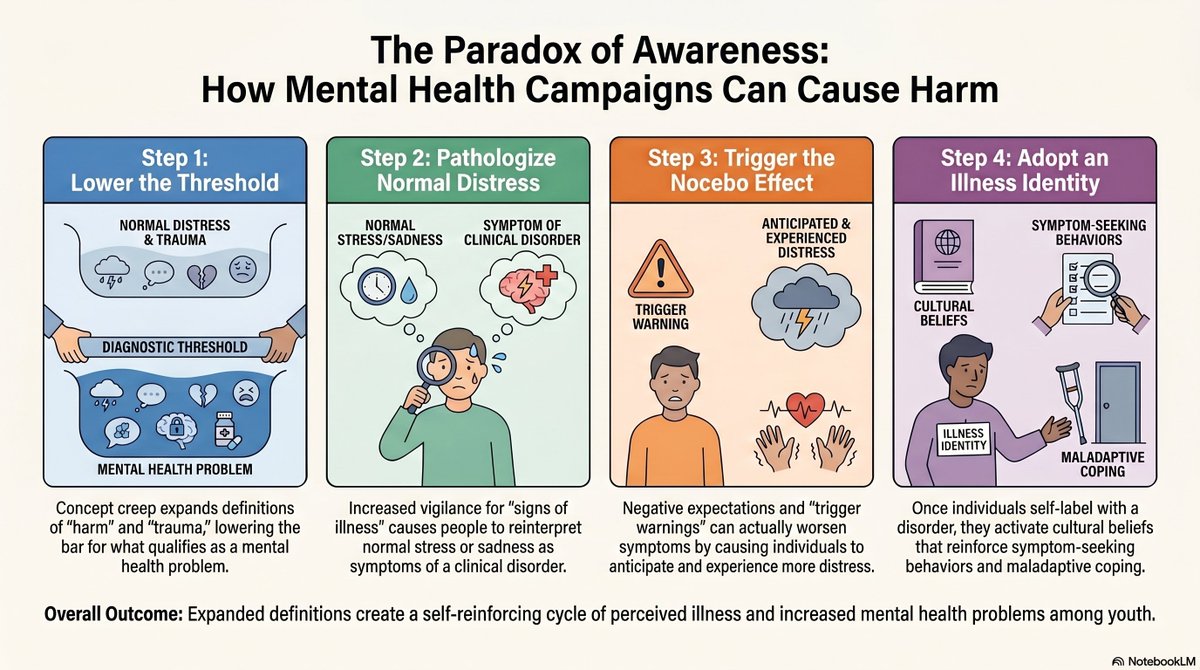
Imagine a 19-year-old scrolling TikTok. She watches a creator list five "signs you have undiagnosed anxiety." She recognizes three in herself. By the end of the week, she's describing herself as anxious to her friends. A month later, she's avoiding situations she used to handle fine.
What went wrong?
In a new paper by my PhD student Dasha Sandra, titled "Why mental health awareness can harm: Converging explanations for a societal problem", we argue that well-meaning mental health awareness can backfire, and we identify how. Four separate literatures (concept creep, nocebo effects, prevalence inflation, and illness self-labeling) have been circling the same problem from different angles. We show they converge on three mechanisms:
1.Awareness lowers the threshold for what counts as a disorder.
2. It trains people to scan their inner lives for symptoms and reinterpret normal distress as pathology.
3. Once someone adopts an illness identity, they behave in ways that confirm and deepen it.
The evidence is wide. Learning that loneliness is harmful makes solitude feel worse. Learning that stress is harmful worsens well-being and performance. Awareness videos about fake conditions like "wind turbine syndrome" produce real headaches. Trigger warnings raise anticipatory anxiety without reducing distress.
This does not mean awareness should stop. It means awareness can have unintended consequences, including manufacturing the suffering it tries to prevent. Inoculating people against these mechanisms works, and we already have evidence it does.
Link to paper: https://t.co/ucoGyhEuAj
📢 New preprint out!
In three samples (N=594), incl. a U.S.-representative cohort & test-retest cohort, we formalize social motivation, learning, & homeostatic control within a computational framework & identify a phenotype linked to chronic loneliness
https://t.co/o7Ne1DINch
🚨New Preprint!!
Thrilled to share with you our latest work: “Mixture of Cognitive Reasoners”, a modular transformer architecture inspired by the brain’s functional networks: language, logic, social reasoning, and world knowledge.
1/ 🧵👇
Finally got around to incorporating all Github feedback on my open access textbook, making around 20 minor improvements, and updating some references. 17 chapters of state of the art stats and methods education, freely available for any course you teach. https://t.co/FdQIS63fVd
🚨 @mark_ho_ & I are recruiting a joint postdoc interested in computational models of social interaction & computational psychiatry
💻 Ideal candidates have experience with multi-player web-based experiments & computational cognitive modeling
🔗 https://t.co/c3krmv6c8o
Reinforcement Learning and Active Inference are two frameworks used in computational psychiatry, but these are rarely directly compared empirically. Here, we aimed to compare these in a more systematic manner by fitting each to multiple datasets: https://t.co/NzO9w71Aqe
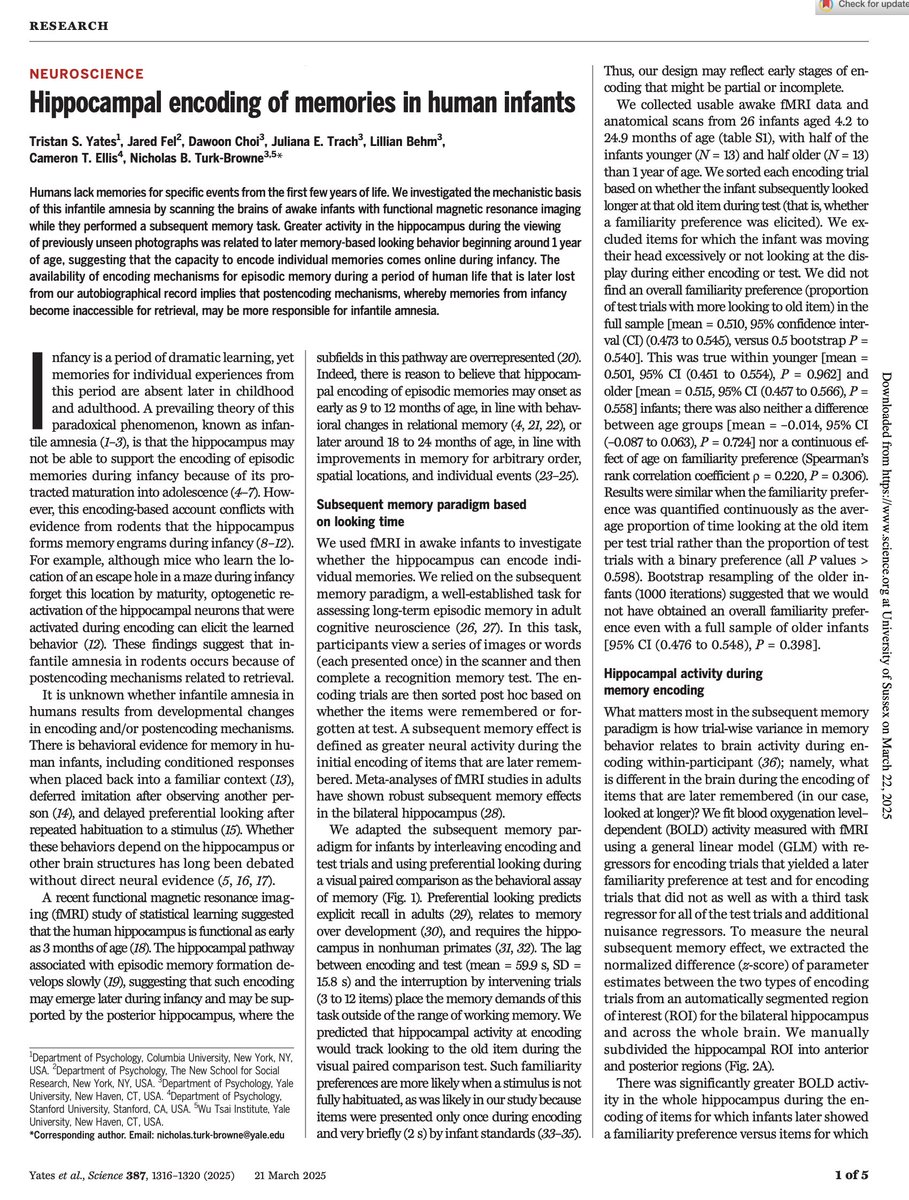
Hippocampal encoding of memories in human infants. Great to see this important study out now in @ScienceMagazine from the lab of Nicholas Turk-Browne @Yale@CIFAR_News https://t.co/ZIhglhYpQM